

The approach to retinal detachment and episcleral surgery scarring is evolving. Often, pneumatic retinopexy is the procedure of choice, but other approaches such as scleral buckling, vitrectomy, silicone oil tamponade, or a combination of these procedures may be preferred in specific situations. In this case, I present a procedure where I use the novel 29-Gauge Spotlight Directional Chandelier (29G SDC; Vitreq, a Beaver-Visitec International company) and a classic episcleral cryosurgery technique with CryoTreq.
CASE PRESENTATION
Background. A 56-year-old woman presented with a retinal detachment in her right eye. Years earlier, she had experienced a detachment in the contralateral eye and had undergone pneumatic retinopexy. After that failed procedure, she had undergone three additional surgeries (retinal buckling, vitrectomy, and silicone oil tamponade), resulting in a very low visual acuity. When counseling the patient on her options for her right eye, she convinced me—not I convinced her—to do a classic episcleral surgery.
Surgery. This case involved a minimally invasive episcleral surgery. I needed to open only two layers, the conjunctiva and the tenon, to expose only one quadrant, the superior temporal one. Being in a university hospital, I always try to find good opportunities to teach residents and young surgeons. For this reason, I opted to operate with a 29G SDC because it’s a perfect tool also for teaching: it enhances the view of the breaks, having an integrated directional function and coming with a wide-view fiber tip for global endoillumination, I can turn it in every direction to see well everywhere. The 29G SDC includes an integrated valved-entry system and scleral marker to aid with insertion and fixation of the fiber. I can insert it into the trocar using a simple maneuver (Figure 1).
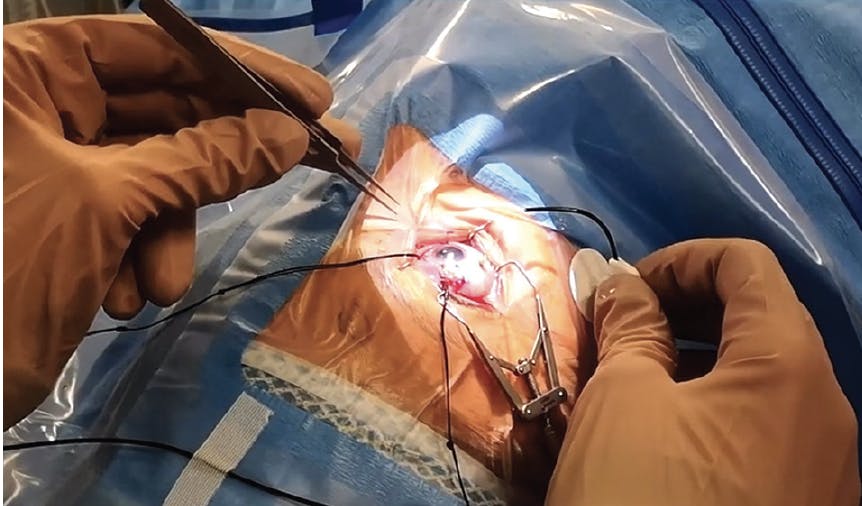
In this case, I was able to easily identify the retinal break indenting the superior quadrants. The directional chandelier was in the temporal inferior quadrant during the treatment, opposite to the break.
To mark the sclera, I used an O’Connor scleral depressor-marker. I then highlighted the indentation with a blue pen and proceeded to treat the retinal break with the CryoTreq (Figure 2), the first and only disposable handheld instrument for ophthalmic cryocoagulation. With the CryoTreq technology, cryosurgery can be completed in as little as a few minutes. The device is quickly prepared with a simple maneuver of the activation lever after which the cryotherapy is delivered through a simple touch of a finger.
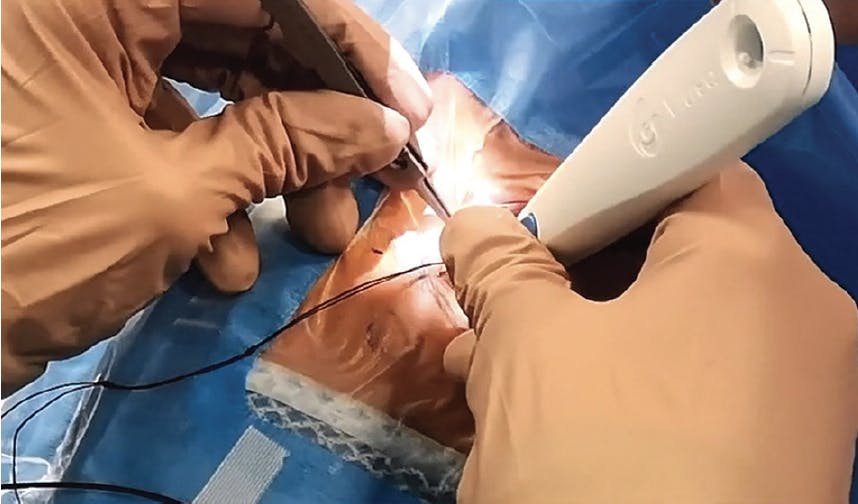
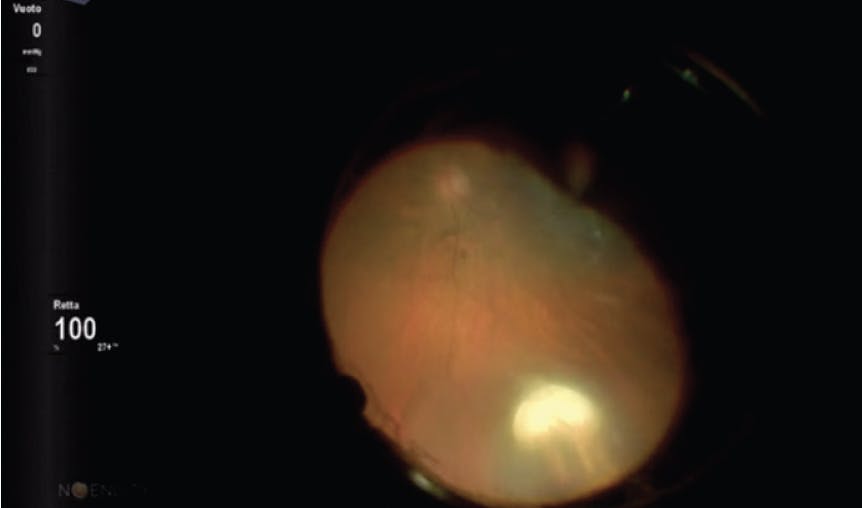
The CryoTreq provided perfect control of the retina. I saw the small break in the periphery; once the device was in the correct position centered on the break, I supplied cryotherapy with the push of a button (Figure 3). The device can supply up to 15 freeze cryotherapy applications, which is enough to treat any retinal area within the eye. At the end of the procedure, I placed a 5-mm sponge to close the break.
CONCLUSION
The use of the novel 29G SDC in complex cases has helped to simplify my surgical approach. It helps create a stable eye and a pristine view of the surgical field. Further, cryosurgery with the CryoTreq is a huge step forward, satisfying the needs of reliability and ease of use. These tools are great adjuncts to improving and simplifying one’s surgical technique.
