



Watch Related Case Video
The primary scleral buckle procedure is an important tool in the vitreoretinal surgeon’s armamentarium. Scleral buckling with the use of indirect ophthalmoscopy and condensing lens offers a reliable and safe surgical option for retinal detachment repair. Thus, a primary scleral buckle often is the preferred procedure for retinal detachments that occur in young phakic patients without a posterior vitreous separation and in cases of retinal dialyses. Nevertheless, adequate placement of a primary scleral buckle is a precise, technically difficult procedure, and repeated use and removal of the indirect ophthalmoscope during the surgery can be time-consuming and ergonomically challenging for the surgeon.
Instead, there has been a consistent trend toward vitrectomy as the procedure of choice for primary retinal reattachment. Advances in contact and noncontact viewing systems for vitrectomy have allowed for improved visualization of pathology through increased magnification, improved illumination through media opacities, and improved wide-angle peripheral viewing systems. Further, small-gauge transscleral instrumentation allows for fine manipulation of tissue while maintaining sutureless closure. In addition, vitrectomy viewing systems confer educational benefits for training fellows, residents, and other members of the surgical team. By viewing through the surgical microscope or through synchronous viewing monitors, all members of the team share the surgeon’s view of vitrectomy surgery.
More recently, vitreoretinal surgeons have harnessed the benefits of both approaches through use of a combined chandelier-assisted scleral buckle. Chandelier endoillumination systems allow for visualization of the posterior segment through single- or dual-fiber systems that pass lighting probes through the sclera with or without valved or nonvalved cannulas. Current models include 25-, 27- and 29-gauge systems and illuminated infusion options by Synergetics from Bausch + Lomb, DORC, and Alcon Laboratories, Inc. The single-fiber 25-gauge Awh Vivid Chandelier (Synergetics by Bausch + Lomb) provides not only widefield view but also easy maneuverability and adjustable fiber depth, which are particularly useful during buckling procedures.
Adoption of the chandelier to assist in primary scleral buckles was first described by Aras and colleagues in 2012.1 After preparing the eye for scleral buckle placement, the surgeon introduces a chandelier system while viewing the posterior segment under a wide-angle viewing platform. This combined approach further refines the scleral buckle technique by allowing surgeons to precisely localize breaks, apply cryotherapy, and drain subretinal fluid under direct visualization while limiting intraocular manipulation.
CASE REPORT
A 32-year-old pseudophakic man presented to the retina service with a macula-involving inferior retinal detachment secondary to inferior hole, along with lattice degeneration in the right eye. The patient was referred for scleral buckle placement with cryoretinopexy.
After creation of a peritomy, rectus muscles were hooked. A single-fiber 25-gauge chandelier was placed 180º from the pathology of interest. The chandelier was used to precisely identify the location of the retinal hole in the inferonasal quadrant. Cryotherapy was applied to this site. A #279 buckle element was placed in the inferotemporal quadrant, and a #240 band was passed through partial thickness scleral belt loops in the remaining quadrants. Chandelier illumination under the microscope allowed for adequate drainage of inferior subretinal fluid under direct visualization without complication. Figures 1 to 4 demonstrate various steps under the widefield viewing system using chandelier illumination. Postoperatively, the patient did well, and the retina remained attached at postoperative month 6 (Figure 5).
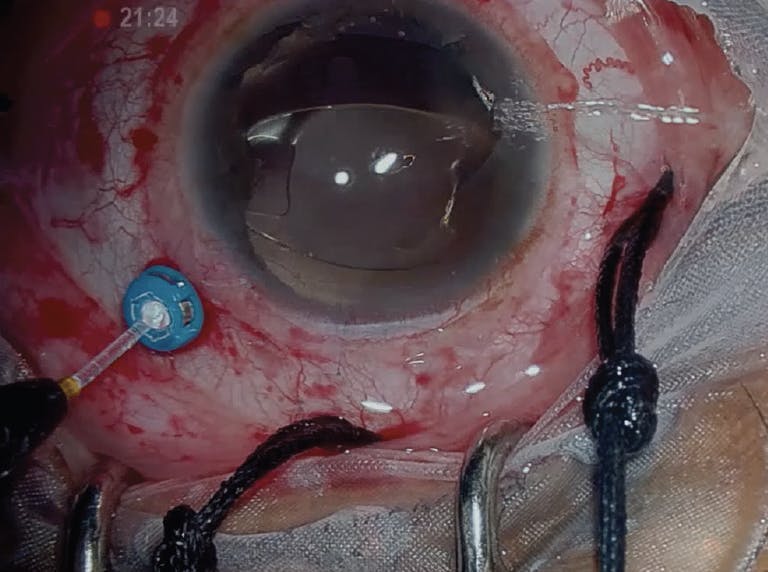
Figure 1. Single-fiber 25-gauge chandelier placed 180º from treatable pathology in pseudophakic patient.
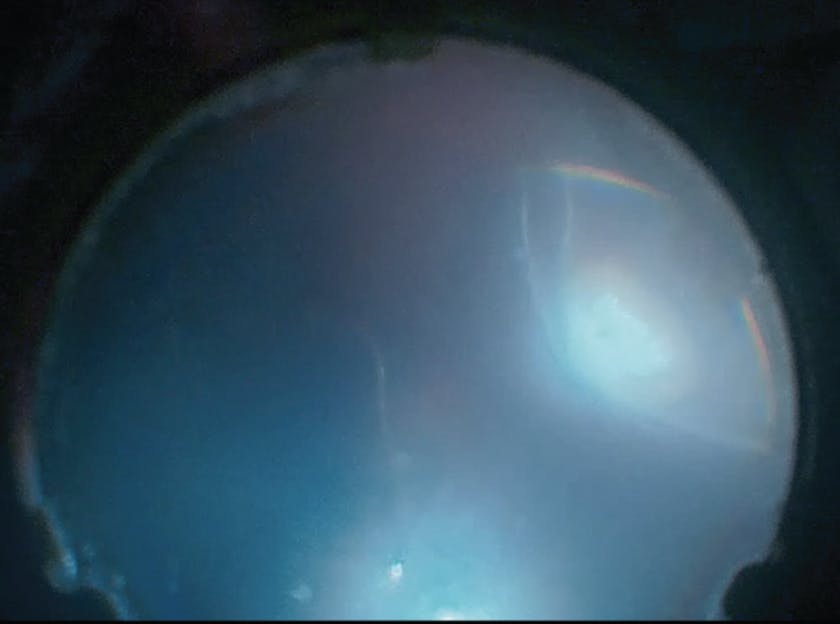
Figure 2. Wide-angle viewing system view under chandelier illumination shows cryotherapy along with indentation and the retinal hole.
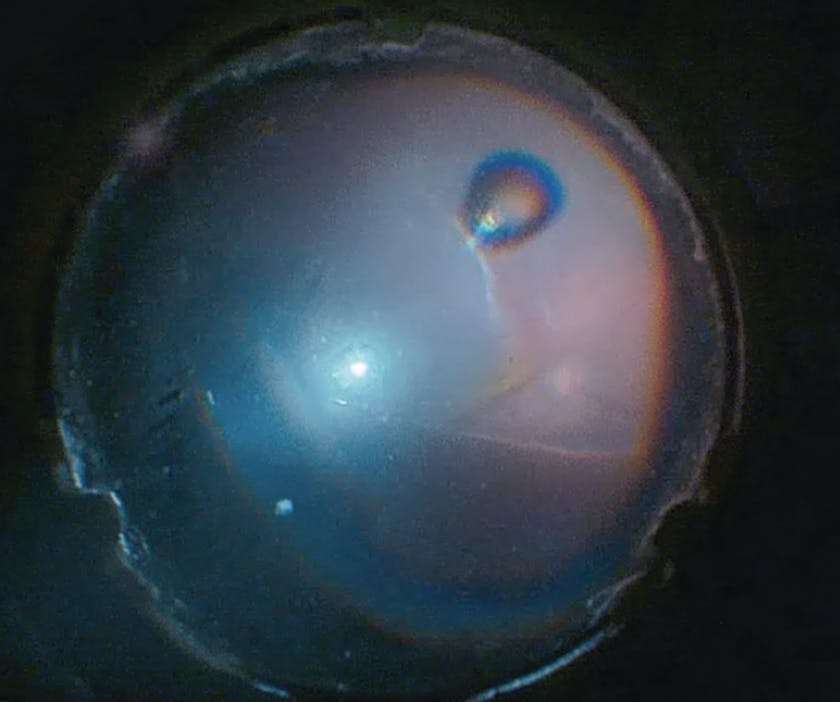
Figure 3. Wide-angle viewing system view under chandelier illumination shows area of retinal detachment involving macula.
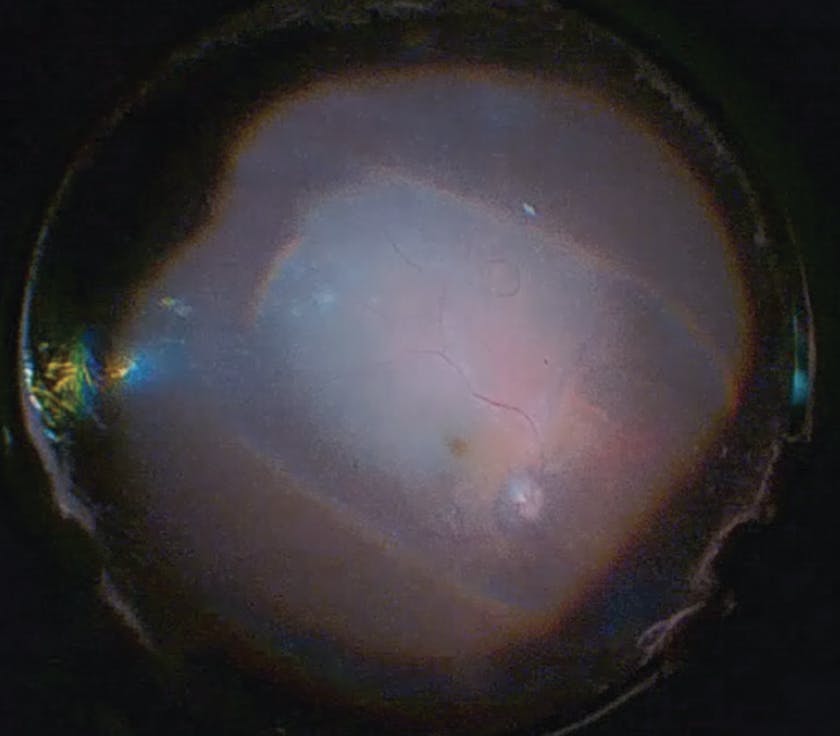
Figure 4. Wide-angle viewing system view under chandelier illumination shows resolution of subretinal fluid after subretinal fluid drainage.
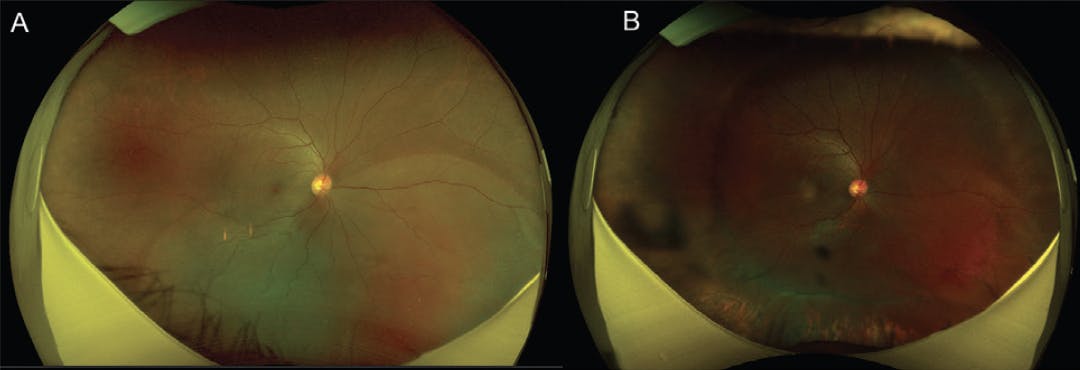
Figure 5. Widefield fundus photograph of the right eye at baseline (A) showing retinal detachment, and at 2-month follow-up after surgery (B) showing attached retina, chorioretinal atrophy scars, and buckle effect.
DISCUSSION
Since this technique was first described, many case reports and series have been published documenting its successful use. More recently, a clinical trial comparing standard to chandelier-assisted scleral buckles found no differences in the anatomic success of retinal detachment surgery.2 In addition, multiple studies have found that widefield viewing under the chandelier enabled surgeons to find retinal breaks intraoperatively that were not localized preoperatively, thus reducing missed retinal breaks, the leading cause of surgical failure.
Compared to conventional scleral buckles, this approach may confer risks associated with the creation of sclerotomies for the chandelier illumination. These include prolapse of formed vitreous from the sclerotomy site and retinal breaks around the sclerotomy site. In addition, the chandelier fibers may become dislodged during the surgery and risk lens touch in phakic patients. Nevertheless, careful placement and diligent use during the procedure can avoid complications.
As expected, there may be a learning curve to adoption of chandelier-assisted scleral buckling. Common best practices for this procedure include the following:

- Preoperative planning to identify causative breaks is critical. The surgical plan includes creation of peritomy and hooking all rectus muscles, followed by insertion of the chandelier, and, finally, cryopexy (with or without subretinal fluid drainage) under direct visualization.
- Chandelier placement sites should be 180º away (in pseudophakic patients) or 90º away (in phakic patients) from the pathology of interest to maximize illumination during cryopexy treatment. If required, two illumination sources (such as a dual-fiber chandelier) can be placed in diagonally opposite positions for better visualization.
- Sclerotomies can be made with or without beveling of the trocar.
- Throughout the procedure, care should be taken to minimize vitreous prolapse through the sclerotomy sites. This includes maintaining physiologic IOP (including by use of paracentesis to decompress the anterior chamber) by removing cannulas prior to tightening the buckle and by plugging cannulas with a valve when not in use. In addition, carefully checking the sclerotomy sites at the end of the procedure and cutting vitreous wicks from sclerotomy sites can reduce traction and iatrogenic breaks. While some groups advocate for suturing the sclerotomy site, this may not be necessary depending on the gauge of cannula used.
CONCLUSIONS
Chandelier-assisted scleral buckling enables surgeons to take advantage of recent advances in vitrectomy visualization and apply them to scleral buckle placement. This combined approach offers both ergonomic benefits for the surgeon and educational benefits for the entire surgical team. There may be a learning curve for new adopters of this procedure, however, and thus we encourage surgeons to take the above precautions to maximize the benefits of this combined approach.
CRAVING MORE CASES?
Interact with past Retina Clinical Case Compendiums online.
1. Aras C, Ucar D, Koytak A, Yetik H. Scleral buckling with a non-contact wide-angle viewing system. Ophthalmologica. 2012;227(2):107-110.
2. Albalkini AS, Abdullatif AM, Albalkini MS, et al. Chandelier-assisted versus standard scleral buckling for primary rhegmatogenous retinal detachment a randomized clinical study. Retina. 2022;42(9):1745-1755.
