

In my clinic, SubLiminal Laser Therapy has emerged as a leading treatment for macular diseases. I typically use the treatment procedure recommended by the SOLS society.
Power titration is required prior to treatment to prevent variability in treatment response between patients—particularly those with pigmented fundus, where lower power may be needed.
SubLiminal Laser Therapy is a versatile procedure. Both center-involving and non-center–involving DME can be treated with this laser therapy, with or without a combination of IV drugs. OCT is used to guide treatment. A retreatment should not be considered until about 12 weeks because it takes this kind of time for the treatment to show its effect.
I also use SubLiminal Laser Therapy for chronic and acute (at least 1 month) CSR. The demonstrated effectiveness, simplicity, and safety of the procedure position it as a viable first-line treatment. Treatment should be applied to a large area, concentrating around the leakage point. Follow-up should be scheduled after 6 weeks to assess for response and a potential retreatment.
Historically, photodynamic therapy (PDT) lasers have been used to treat chronic CSR. Until recently, the PLACE trial was the only prospective, randomized, controlled trial comparing subthreshold laser with half-dose PDT in patients with chronic CSR.
In this trial, half-dose PDT was reported to be superior to subthreshold laser in terms of the rate of complete resolution of subretinal fluid and retinal sensitivity improvement on microperimetry. The methodology of subthreshold laser delivery in this study and its data analysis, however, has been strongly contested by experienced laser practitioners.
A recent prospective, double-masked, randomized, controlled clinical trial compared anatomical and functional outcomes of half-dose PDT and yellow 577 nm subthreshold subliminal laser in treating patients with CSR.1 It demonstrated that subthreshold laser therapy is slower but just as good as PDT.
SAFETY CHECKS
Transfoveal treatments are not recommended for beginner surgeons, and they are also not necessary. Treating a large enough area allows you to spare the fovea. During treatment, check for any visible changes in the retinal tissue. If present, the power must be lowered.
I also check the fluence to make sure I’m within safe parameters just before initiating treatment. A good rule of thumb is that under 12 J/cm2 you will never cause retinal damage. Between 12 and 20 J/cm2 will be safe in the vast majority of cases (Figure), and over 20 J/cm2 you should start being careful depending on the patient’s pigmentation or in thin retinas due to chronic conditions. Strong variability may appear in the energy-absorption by the RPE between patients, hence the importance of titration as stated in the beginning.
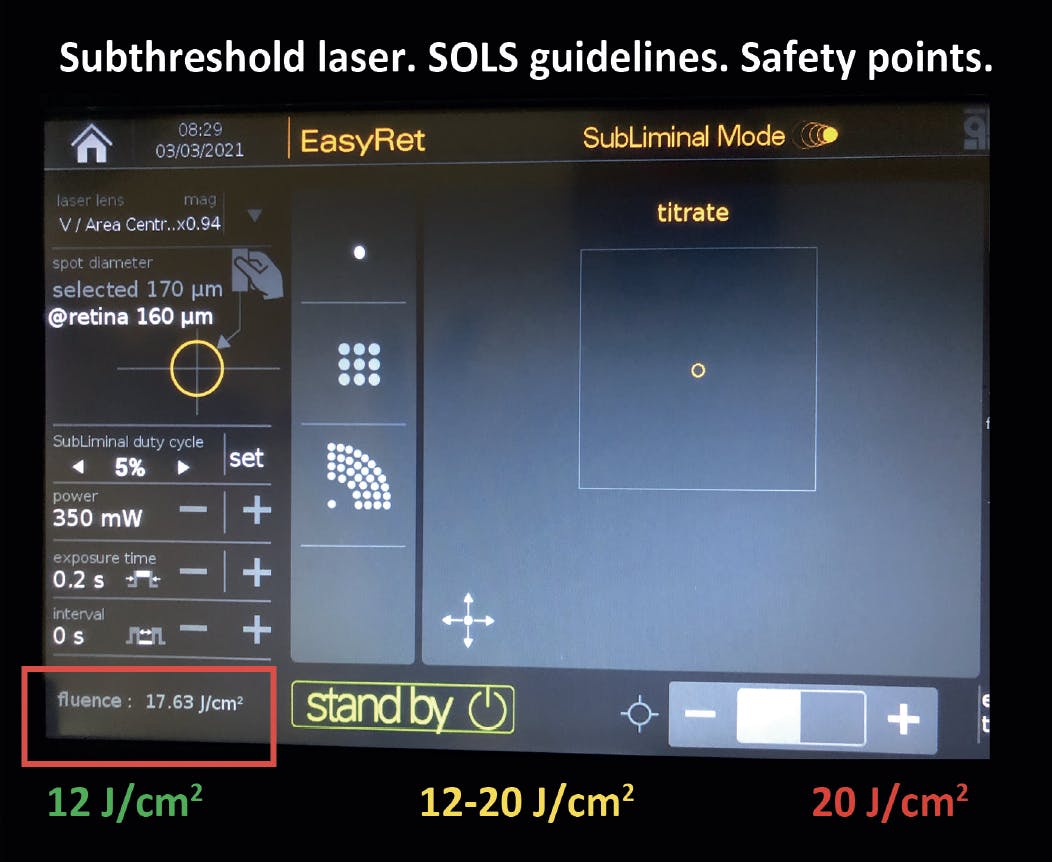
Lastly, I recommend checking the guidelines established by the SOLS to ensure a reproducible and sound technique.
1. Brelen M.E., Ho M., Li S., Ng D.S.C., Yip Y.W.Y., Lee W.S., Chen L.J., Young A.L., Tham C.C. & Pang C.P., Comparing half-dose photodynamic therapy with subthreshold micropulse laser for the treatment of central serous chorioretinopathy, Ophthalmology Retina (2023), doi: https://doi.org/10.1016/j.oret.2023.10.024.
