
WHERE IT ALL BEGAN
I grew up in a small town in Malaysia and received a full-ride scholarship to attend Duke University. During my freshman year, I studied global humanitarian challenges and volunteered for an eye care nonprofit at a remote village in China and a refugee camp in Ghana. There, I witnessed the life-changing effect of sight-restoring surgeries, which made me rethink my career aspirations.
Later, I had the opportunity to shadow Leon Herndon, MD, in clinic. The tremendous effect he had on his patients inspired me to become an ophthalmologist. After graduating from medical school at the Duke-National University of Singapore, I completed an ophthalmology residency at Duke and a retina fellowship at the Wilmer Eye Institute.
MY PATH TO RETINA
During my retina rotation in residency, I saw three patients with Coats disease and attended a journal club on Coats disease hosted by Prithvi Mruthyunjaya, MD, all within a few weeks. Given the rarity of this condition, I felt this was the universe pointing me toward retina! The constant development of innovative therapeutics and technologies in retina was very exciting, and Sharon Fekrat, MD, made sure we had access to them, even as residents. Dr. Fekrat and Xi Chen, MD, PhD, staffed my first vitrectomies and scleral buckles, and their endless encouragement and enthusiasm helped solidify my career choice. In addition, Cynthia A. Toth, MD, has been an influential mentor. She is an academic tour de force who has inspired me to be the best I can be with her impeccable standards for patient care, research, and teaching.
SUPPORT ALONG THE WAY
I am indebted to my mentors at Duke and all my fellowship mentors at Wilmer, in particular James T. Handa, MD; Zelia M. Correa, MD, PhD; Adrienne W. Scott, MD; David M. Wu, MD, PhD; Fernando Arevalo, MD, PhD; Sharon D. Solomon, MD; Mandeep S. Singh, MD, PhD; Peter A. Campochiaro, MD; and Neil M. Bressler, MD. Wilmer was an inspiring place to be—I witnessed mentors transforming our field through their leadership in basic science research and clinical trials while still maintaining busy clinical workloads. They showed me what is possible with a lot of hard work and a sprinkling of good luck. I still reach out to them for advice on difficult cases, grant writing, and professional opportunities, and they continue to be supportive.
I am also grateful for the mentorship and support of Rebecca M. Sappington, PhD; Jian-Xing Ma, MD, PhD; and Craig M. Greven, MD, in my journey as a clinician-scientist at Wake Forest School of Medicine.
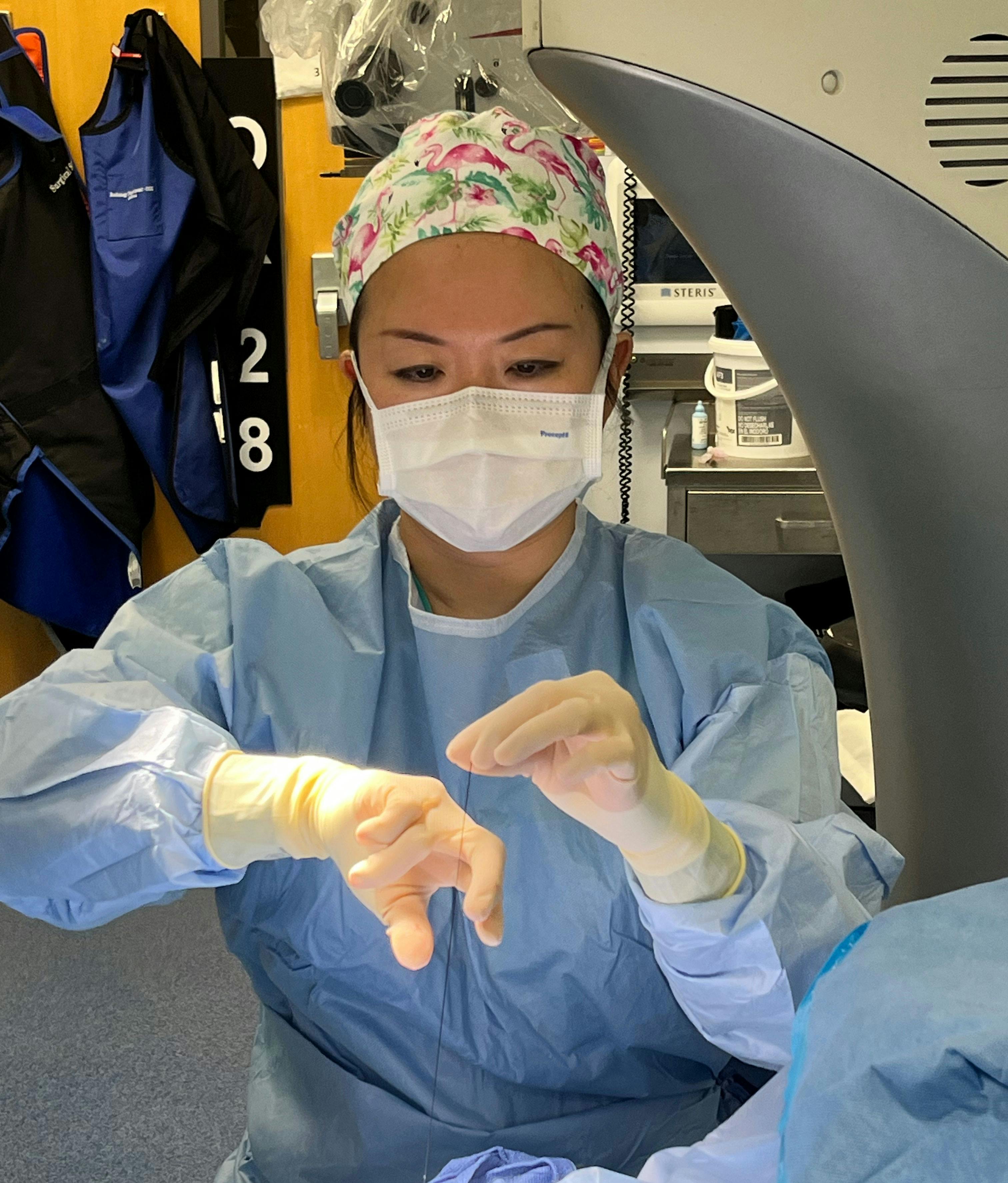
Dr. Ong’s advice: Be kind to yourself and others. Retina is a challenging subspecialty—our patients can have tough pathology, difficult social situations, and, sometimes, personalities, and our hours are long and unpredictable; lean on your village when you need to and be that source of support for others.
AN EXPERIENCE TO REMEMBER
One of my patients is a 30-year-old woman who presented with severe tractional retinal detachments in both eyes from proliferative diabetic retinopathy. When we first met, she was in a wheelchair and completely dependent on others because she could not see. I observed the right eye since there had been no light perception for years and took her to surgery to repair the left retinal detachment. Her vision has recovered greatly since her surgery, and she now lives in her own apartment and, last year, volunteered to host Thanksgiving dinner for her family and friends.
