
_1749218012.png)
In today's fast-paced medical landscape, precision and efficiency are crucial. However, inefficiencies in many retinal practices hinder patient care. Leveraging modern technology to streamline workflows is key to managing growing patient volumes and improving outcomes.
Challenges in Diagnostic Workflows
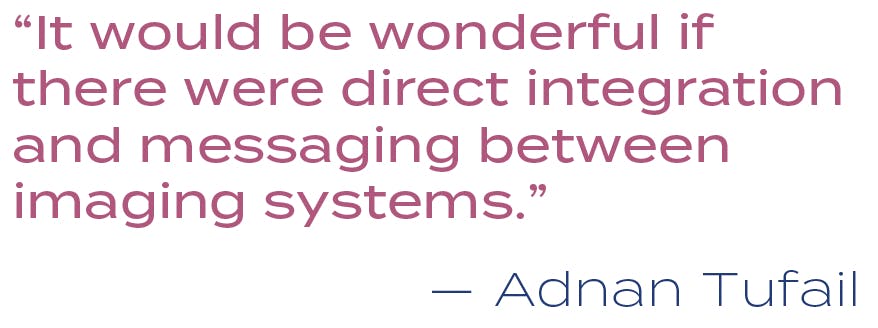
A significant challenge in hospital settings is the lack of standardized imaging workflows. Often, it is unclear which imaging modalities have been performed, leading to redundancy. Additionally, multiple proprietary imaging platforms, lacking universal standards for storage and communication, further complicate image retrieval.
Clinicians are often forced to navigate disparate systems, manually extract key data, and enter it into electronic medical records (EMRs)—a time-consuming process that reduces valuable patient interaction.
A vendor-neutral imaging platform that consolidates all imaging data into a single interface could automate data extraction, integrate with EMRs, and flag critical findings, significantly enhancing efficiency and diagnostic accuracy.
AI Transforming Diagnosis and Monitoring
Well-characterized conditions like AMD and diabetic retinopathy have driven the development of CE-marked AI tools, with even greater advancements on the horizon. The role of AI in retinal care is widely acknowledged (Figure 1).
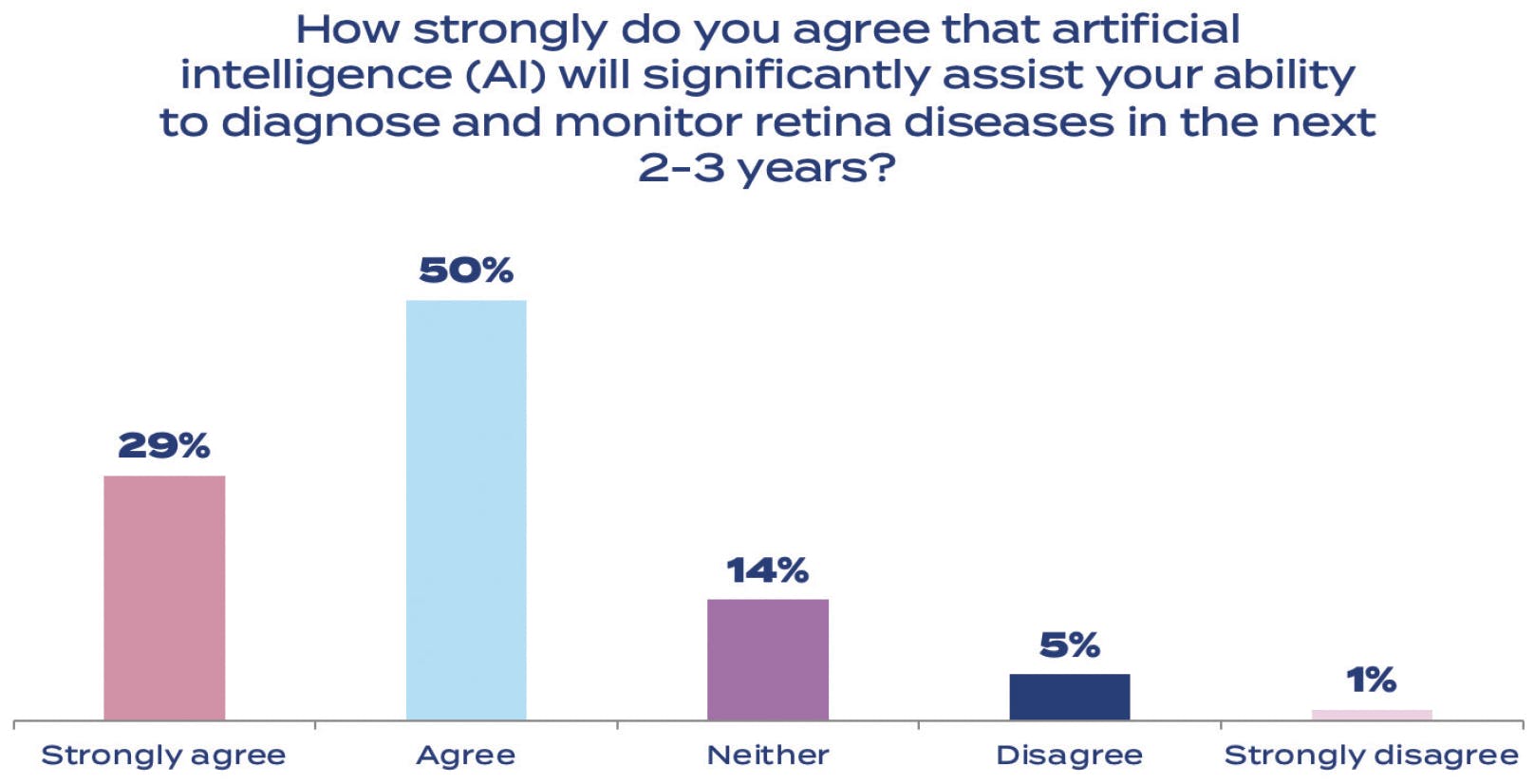
Figure 1. According to the 2023 EURETINA Clinical Trends Survey, 79% of respondents agree or strongly agree that AI will significantly assist their ability to diagnose and monitor retinal diseases in the next 2–3 years.
AI-powered tools continue to evolve, promising automation in image analysis, metric extraction, and disease detection. In neovascular age-related macular degeneration (nAMD), AI can assess disease activity, quantify fluid, and identify early signs of atrophic AMD. Moreover, AI has the potential to seamlessly extract and integrate this data into EMRs, improving decision-making and reducing clinician workload.
CE-marked AI products have already demonstrated significant capabilities, and research software suggests even greater potential. However, integration challenges persist, particularly in regions with strict data privacy regulations and clinical settings with outdated network infrastructures. Potential solutions include cloud-based AI processing and the development of AI-powered OCT devices with built-in analytics that do not require data being processed external to the OCT device.
Regulatory classification plays a key role in AI adoption. As a decision-support tool, AI assists clinicians, with the clinician ultimately responsible for interpretation. However, if AI is classified as a diagnostic tool, its assessments carry greater clinical weight. Rigorous trials are necessary to validate AI’s accuracy, and if proven to match or surpass human clinicians, adoption will accelerate. Even in a support role, AI may streamline workflows and reduce clinic times.

Challenges in Managing Complex Retinal Cases
High-flow imaging in retinal care typically follows disease-specific protocols, ensuring consistency in evaluations. However, complex cases often require flexibility. When patients exhibit unusual manifestations, additional imaging may be necessary. Balancing standardized protocols with individualized follow-ups enhances both efficiency and comprehensive assessment.
Conclusion
Optimizing diagnostic workflows in retinal care requires a robust IT infrastructure to enable seamless data transfer and integration. Imaging devices should be DICOM-compliant and connected to a centralized platform for rapid retrieval. Automated image analysis and EMR integration reduce manual workload, enhance efficiency, and improve diagnostic accuracy and patient care.
The views and opinions expressed in this content may not necessarily represent those of Bryn Mawr Communications or Retina Today.
