

The LIGHTSITE III trial of photobiomodulation (PBM) using the ValedaTM PBM (Alcon) met its primary efficacy endpoint in demonstrating improved vision in treated eyes compared to sham. Indeed, the LIGHTSITE I, II, and III trials consistently showed that ValedaTM PBM improves visual acuity with no serious treatment-related adverse events.1 As important as these functional outcomes are, data acquired in these studies and in additional post hoc analyses have revealed that ValedaTM PBM may also have a benefit for anatomic outcomes that are meaningful for patients with early or intermediate age-related macular degeneration (AMD).
EVIDENCE OF ANATOMIC BENEFIT IN LIGHTSITE I AND II
In the LIGHTSITE I study, 46 eyes of 30 patients with any stage dry AMD were treated with the Valeda Light Delivery System (n = 24 PBM; n = 22 sham) in two series of treatment (3X per week for 3-4 weeks) over 1 year.2 Notably, 45.8% of PBM eyes and 40.9% of sham eyes had foveola-involving geographic atrophy (GA) at baseline. The mean baseline BCVA letter score was 71.9 ±2.5 in the sham group and 73.8 ±1.9 in the PBM group.
At the end of the study, 50% of eyes (n = 12) were deemed to be high responders, defined as ≥ 5 letter improvement in BCVA. Among this subset of high responders, 11 of 12 (91.6%) had no foveola involvement, and the mean letter gain at month 1 and month 7 was +8 and +6 letters, respectively. By contrast, 10 of 12 (83.3%) low responders (ie, < 5 letter improvement) had central foveola involving GA.2 While there was no difference in GA lesion growth between the two groups, there was a significant reduction in central drusen volume in PBM-treated eyes (P = .05), whereas sham-treated eyes showed a numerical growth.2
Based on findings from LIGHTSITE I, LIGHTSITE II excluded eyes with GA within the central fovea but did enroll eyes with extrafoveal and subfoveal lesions (31% PBM, 47% sham). As well, the retreatment protocol was shortened to four months. In total, 32 eyes were randomized to PBM and 19 eyes to sham, with treatment occurring 3X per week over 3 to 4 weeks (9 treatments per series) with repeated treatments at baseline and at month 4 and 8.3
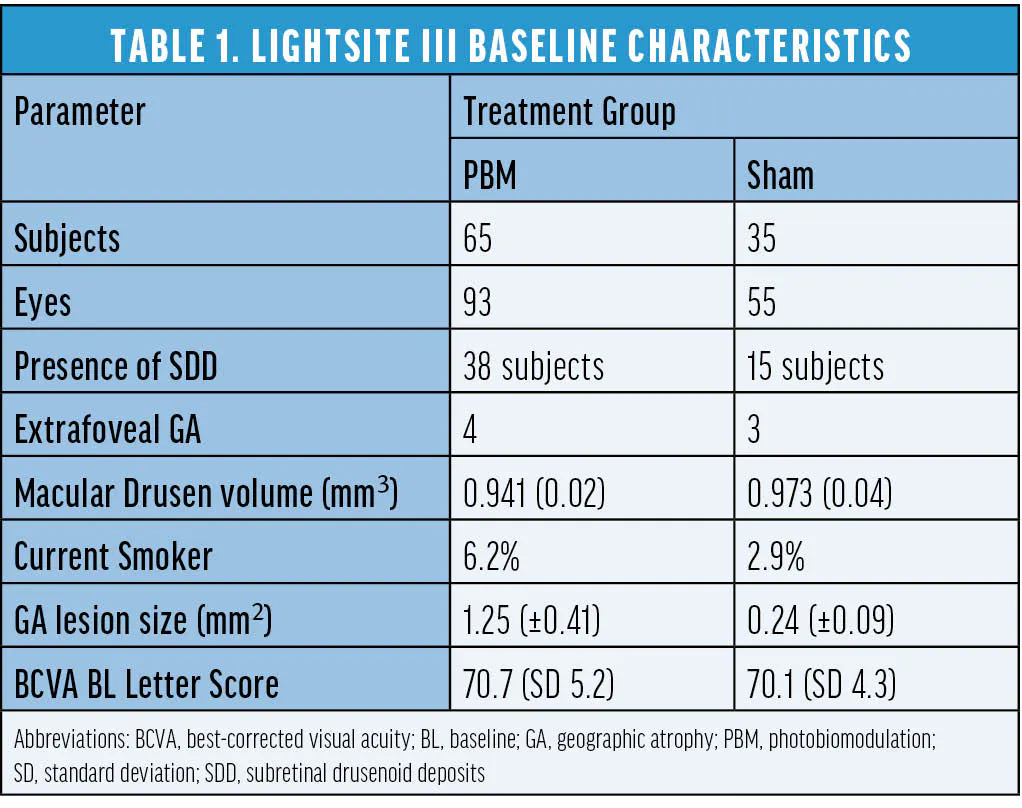
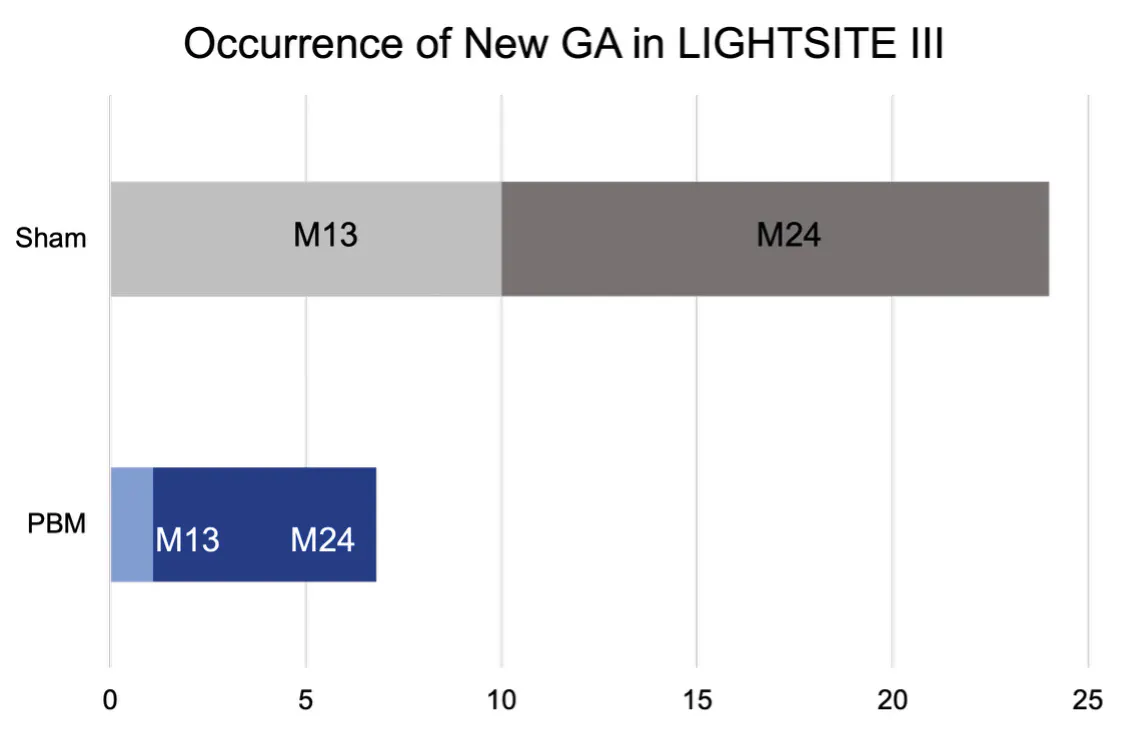
*Figure 1. In LIGHTSITE III, the occurrence of new geographic atrophy was significantly higher in the sham group than in the photobiomodulation group at months 13 and 24.
*It is unclear if this outcome is related to the investigational treatment, as development of incident GA was not a pre-specified endpoint. The study and the pre-specified endpoints were not designed to assess whether the treatment could slow the rate of progression to GA, the incidence of GA, or the rate of GA lesion growth.
There were several lines of evidence suggesting anatomic benefit associated with PBM treatment in LIGHTSITE II3:
- Reduction in drusen growth observed in PBM-treated eyes. Macular drusen volume was 0.58 ±0.27 mm3 at baseline and 0.58 ±0.27 mm3 at month 9 in the PBM group (n = 32 eyes), and it was 0.59 ±0.22 mm3 at baseline and 0.62 ±0.28 mm3 in the sham group (n = 19 eyes).
- Reduction in GA lesion growth observed in PBM-treated eyes. GA area was 4.86 ±6.32 mm2 at baseline and 4.601 ±6.26 mm2 at month 9 in the PBM group (n = 8 eyes; 0.73 ±0.56 mm2 change from baseline), and it was 6.65 ±8.91 mm2 at baseline and 7.06 ±10.0 mm2 at month 9 in the sham group (n = 8 eyes; 1.27 ±1.47 mm2 change from baseline).
- Reduced incidence of conversion to wet AMD in PBM-treated eyes. The overall conversion from dry to wet AMD was 3.1%, 5.6%, and 4.8% in PBM-treated eyes, sham-treated eyes, and non-study eyes, respectively. Notably, 16 of the 44 eyes enrolled in the study were considered high risk for conversion (defined as presence of wet AMD in the fellow eye); none of the high-risk eyes in the PBM group (0 of 12) converted to wet AMD.
INCIDENT GEOGRAPHIC ATROPHY AND LESION GROWTH IN LIGHTSITE III
To fully contextualize the anatomic outcomes in LIGHTSITE III, it is important to review the baseline characteristics of patients in the study (Table 1).1,4,5 Notable is that the presence of subretinal drusenoid deposits, a known risk factor for development of GA, was higher in the PBM arm compared to sham. However, only a small number of eyes had extrafoveal GA at baseline (n = 4 PBM; n = 3 sham). In these patients, the GA lesion size was larger in the PBM arm compared to sham.
In the study, treatment with ValedaTM PBM resulted in a lower occurrence of new-onset GA compared to sham at month 13 (P = .024) and month 24 (P = .007) (Figure 1).1,5 At month 24, 12 of 50 (24.0%) eyes in the sham group showed development of incident GA compared to 6 of 87 (6.8%) eyes in the PBM group.5 Of note, 5 of 6 (83.3%) eyes in the PBM group that converted to GA developed non-central GA; in the sham group, 7 of 12 (58.3%) eyes that converted to GA developed central-involving GA.5 Furthermore, in a post hoc Cox proportional hazard model predicting time to event of GA incidence, the hazard ratio (HR) for GA incidence was 0.27 (P < .006), indicating a statistically significant risk reduction of 73% to new incident GA over 24 months with ValedaTM PBM versus sham treatment (Figure 2).6
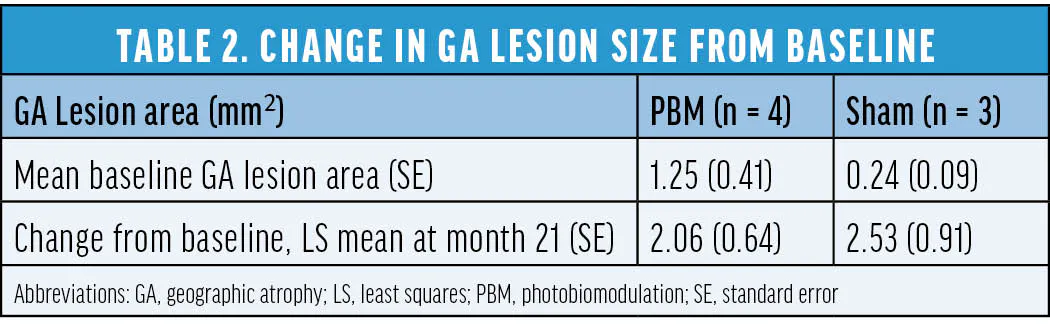
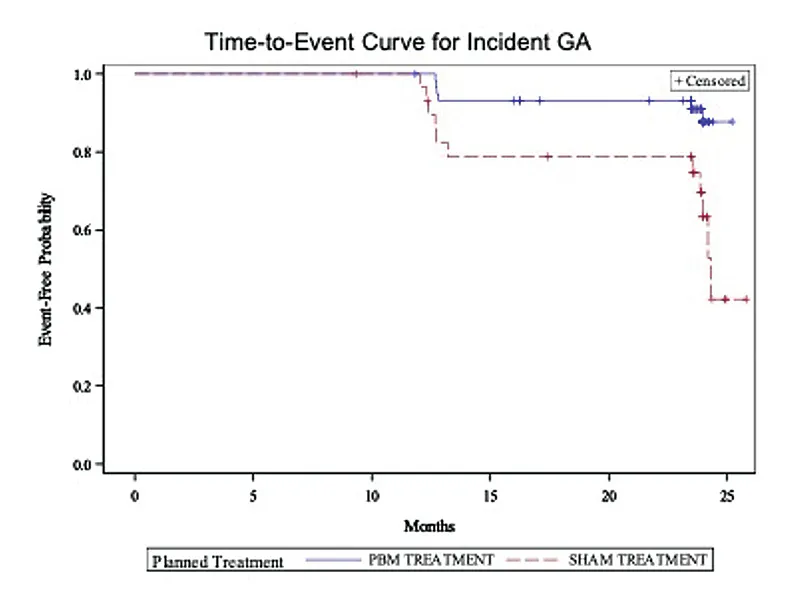
Figure 2. Results of a post hoc Cox proportional hazards model time-to-event hazard ratio of geographic atrophy incidence.
Regarding GA lesion area, mean lesion growth was numerically greater in sham-treated eyes compared with PBM-treated eyes (Table 2).5 Notably, baseline lesion size was significantly larger in the PBM group, a factor typically associated with faster absolute growth, yet lesion expansion appeared lower in PBM-treated eyes. While GA progression is inherently heterogeneous and the number of patients with GA in this study was limited, these numerical findings provide supportive, hypothesis-generating evidence that warrants further investigation in larger, dedicated studies.
ADDITIONAL ANATOMIC OUTCOMES IN LIGHTSITE III
A greater numerical increase was observed with respect to macular drusen volume at 21 months of study.5 The central drusen volume increased 0.056 mm3 in PBM-treated eyes and 0.098 in sham-treated eyes at month 21. This translated to a ~2x increase in drusen volume in sham- versus ValedaTM PBM-treated eyes at month 21.
Investigators also looked at the development of incomplete retinal pigment epithelial (RPE) and outer retinal atrophy (iRORA), which is considered a precursor of GA and a risk factor for the development of complete RPE and outer retinal atrophy (cRORA). At month 21, iRORA occurred in 7 of 33 (21.2%) of sham-treated eyes and in 9 of 67 (13.4%) of ValedaTM PBM-treated eyes.5
Furthermore, among eyes with iRORA at baseline (n = 10), there was a reduced incidence of new GA in eyes treated with ValedaTM PBM compared to sham (Figure 3). Among eyes with iRORA at baseline, 4 of 5 (80%) sham-treated eyes and 1 of 5 (20%) ValedaTM PBM-treated eyes developed cRORA at month 24.5
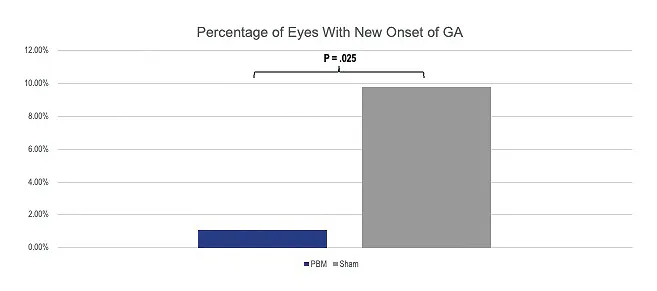
Figure 3. In LIGHTSITE III, the occurrence of GA among eyes with incomplete retinal pigment epithelial and outer retinal atrophy at baseline was 9.8% in sham-treated eyes and 1.1% in photobiomodulation (PBM)-treated eyes, demonstrating a statistically significant reduction in new-onset GA in the PBM group.
Onset of neovascular AMD (nAMD), which was considered an adverse event, occurred in 9 patients in the study, including 7 (7.5%) in the PBM group and 2 (3.6%) in the sham group. However, the prevalence of high-risk eyes (ie, fellow eye with nAMD at baseline) was 3X higher (12:4) in the PBM group versus the sham group. Of the 9 eyes that progressed to nAMD, 6 had nAMD in the fellow eye at baseline. Additionally, when sham was normalized to the higher rate, development frequency was estimated at 7.3%, which was similar to the PBM group.5
CONCLUSION
Anatomic outcomes among eyes enrolled in LIGHTSITE III help contextualize functional outcomes from the study. Taken together, the data shown above are encouraging, showing a potential disease-modifying effect beyond the improvements in visual function.
1. LIGHTSITE III Clinical Study Report (CSR) Month 24 data 29AUG2023 no appendices (CSP005) (REF-28073)
2. Markowitz SN, Devenyi RG, Munk MR, et al. A double-masked, randomized, sham-controlled, single-center study with photobiomodulation for the treatment of dry age-related macular degeneration. Retina. 2020;40(8):1471-1482.
3. Burton B, Parodi MB, Jürgens I, et al. LIGHTSITE II randomized multicenter trial: evaluation of multiwavelength photobiomodulation in non-exudative age-related macular degeneration. Ophthalmol Ther. 2023;12(2):953-968.
4. Boyer D, Hu A, Warrow D, et al. LIGHTSITE III: 13-Month efficacy and safety evaluation of multiwavelength photobiomodulation in nonexudative (dry) age-related macular degeneration using the Lumithera Valeda Light Delivery System. Retina. 2024;44(3):487-497.
5. Jaffe GJ, Boyer D, Hu A, et al. Long-term efficacy and safety of photobiomodulation in dry age-related macular degeneration (LIGHTSITE III: 24-month analysis). Retina. 2026;46(5):783-795.
6. Do D. Photobiomodulation for Dry AMD. Presented at the American Academy of Ophthalmology, October 20, 2024; Chicago, IL.
