

In therapeutic applications, PBM works at the cellular level, primarily affecting mitochondria to increase ATP production and modulate reactive oxygen species.
Photobiomodulation (PBM) is the process by which specific wavelengths of light are absorbed by cellular photoacceptor molecules, resulting in the activation of signaling pathways that culminate in biological changes within the cell.
Examples of different wavelengths of light interacting with photoacceptor molecules to trigger biologic responses can be found in nature. For instance, the process of photosynthesis is a light-dependent reaction in which chlorophyll captures light energy that splits water molecules, thereby releasing oxygen and creating energy-storing molecules (ie, adenosine triphosphate [ATP]). Another example is phototransduction, the biochemical process in retinal rods and cones that converts light energy to electrical signals, allowing for vision.
In therapeutic applications, PBM primarily affects mitochondria to increase ATP production and modulate reactive oxygen species (ROS). Furthermore, it activates transcription factors that promote cell proliferation, migration, and tissue oxygenation.1
Cytochrome c Oxidase (CcO) is the key photoacceptor in mitochondria, converting light into cellular signals.1,2 It acts as the terminal electron acceptor in the respiratory chain, enabling ATP synthesis. Photon absorption by CcO triggers a cascade that increases ATP and ROS production. Notably, the retina is mitochondria-rich, and dysfunction may lead to diseases like AMD.3 As an additional effect of treatment, PBM also releases nitric oxide from CcO, enhancing its activity and boosting energy output.2
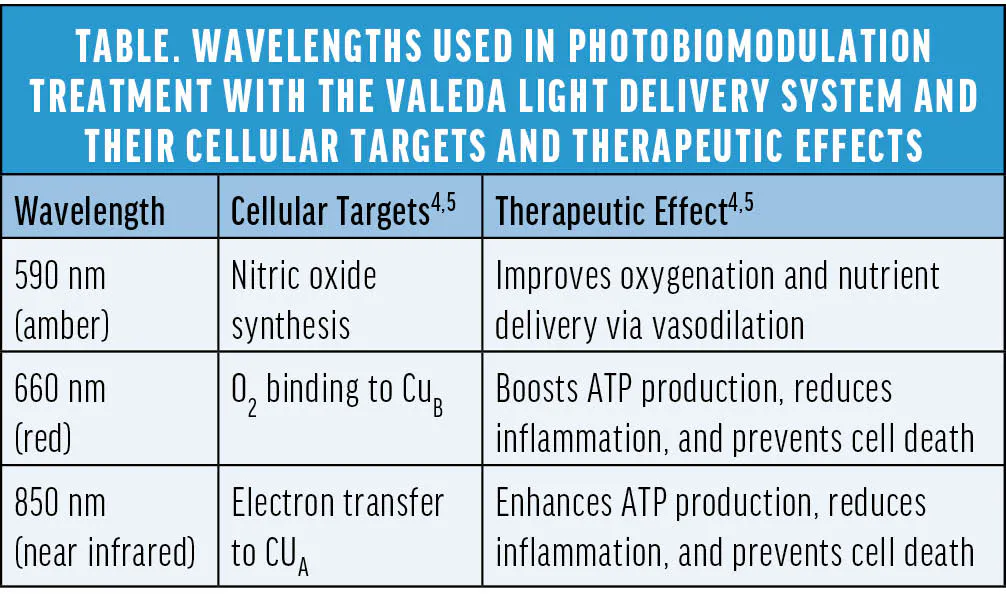
ValedaTM PBM (Alcon) harnesses the concept of PBM for application in the treatment of dry age-related macular degeneration (AMD). The wavelengths used in the treatment were strategically selected for their ability to target key cellular mechanisms relevant to AMD pathology (Table).4,5 Fundamentally, ValedaTM PBM delivers three selected wavelengths proven to upregulate cellular energy production.4,5
Our research group recently studied the proposed mechanism of action associated with Valeda in a pilot study in six eyes of five patients, all of whom had been diagnosed with geographic atrophy secondary to AMD.6 For the study, we used a spectrally resolved autofluorescence device (Eidon, CenterVue) that facilitates visibility of green-emitting fluorophores. Of note, while this device is solely for research purposes, it has been validated to quantify minor fluorophores, such as flavin adenine dinucleotide (FAD). The quantification of FAD is notable because this intracellular molecule that is stored in mitochondria is a potential biomarker for mitochondrial activity. PBM treatment was administered in nine sessions over 3 weeks.
Our analysis relied on an algorithm that mapped the fluorophore area on the spectrally resolved autofluorescence image. Using this algorithm, we determined that the area was 0.458 mm2 at baseline, which increased to 0.480 mm2 after 1 month of treatment and to 0.537 mm2 after 3 months of treatment. These changes represent a 4.89% increase in the fluorophore area versus baseline at 1 month, and a 17.11% increase at 3 months compared to baseline. No adverse systemic or local side effects were noted during this study.
Our results in this pilot study are preliminary but suggest that PBM with the Valeda Light Delivery System increases minor fluorophore activity, which is a plausible biomarker for increased mitochondrial activity. We plan to further evaluate these findings in a larger cohort of 30 patients with intermediate AMD (NCT06582511).
1. Chung H, Dai T, Sharma SK, et al. The nuts and bolts of low-level laser (light) therapy. Ann Biomed Eng. 2012;40(2):516-533.
2. de Freitas LF, Hamblin MR. Proposed mechanisms of photobiomodulation or low-level light Therapy. IEEE J Sel Top Quantum Electron. 2016;22(3):7000417.
3. Eells JT. Mitochondrial dysfunction in the aging retina. Biology (Basel). 2019;8(2):31.
4. Wong-Riley MT, Liang HL, Eells JT, et al. Photobiomodulation directly benefits primary neurons functionally inactivated by toxins: role of cytochrome c oxidase. J Biol Chem. 2005;280(6):4761-4771.
5. Ball KA, Castello PR, Poyton RO. Low intensity light stimulates nitrite-dependent nitric oxide synthesis but not oxygen consumption by cytochrome c oxidase: Implications for phototherapy. J Photochem Photobiol B. 2011;102(3):182-191.
6. Beretta F, Zucchiatti I, Sacconi R, et al. Multiwavelength photobiomodulation in atrophic age-related macular degeneration. Eur J Ophthalmol. 2025;35(4):1336-1341.
