

Age-related macular degeneration (AMD) is classified into two categories: exudative (neovascular) AMD, which is characterized by abnormal blood vessel growth, and dry AMD, which is characterized by macular pigmentary changes and the accumulation of extracellular material under the macula known as drusen. It is estimated that about 196 million people globally are living with any AMD, with global projected cases expected to rise to 288 million in 2040.1
Significant advances have been made in the treatment of advanced AMD. The standard of care for treatment of the neovascular form of advanced AMD is intravitreal injections of anti-VEGF agents. Meanwhile, the recent availability of complement inhibitors for the treatment of geographic atrophy (GA) in many parts of the world means that a treatment option is available where previously none existed.
Historically, treatment options for dry AMD have been limited beyond recommendations for lifestyle modifications and AREDS2 antioxidant supplementation. Recently, photobiomodulation (PBM) has emerged as a potential solution to address this unmet need. Briefly, PBM is an established biotechnology that involves applying light from the visible spectrum to near infrared (500-1000 nm) to selected tissue to produce a cellular effect.2,3 ValedaTM PBM (Alcon) uses three specific wavelengths to restore cellular energy production and improve retinal cellular health (see Reviewing the Mechanism of Action Associated With Photobiomodulation for more information on ValedaTM PBM’s mechanism of action).2,3 ValedaTM PBM is intended to provide improved visual acuity in patients with BCVA of 20/32 through 20/70 and who have dry AMD characterized by:
- The presence of at least three medium drusen (> 63 µm and ≤ 125 µm in diameter), or large drusen (> 125 µm in diameter), or non-central GA AND
- The absence of neovascular maculopathy or center-involving GA.
PBM has been studied in multiple randomized clinical trials, including LIGHTSITE I and LIGHTSITE II, each of which demonstrated the treatment’s safety and efficacy in individuals with dry
AMD.4-6 PBM was further evaluated in eyes with early or intermediate AMD in the LIGHTSITE III study and the LIGHTSITE IIIb extension study, which collectively provide long-term safety and efficacy findings of ValedaTM PBM.7-9
About the LIGHTSITE III Study
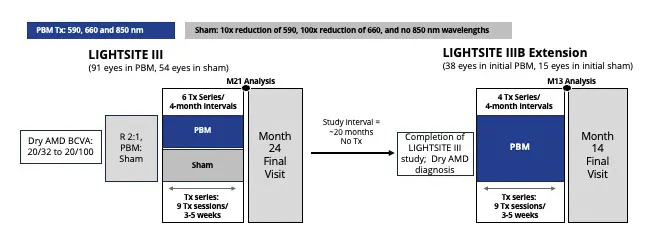
LIGHTSITE III was a double-masked, randomized, sham-controlled, parallel-group, multicenter, prospective trial to assess the safety and efficacy of PBM in patients with early or intermediate dry AMD. In the PBM arm, subjects were treated with the Valeda Light Delivery System in a course of nine sessions over a period of 3 to 5 weeks; the 24-month study included six courses of treatments delivered every 4 months. The sham treatment arm consisted of an active control: delivery of a lower fluence of selected wavelengths compared to PBM. This active control minimized intervention bias since all study subjects had a similar treatment experience. Subjects were evaluated for efficacy and safety outcomes. Data were collected during 61 total visits per protocol, and the primary analysis for the study was at month 21.
The LIGHTSITE III study was followed by LIGHTSITE IIIb, an open-label, prospective, multicenter, single-arm extension trial on the continued use of PBM in a subgroup of patients with dry AMD who participated in the LIGHTSITE III trial. There was a 20-month interval between the two studies resulting from budgetary and logistical factors, during which no treatment was administered. The full trial design schematic for LIGHTSITE III and LIGHTSITE IIIb is shown in Figure 1.
Results: BCVA
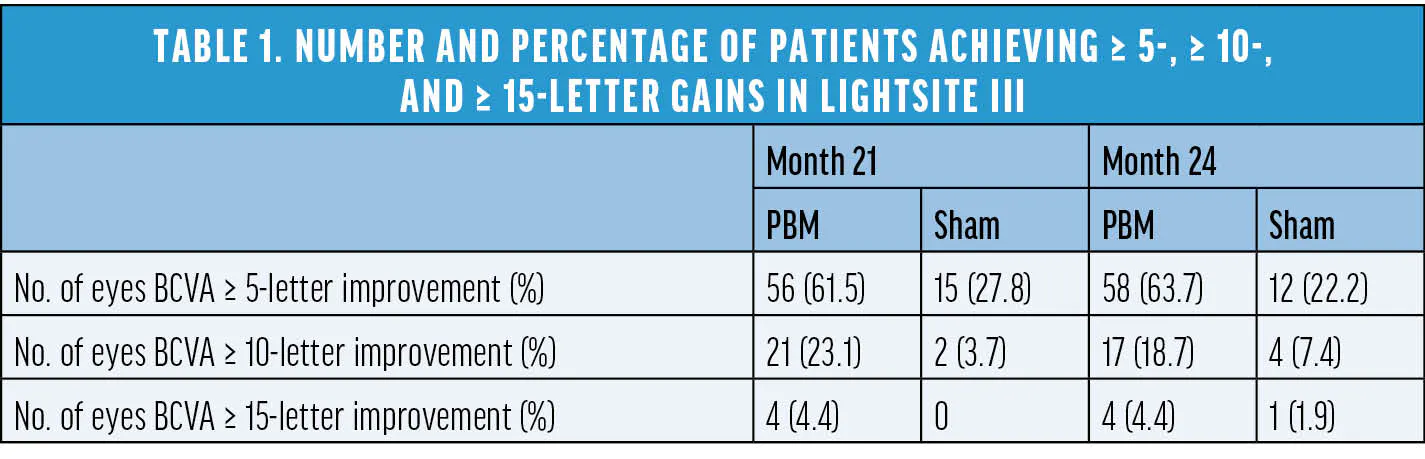
The LIGHTSITE III trial met the predetermined primary efficacy BCVA endpoint at month 21 with a gain of 6.2 ETDRS letters (~1 line; P = .0036) versus baseline in the PBM group, which was maintained at month 24 (+5.6 ETDRS letter gain; P = .0024; n = 98 subjects and 145 eyes).6,8 Furthermore, 84% of PBM-treated patients maintained or improved vision at about 2 years compared to baseline, and more than 60% of PBM-treated patients experienced ≥ 1-line vision improvement at about 2 years compared to baseline (n = 98 subjects and 145 eyes).10,11 A greater percentage of eyes in the ValedaTM group achieved ≥ 5-, ≥ 10-, and ≥ 15-ETDRS letter gains at month 21 compared to eyes in the sham group, and these differences were also apparent at month 24 (Table 1).8
Results from the LIGHTSITE IIIb study demonstrated that visual gains could be restored following repeated PBM treatment, with benefits to vision maintained over 4.5 years in the PBM group.9,12 Analysis of 38 eyes continuously followed over both LIGHTSITE III and LIGHTSITE IIIb showed that those in the original PBM group maintained about one line of vision, while eyes that crossed over to PBM during the extension trial stabilized but did not decline further (Figure 2).12
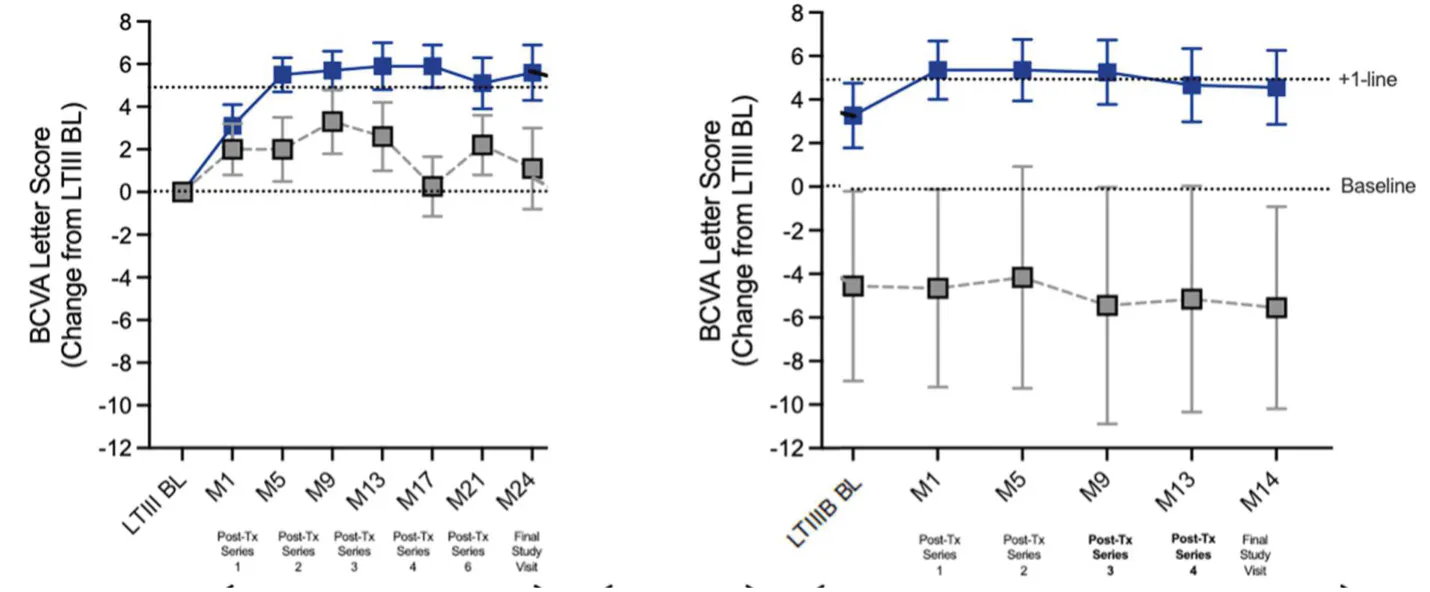
Figure 2. Results of a post-hoc analysis of BCVA change in eyes followed continuously over LIGHTSITE III and LIGHTSITE IIIb. During a 20-month intermission in treatment between LIGHTSITE III and LIGHTSITE IIIb, eyes that were treated with PBM lost 2.2 letters of BCVA, while those in the sham group lost 5.6 letters of BCVA. Vision improvement to +1 line compared to LIGHTSITE III baseline was restored in eyes in the PBM group, while vision appeared to stabilize in eyes in the sham group crossed over to PBM during LIGHTSITE IIIb.
Conclusion
Results from the LIGHTSITE III and LIGHTSITE IIIb studies substantiate earlier findings from smaller randomized controlled clinical trials, definitively demonstrating vision improvement in eyes with dry AMD. The gains in vision in LIGHTSITE III are particularly notable given that the majority of eyes enrolled had an initial BCVA letter score consistent with very mild or near-normal vision.7 Taken together, data from LIGHTSITE III and LIGHTSITE IIIb support PBM’s proposed mitochondrial mechanism of action in dry AMD by showing that vision gains can be maintained with continuous treatment.
Despite the requirement for multiple treatment visits during these studies (ie, 54 treatments over 61 site visits in the 24-month LIGHTSITE III study), the discontinuation rate was low at 20%. It should be noted that although the number of study visits was extensive, treatments were completed in < 5 minutes per eye, and ValedaTM PBM therapy does not require pupil dilation.11 Nevertheless, the low attrition rate in LIGHTSITE III may suggest that patients were motivated by vision gains to continue participation (see Real-World Experience With ValedaTM Photobiomodulation for additional information).
On the whole, these data demonstrate benefits for vision that indicate a disease-modifying effect associated with multiwavelength PBM therapy, and they are supported by additional data that demonstrate improvements in anatomical endpoints (see Anatomic Outcomes in LIGHTSITE III for additional information).
1. Wong WL, Su X, Li X, et al. Global prevalence of age-related macular degeneration and disease burden projection for 2020 and 2040: a systematic review and meta-analysis. Lancet Glob Health. 2014;2(2):e106-e116.
2. Ball KA, Castello PR, Poyton RO. Low intensity light stimulates nitrite-dependent nitric oxide synthesis but not oxygen consumption by cytochrome c oxidase: Implications for phototherapy. J Photochem Photobiol B. 2011;102(3):182-191.
3. Wong-Riley MT, Liang HL, Eells JT, et al. Photobiomodulation directly benefits primary neurons functionally inactivated by toxins: role of cytochrome c oxidase. J Biol Chem. 2005;280(6):4761-71.
4. Markowitz SN, Devenyi RG, Munk MR, et al. A double-masked, randomized, sham-controlled, single-center study with photobiomodulation for the treatment of dry age-related macular degeneration. Retina. 2020;40(8):1471-1482.
5. Burton B, Parodi MB, Jürgens I, et al. LIGHTSITE II randomized multicenter trial: evaluation of multiwavelength photobiomodulation in non-exudative age-related macular degeneration. Ophthalmol Ther. 2023;12(2):953-968.
6. LIGHTSITE III Clinical Study Report (CSR) Month 24 data 29AUG2023 no appendices (CSP005) (REF-28073)
7. Boyer D, Hu A, Warrow D, et al. LIGHTSITE III: 13-month efficacy and safety evaluation of multiwavelength photobiomodulation in nonexudative (dry) age-related macular degeneration using the Lumithera Valeda Light Delivery System. Retina. 2024;44(3):487-497.
8. Jaffe GJ, Boyer D, Hu A, et al. Long-term efficacy and safety of photobiomodulation in dry age-related macular degeneration (LIGHTSITE III: 24-month analysis). Retina. 2026;46(5):783-795.
9. Do D. Clinical Findings from the LIGHTSITE III and IIIB Extension Trials. Presented at EURetina 2025, Paris, France.
10. Valeda US Label Exhibit Data (REF-28187)
11. Valeda US User Manual (LBL-0001-01 REV C) (REF-27575)
12. LIGHTSITE IIIb Clinical Study Report.
