


CPT Code: CPT 92242 (combined FA/ICG)
CASE PRESENTATION
A 21-year-old man presented with a 1-week history of photophobia, redness, and a central scotoma in the left eye. Visual acuity was 20/20 in the right eye and 20/30 in the left.
Making the Diagnosis
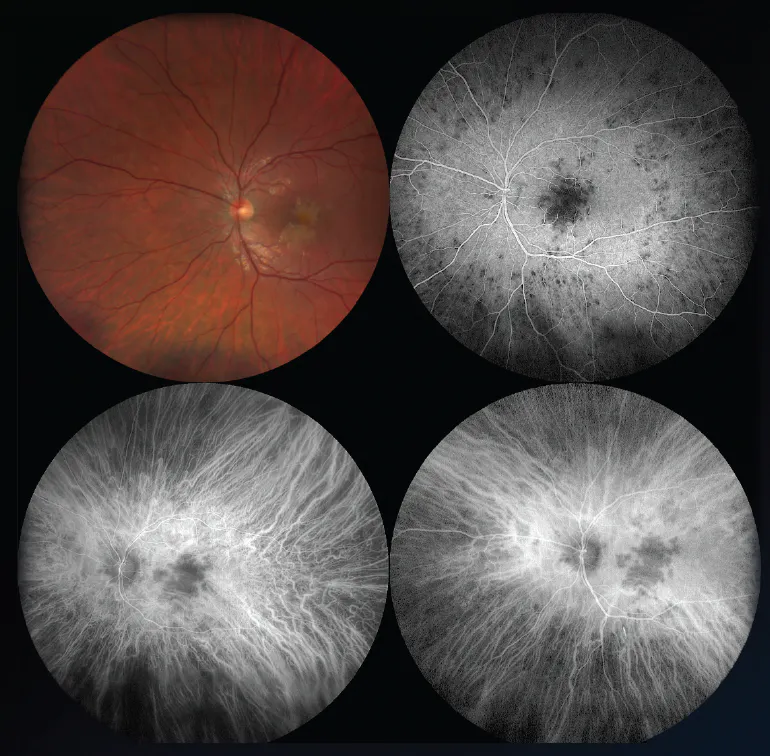
A multimodal imaging approach, including simultaneous fluorescein and indocyanine green angiography (FA/ICGA) with the CLARUS 700 from ZEISS, was used to establish the diagnosis. The ZEISS CLARUS 700 was selected for its ultra-widefield imaging capability, which captures peripheral pathology, as well as its high resolution, which allows for optimal visualization of macular pathology and vascular detail. Additionally, the system enables simultaneous FA/ICGA acquisition in movie mode, reducing photography chair time and providing highly detailed early-phase imaging during angiographic filling.
In this case, ICGA demonstrated relatively uniform and persistent hypocyanescence of a macular lesion in both the early (Figure, bottom left) and late (Figure, bottom right) phases—findings consistent with acute posterior multifocal placoid pigment epitheliopathy (APMPPE).1
Discussion
The hypocyanescence observed in this case is indicative of active choriocapillaris hypoperfusion and helps significantly narrow the differential diagnosis. Although other inflammatory and infectious conditions may demonstrate similar findings, few exhibit hypocyanescence that persists across both early and late ICGA phases.
Masquerade infectious entities, such as acute syphilitic posterior placoid chorioretinitis2 and tubercular serpiginous-like choroiditis,3 tend to appear more heterogeneous on ICGA, with variable degrees of cyanescence, in contrast to the more homogeneous hypocyanescent pattern observed here.
Because APMPPE is typically self-limited, accurate diagnosis using multimodal imaging (including ICGA) can help avoid unnecessary testing and treatment. Nevertheless, infectious etiologies such as syphilis and tuberculosis should be excluded with appropriate laboratory evaluation. In more severe cases requiring systemic corticosteroids, ICGA may also help guide management, as only active lesions demonstrate hypocyanescence.1
1. Carreño E, Maghsoudlou P, Fonollosa A, et al; Multimodal Imaging in Uveitis (MUV) Taskforce. Evidence and consensus-based imaging guidelines in acute posterior multifocal placoid pigment epitheliopathy (APMPPE) - Multimodal imaging in Uveitis (MUV) Taskforce Report 7. Am J Ophthalmol. 2025;278:38-51.
2. Villaret J, Errera MH, Sahel JA, et al. Indocyanine green angiography features in acute syphilitic posterior placoid chorioretinitis. Am J Ophthalmol. 2022;241:40-46.
3. Bansal R, Gupta V. Tubercular serpiginous choroiditis. J Ophthalmic Inflamm Infect. 2022;12(1):37.
Not all products, services, or offers referenced in this article are approved or offered in every market and approved labeling and instructions may vary from one country to another.
The statements of the author reflect only their personal opinions and experiences and do not necessarily reflect the opinion of any institution that they are affiliated with. The author alone is responsible for the content of their experience reported and any potential resulting infringements. Carl Zeiss Meditec AG and its affiliates do not have clinical evidence supporting the opinions and statements of the author nor accept any responsibility or liability of the authors’ content.
The authors has a contractual or other financial relationship with Carl Zeiss Meditec, Inc. and its affiliates and have received financial support.
CAP-en-US_31_173_0300I
