

Over the past two decades, glaucoma specialists have witnessed remarkable innovation, and the advent of MIGS has reshaped the treatment landscape. The traditional therapeutic paradigm, once characterized by stepwise escalation that reserved surgery for advanced disease, is now being challenged by safer and more proactive interventional strategies. As a result, these procedures are increasingly offered earlier in the disease course, often to younger and otherwise healthy patients, making long-term safety a central determinant in procedural selection. MIGS development has been accompanied by a rapidly expanding evidence base. Among these procedures, the iStent technologies (Glaukos Corporation) have accumulated the most extensive data, from more than 400 published studies. Numerous authors, including myself, have explored this large body of literature to determine whether any MIGS technique consistently outperforms others. The final IOP outcomes tend to converge across procedures, consistently stabilizing in the mid-teens. Consequently, safety— particularly long-term safety—becomes the key differentiator between MIGS procedures.
LITERATURE REVIEW
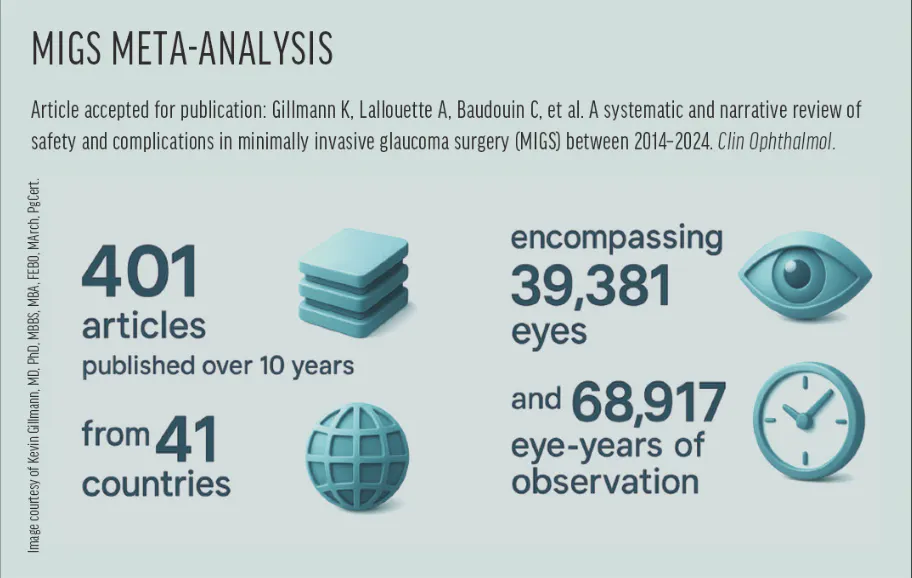
To address this critical gap, our group recently conducted a systematic and narrative review evaluating the safety of MIGS across more than 400 publications, encompassing nearly 69,000 eye-years of follow-up data (see the sidebar: MIGS Meta-Analysis).1 Full methodological details will be presented in our forthcoming manuscript. Across procedures, complications varied widely in frequency and clinical significance, and could generally be classified into three broad categories:
- Common, transient events: These included hyphema and early postoperative IOP spikes—typically mild, self-limited, and observed across many MIGS techniques.
- Less frequent but chronic or clinically significant events: Examples included choroidal detachments, persistent hyphema, macular edema, and progressive endothelial cell loss.
- Technique-specific complications requiring special consideration: These included Descemet membrane detachment in up to 9.1% of ab interno canaloplasty (AbIC) cases; device misplacement and pupillary distortion in up to 27.8% and 12.9% of MINIject (iSTAR) procedures, respectively; supraciliary effusions reported in up to 92% of trabeculotomies; progressive peripheral anterior synechiae in up to 19% of Hydrus (Alcon) implantations; and deep or “buried” stents seen in up to 45% of iStent inject® cases. Interestingly, some surgical variations appeared to play a meaningful role in modulating risk. For instance, although hyphema and IOP spikes were common following trabeculotomy, and persistent hyphema sometimes required washout, more tissue-sparing approaches tended to reduce these events. Similarly, with iStent devices, following the introduction of the iStent inject® W and its refined design, there have been no further published reports of device overimplantation.
SAFETY ADVANTAGES
As MIGS are increasingly used in younger populations, endothelial health and the preservation of ocular anatomy are particularly important. In this regard, Iqbal Ike K. Ahmed, MD, and colleagues provided valuable insight through a 5-year post hoc comparison of Hydrus, iStent inject®, and CyPass (Alcon), against phacoemulsification controls.2 At 5 years, the iStent inject® demonstrated endothelial cell loss (ECL) comparable to controls, while the Hydrus group showed a significantly higher proportion of eyes with >30% ECL (20.8% vs 10.6%, P = 0.01), with an acceleration of ECL over time. Overall, all MIGS procedures carry some risk of adverse events, although their profile and severity vary considerably. Trabecular bypass implants (including iStent devices) and ab interno canaloplasty (AbIC) generally demonstrated the lowest rates of serious complications and the least structural disruption, preserving options for future surgical intervention. For AbIC, reported rates of macular edema and Descemet detachment varied considerably across publications, raising questions about heterogeneity in surgical technique or in reporting methodology. For the iStent inject®, mispositioning was the predominant device-specific adverse event, which appears to have improved substantially with the iStent inject® W and was not associated with migration, harm, or secondary complications. By contrast, goniotomies and trabeculotomies produced higher rates of transient hyphema and IOP fluctuation, while suprachoroidal devices exhibited the highest incidence of clinically significant complications. However, a major challenge highlighted by this review was the heterogeneity of safety definitions and reporting practices. Common events such as hyphema or IOP spikes were inconsistently documented, and late or examination-dependent findings, including endothelial cell loss, peripheral anterior synechiae, or supraciliary effusions, were frequently underreported. This variability substantially limits comparability across studies and underscores the need for standardized safety reporting frameworks.
SUMMARY
In conclusion, our comprehensive review delivers two key messages. First, the field urgently needs harmonized safety definitions, consistent reporting standards, and long-term prospective studies to accurately characterize surgical risks. Second, as MIGS becomes firmly established as an early interventional strategy, techniques that preserve tissue and maintain anatomical integrity may offer the most favorable balance between efficacy, safety, and long-term surgical flexibility.
REFERENCES
1.Gillmann K, Lallouette A, Baudouin C, et al. A systematic and narrative review of safety and complications in minimally invasive glaucoma surgery (MIGS) between 2014–2024. Clin Ophthalmol. Submitted for publication.
2. Ahmed IIK, Sheybani A, DeFrancesco T, et al. Corneal endothelial safety profile in minimally invasive glaucoma surgery. J Cataract Refract Surg. 2023;50(4):369–377.
iStent inject® IMPORTANT SAFETY INFORMATION
INDICATIONS FOR USE: The iStent inject® is intended to reduce intraocular pressure safely and effectively in patients diagnosed with primary open-angle glaucoma, pseudo-exfoliative glaucoma or pigmentary glaucoma. The iStent inject® can delivertwo (2) stents on a single pass, through a single incision. The implant is designed to stent open a passage through the trabecular meshwork to allow for an increase in the facility of outflow and a subsequent reduction in intraocular pressure. The device is safe and effective when implanted in combination with cataract surgery in those subjects who require intraocular pressure reduction and/or would benefit from glaucoma medication reduction. The device may also be implanted in patients who continue to have elevated intraocular pressure despite prior treatment with glaucoma medications and conventional glaucoma surgery. CONTRAINDICATIONS: The iStent inject® System is contraindicated under the following circumstances or conditions: • In eyes with primary angle closure glaucoma, or secondary angle-closure glaucoma, including neovascular glaucoma, because the device would not be expected to work in such situations • In patients with retrobulbar tumor, thyroid eye disease, Sturge-Weber Syndrome or any other type of condition that may cause elevated episcleral venous pressure. WARNINGS/PRECAUTIONS: • For prescription use only. • This device has not been studied in patients with uveitic glaucoma. • Do not use the devices if the Tyvek® lid has been opened or the packaging appears damaged. In such cases, the sterility of the device may be compromised. • Due to the sharpness of certain injector components (i.e. the insertion sleeve and trocar), care should be exercised to grasp the injector body. Dispose of device in a sharps container. • iStent inject® is MR-Conditional • Physician training is required prior to use of the iStent inject® System. • Do not re-use the stent(s) or inserter, as this may result in infection and/or intraocular inflammation, as well as occurrence of potential postoperative adverse events • There are no known compatibility issues with the iStent inject® and other intraoperative devices (e.g., viscoelastics) or glaucoma medications. • Unused product & packaging may be disposed of in accordance with facility procedures. Implanted medical devices and contaminated products must be disposed of as medical waste. • Due to the sharpness of certain injector components (i.e. the insertion sleeve and trocar), care should be exercised to grasp the injector body • The surgeon should monitor the patient postoperatively for proper maintenance of intraocular pressure. If intraocular pressure is not adequately maintained after surgery, the surgeon should consider an appropriate treatment regimen to reduce intraocular pressure.
iStent inject® W IMPORTANT SAFETY INFORMATION
INDICATIONS FOR USE: The iStent inject® W, is intended to reduce intraocular pressure safely and effectively in patients diagnosed with primary open-angle glaucoma, pseudo-exfoliative glaucoma or pigmentary glaucoma. The iStent inject® W, can deliver two (2) stents on a single pass, through a single incision. The implant is designed to stent open a passage through the trabecular meshwork to allow for an increase in the facility of outflow and a subsequent reduction in intraocular pressure. The device is safe and effective when implanted in combination with cataract surgery in those subjects who require intraocular pressure reduction and/or would benefit from glaucoma medication reduction. The device may also be implanted in patients who continue to have elevated intraocular pressure despite prior treatment with glaucoma medications and conventional glaucoma surgery. CONTRAINDICATIONS: The iStent inject® W System is contraindicated under the following circumstances or conditions: • In eyes with primary angle closure glaucoma, or secondary angle-closure glaucoma, including neovascular glaucoma, because the device would not be expected to work in such situations. •In patients with retrobulbar tumor, thyroid eye disease, Sturge-Weber Syndrome or any other type of condition that may cause elevated episcleral venous pressure. WARNINGS/PRECAUTIONS: • For prescription use only. • This device has not been studied in patients with uveitic glaucoma. • Do not use the device if the Tyvek® lid has been opened or the packaging appears damaged. In such cases, the sterility of the device may be compromised. • Due to the sharpness of certain injector components (i.e. the insertion sleeve and trocar), care should be exercised to grasp the injector body. Dispose of device in a sharps container. • iStent inject® W is MR-Conditional. • Physician training is required prior to use of the iStent inject® W System. • Do not re-use the stent(s) or injector, as this may result in infection and/or intraocular inflammation, as well as occurrence of potential postoperative adverse events. • There are no known compatibility issues with the iStent inject® W and other intraoperative devices. (e.g., viscoelastics) or glaucoma medications. • Unused product & packaging may be disposed of in accordance with facility procedures. Implanted medical devices and contaminated products must be disposed of as medical waste. • The surgeon should monitor the patient postoperatively for proper maintenance of intraocular pressure. If intraocular pressure is not adequately maintained after surgery, the surgeon should consider an appropriate treatment regimen to reduce intraocular pressure. • Patients should be informed that placement of the stents, without concomitant cataract surgery in phakic patients, can enhance the formation or progression of cataract. ADVERSE EVENTS: Please refer to Directions For Use for additional adverse event information. CAUTION: Please reference the Directions For Use labelling for a complete list of contraindications, warnings and adverse events.
Glaukos®, iStent®, iStent inject® and iStent inject® W are registered trademarks of Glaukos Corporation. All rights reserved. ©2026. Third-party trademarks are the property of their respective owners. PM-EU-0391
