


At a Glance
• In situations in which there is poor capsular support, four-point fixation of an IOL may allow excellent IOL stability, and PFTE suture material might reduce concerns regarding polypropylene suture breakage.
• This technique can be employed by any vitreoretinal surgeon and combined with standard three-port PPV.
• To date, the technique has resulted in favorable visual outcomes with low rates of intraoperative and postoperative complications.
In situations in which there is poor capsular support, such as a complicated cataract surgery or dislocated intraocular lens (IOL)-capsular bag complex, scleral fixation of a posterior chamber IOL can be an effective approach for the vitreoretinal surgeon.1 In 2014, our institution described a modified ab externo technique for sutured scleral fixation of an Akreos AO60 IOL (Bausch + Lomb) using a polytetrafluoroethylene (PFTE; Gore-Tex, W.L. Gore & Associates) suture.2 It was hypothesized that four-point fixation of an Akreos AO60 IOL would allow excellent IOL stabilization, while the resilient PFTE material might reduce concerns regarding suture breakage encountered with polypropylene sutures.3,4 In addition, the technique could easily be paired with concurrent three-port pars plana vitrectomy (PPV), which might be necessary in the setting of a dislocated IOL or retained lens material.
Iris fixation or sutureless scleral fixation of an IOL, or placement of an anterior chamber IOL, may also be employed effectively in the setting of poor capsular support.1 However, we believe that scleral fixation of an Akreos AO60 IOL with PFTE suture has many advantages, including relative ease of insertion and fixation, use of small corneal incisions, avoidance of iris contact, and (theoretically) a lower risk of dislocation.
The key steps of this procedure are illustrated in a supplemental video (Video 1), and full details of the procedure have previously been published.2,5 The procedure was also presented at the 2015 Vit-Buckle Society meeting in Miami, Fla., by Rahul Khurana, MD (Video 2). This article presents a brief recap of the technique along with helpful tips for achieving best results.
Video 1: Scleral Fixation of an IOL
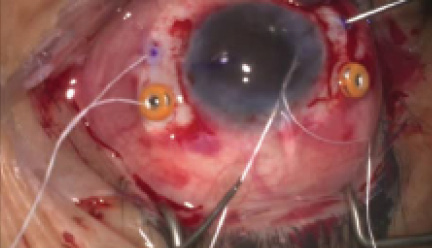
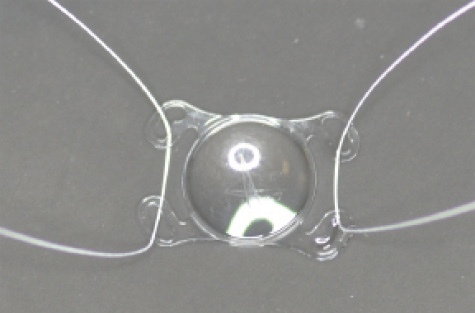
Figure 1. The suture is passed through the first IOL eyelet from anterior to posterior and then through the corresponding second eyelet from posterior to anterior. This pattern is then repeated on the contralateral side.
TECHNIQUE
A toric lens marker is used to mark the corneal limbus at two points in the horizontal plane 180° apart. Nasal and temporal conjunctival peritomies are created; hemostasis is maintained using external cautery. A standard infusion line for PPV is installed. The two remaining trocars are placed superotemporally and superonasally to the marked horizontal axis, 2 mm to 3 mm posterior to the limbus, using a straight-in, nontunneled approach. The introducers are then used to construct two additional sclerotomies, each 4 mm from one of the superonasal and superotemporal trocars, while maintaining the same 2- to 3-mm distance from the limbus.
Standard PPV is then performed. This technique is compatible with 23-, 25-, or 27-gauge instrumentation.
The anterior chamber is entered through a clear corneal incision that was created using a phaco keratome blade and then slightly enlarged. (A previously constructed incision can be used if cataract extraction was recently performed.) The anterior chamber is stabilized using a viscoelastic substance while the infusion line is clamped.
Next, the CV-8 needles of the 8-0 PFTE suture are removed, and the suture is cut into halves. Each suture end is threaded through the two adjacent eyelets of the Akreos AO60 IOL. The suture is passed through the first IOL eyelet from anterior to posterior and then through the corresponding second eyelet from posterior to anterior (Figure 1). This pattern is repeated on the contralateral side of the IOL. In a hand-to-hand technique, the two nasal or two temporal ends of PFTE suture are passed into the anterior chamber and pulled out of the corresponding sclerotomy using intraocular forceps.
The Akreos AO60 IOL can then be folded along its long axis using Kelman-McPherson or similar forceps and introduced into the anterior chamber. Once in the eye, the IOL is displaced into the posterior chamber, and each remaining end of the PFTE suture can be grasped and externalized through the respective sclerotomies using Max-Grip (Alcon) or similar serrated forceps. All four ends of the PFTE suture are then pulled, and tension is balanced to ensure that the IOL is well centered.
The trocars are removed, and then the sutures are tied using a 3-1-1 or adjustable slip-knot technique. The knots are trimmed, and nasal and temporal knots are buried into the sclerotomies that previously housed the trocars. The viscoelastic material is removed, and the corneal wound may be closed using a 10-0 nylon suture. The overlying conjunctival peritomy is closed, making sure the PFTE suture is completely covered.
Video 2: Scleral Fixation; VBS Recap

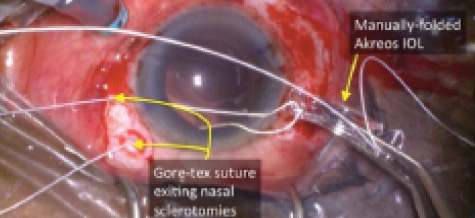
Figure 2. It is helpful to place the two nasal or two temporal ends of the Gore-Tex suture into the anterior chamber and externalize them through the sclerotomy sites before placing the IOL into the anterior chamber. This minimizes the number of free suture ends within the eye after placement of the IOL.
HELPFUL TIPS
First-time users of this technique tend to have questions regarding the handling of the suture ends within the eye, effective centration of the IOL, and adequate conjunctival and wound closure. The following tips may be helpful.
Management of Suture Ends
Keep track of the suture ends both within and outside the eye. We recommend placing the two nasal or two temporal ends of the PFTE suture into the anterior chamber and externalizing them through the sclerotomy sites prior to placing the IOL into the anterior chamber (Figure 2). This minimizes the number of free suture ends within the eye after placement of the IOL.
IOL Centration
The suture ends should not be tied so firmly as to create a “bowing” effect on the lens. It is helpful to first center the IOL and then incrementally adjust the suture tension on the nasal and temporal ends before tying a permanent knot. A slip knot may be helpful in this regard. Prior to locking the knots, a Lester or Sinskey hook can be used to displace the iris and visualize the IOL haptics to ensure that the suture is taut without crimping the haptics.
Wound Closure
Particularly in the setting of an extensive vitrectomy, sclerotomy sites may leak. To avoid postoperative hypotony, leaking sclerotomy sites should be sutured with 8-0 polyglactin suture. Care should be taken not to cut the PFTE suture that has been passed through the sclerotomy.
Use of Intraocular Air or Gas
Previous reports have noted opacification of acrylic IOLs, including the Akreos AO60 IOL, with use of intraocular air during Descemet stripping endothelial keratoplasty.6 Care must be taken if air or gas is required for a concurrent vitreoretinal surgery indication.
OUTCOMES
We recently published our short-term outcomes with this technique in a retrospective series of 85 eyes.5 With a mean final follow-up of 325 days, logMAR visual acuity improved from 1.43 ± 0.72 (20/538 Snellen equivalent) preoperatively to 0.64 ± 0.61 (20/87) postoperatively (P < .001) across varying surgical indications. No intraoperative complications were encountered. Transient hypotony, thought to be secondary to incompetence of 23-gauge wounds, was the most common postoperative complication, observed in eight eyes (9.4%). In all cases, hypotony resolved by postoperative day 30 without intervention. No suture-related complications, including breakage, erosion, IOL dislocation, or IOL tilt, were encountered. No cases of endophthalmitis or persistent postoperative inflammation were noted.
CONCLUSIONS
Ab externo scleral fixation of an Akreos AO60 IOL with PFTE suture can be effectively employed by any vitreoretinal surgeon and combined with standard three-port PPV. In our clinical experience, the technique has resulted in favorable visual outcomes with low rates of intraoperative and postoperative complications.
Formal evaluation of IOL position using ultrasound biomicroscopy and anterior segment optical coherence tomography is planned. Ultimately, evaluation of long-term outcomes will be necessary to better characterize the advantages and disadvantages of this technique. n

Omesh P. Gupta, MD, is an assistant professor of ophthalmology at Thomas Jefferson University Hospital, an attending surgeon at Wills Eye Hospital, and a partner at Mid Atlantic Retina, all of which are in Philadelphia, Pa. He has no financial interest in the material discussed in this article. Dr. Gupta may be reached at ogupta@midatlanticretina.com.

Jason Hsu, MD, is an assistant professor of ophthalmology at Thomas Jefferson University Hospital, and attending surgeon at Wills Eye Hospital, and a partner at Mid Atlantic Retina, all of which are in Philadelphia, Pa. He has no financial interest in the material discussed in this article. Dr. Hsu may be reached at jhsu@midatlanticretina.com.

M. Ali Khan, MD, is a clinical instructor at Thomas Jefferson University Hospital and a vitreoretinal surgery fellow at Wills Eye Hospital and Mid Atlantic Retina, all of which are in Philadelphia Pa. He has no financial interest in the material discussed in this article. Dr. Khan may be reached at akhan@midatlanticretina.com.
1. Wagoner MD, Cox TA, Ariyasu RG, et al. Intraocular lens implantation in the absence of capsular support: a report by the American Academy of Ophthalmology. Ophthalmology. 2003;110(4):840-859.
2. Khan MA, Gerstenblith AT, Dollin ML, et al. Scleral fixation of posterior chamber intraocular lenses using Gore-Tex suture with concurrent 23-gauge pars plana vitrectomy. Retina. 2014;34(7):1477-1480.
3. Price MO, Price FW Jr, Werner L, et al. Late dislocation of scleral-sutured posterior chamber intraocular lenses. J Cataract Refract Surg. 2005;31(7):1320-1326.
4. Parekh P, Green WR, Stark WJ, Akpek EK. Subluxation of suture-fixated posterior chamber intraocular lenses: a clinicopathologic study. Ophthalmology. 2007;114(2):232-237.
5. Khan MA, Gupta OP, Smith RG, et al. Scleral-fixation of intraocular lenses using Gore-Tex® suture: clinical outcomes and safety profile [published online ahead of print August 28, 2015]. Br J Ophthalmol.
6. Werner L, Wilbanks G, Nieuwendaal CP, et al. Localized opacification of hydrophilic acrylic intraocular lenses after procedures using intracameral injection of air or gas. J Cataract Refract Surg. 2015;41(1):199-207.


