



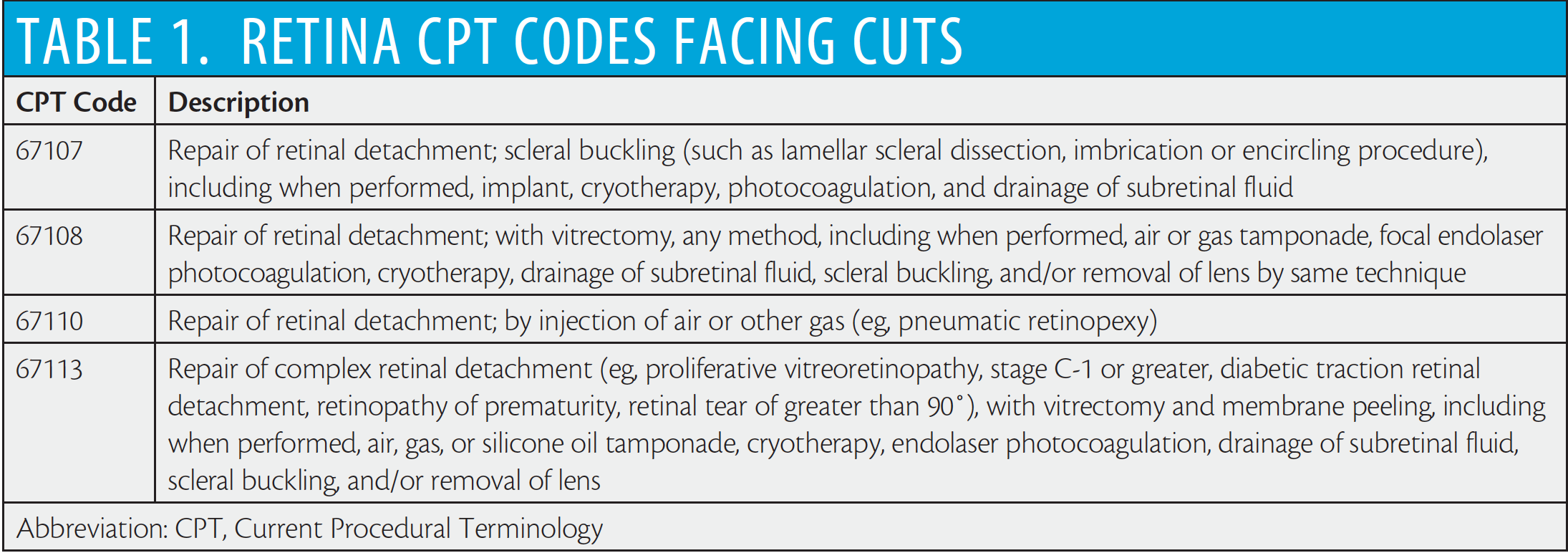
By now, retina specialists are feeling the pain wrought by significant cuts in Medicare payment for retinal detachment surgery. Particularly, cuts were enacted to Current Procedural Terminology (CPT) codes 67107, 67108, 67110, and 67113 beginning January 1, 2016 (Table 1). How did we get here? The Centers for Medicare and Medicaid Services (CMS) identified these four codes for revaluation by the American Medical Association Resource-based Relative Value Update Committee (RUC) in 2015 for implementation in 2016.
AT A GLANCE
• CMS, despite requests to the contrary from the RUC, has scheduled reduced payments for retinal detachment surgeries.
• Responding to the cuts, the AAO began working with Congress to urge CMS to not cut reimbursements for retinal detachment codes.
• Reimbursement cuts to in-office imaging are likely forthcoming, and the AAO is ready to respond.
This was a new step for ophthalmology, in part because three of these codes—67107, 67108, and 67110—had never been valued by the RUC. Consequently, each code carried values and times dating back to the 1992 inception of the Resource-based Relative Value Scale. The fourth code, 67113, was valued by the RUC in 2008 when a new CPT code was created for complex retinal detachment.
SURVEYED, AND THEN…
The four codes were surveyed in 2015 by approximately 15% of the pool of retina specialists who were requested to participate. This pool included members of the American Academy of Ophthalmology (AAO) and the American Society of Retina Specialists (ASRS). We found noticeable changes to these codes. The surveys demonstrated significant decreases in time from the previous valuations for all four codes. In particular, 67108 saw a decrease in intra-service (skin-to-skin) time from 191 minutes to 90 minutes (Table 2). This was somewhat expected, and reasonable.
Based on the surveys, the RUC recommended substantial cuts to the values. It did so, however, by acknowledging the intensity associated with retinal detachment repair. There is historical precedent for this, with CMS accepting the vast majority of RUC recommendations. But this time, CMS was not so accepting.
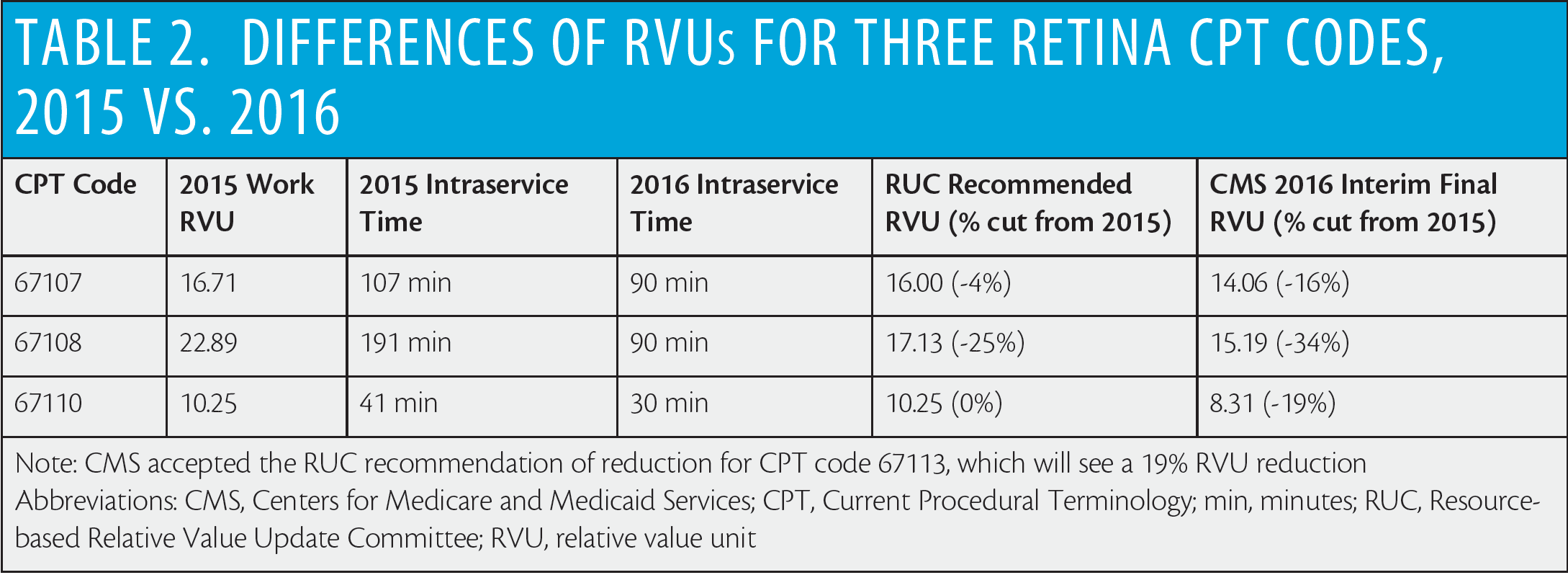
The AAO was stunned. When CMS released the final values that further cut the already large RUC cuts, it did so with an unprecedented rationale, in which a linear decrease in valuation was employed based on the decrease in time. In doing so, CMS completely ignored the intensity of retinal detachment repair. The AAO’s community of ophthalmologists believes that this rationale violates the legislative mandate requiring CMS to consider both time and intensity in determining payment.
Why CMS chose to implement this new rationale is unclear. However, we suspect that it may involve a requirement in the Medicare Access and CHIP Reauthorization Act (MACRA) of 2015. In this legislation, Congress mandated that CMS find $1 billion each year in “misvalued” services. The agency would repeat this exercise for 3 years. What happens if CMS does not find $1 billion? It would cut the conversion factor to make up the difference. That is why the conversion factor decreased by 0.29% in 2016 instead of increasing by the expected 0.5%.
ACTION ON CAPITOL HILL
These unanticipated and unjustified cuts have spurred organized ophthalmology into action. Although halting these codes is a tall task, it does not preclude ophthalmology from taking action to protect fair reimbursement rates for physicians.
Watch it Now
Update on Health Care Policy with David W. Parke II, MD, and Tim Murray, MD, MBA

The AAO immediately partnered with our subspecialty counterparts in ASRS and the Retina Society to protest not only the cuts, but also the new methodology CMS employed. Joining us in this complaint is the RUC, whose vehement objections to the time-based methodology are in recognition of the implications for future valuations throughout the rest of medicine.
We took these objections to a refinement panel in March. This multispecialty group of physicians, along with Medicare contractor medical directors, will review and discuss the work involved in the codes. This is the only formal appeal process allowed for contesting fee cuts, and, because the panel serves in an advisory capacity, CMS is under no obligation to follow the panel’s recommendations.
Knowing this, the AAO is mobilizing Congressional support for this cause via a letter campaign in the House of Representatives. This effort earned the support of 93 members of the House. Each signed one of two letters sent to CMS calling for the agency to reverse course on these cuts. Among these members are 35 with oversight of Medicare through their assignments to the House Committees on Ways and Means and on Energy and Commerce.
From the BMC Archive
From the SGR to MACRA:
Out of the Frying Pan and Into the Fire
George A. Williams, MD
Retina Today, September 2015
Find online at: bit.ly/williams0416
Meanwhile, a half-dozen of the biggest names in the Senate are rallying to ophthalmology’s side, telling CMS that it must revisit its drastic cuts to retina and glaucoma reimbursements. In a letter sent this week, ophthalmologist Sen. Rand Paul, MD (R-Ky.), and others pointed to the agency’s change in methodology, warning that it could trigger similar problems across other medical specialties.
The crowning moment of this advocacy came at a House Medicare oversight hearing by the Energy and Commerce Committee on March 16. Rep. Larry Bucshon, MD, (R-Ind.) demanded answers from a high-ranking CMS leader on why the agency has not followed the recommendations of the RUC for ophthalmology codes.
NEW CMS TARGETS EMERGE
Going forward, retina specialists are likely to see continued downward pressure on reimbursement, particularly in office-based imaging. In 2015, optical coherence tomography was revalued by the RUC. In January 2016, the RUC assigned new recommended values to fluorescein angiography and indocyanine green angiography and created a new code for combined fluorescein and indocyanine green angiography.
The CPT editorial panel made all of these codes bilateral. This means that separate billing for each eye is no longer allowed. Additionally, the RUC implemented new practice expense components recognizing the change from film to digital angiography. CMS will comment on the RUC recommendations in a preliminary rule that will be published in July 2016 for implementation in 2017.
Stay tuned. The hits just keep on coming, but our specialty is not down for the count. n
Section Editor George A. Williams, MD
• chair, department of ophthalmology, William Beaumont Hospital, Royal Oak, Mich.; professor and chair of ophthalmology, Oakland University William Beaumont School of Medicine, Royal Oak, Mich.; secretary of federal affairs, American Academy of Ophthalmology
• member of the Retina Today editorial board
• financial interest: none acknowledged
• gwilliams@beaumont.edu


