



A major milestone in the history of vitrectomy was the introduction of perfluorocarbon liquid (PFCL). Since Stanley Chang, MD, first used it to reattach retinas in eyes with retinal detachment (RD) caused by giant retinal tear,1 PFCL has become an indispensable tool. PFCL is labeled for use in primary or recurrent RD complicated by giant retinal tear, proliferative vitreoretinopathy, and penetrating ocular trauma. It is also used in other conditions to stabilize the retina and to identify breaks in regular RD, to float a dislocated crystalline lens or intraocular lens, and to evacuate hemorrhage from the subretinal or suprachoroidal space.
AT A GLANCE
• PFCL has many uses in managing patients with retinal pathologies.
• Retained subretinal PFCL is the most common complication associated with PFCL use.
• Several techniques can be used to remove subretinal PFCL; choice of technique may be dictated by the location of the PFCL.
PFCL has important properties, including high specific gravity, low viscosity, optical clarity, a refractive index different from that of saline, a boiling point higher than that of water, low surface tension, high interfacial tension, and immiscibility with water, blood, and silicone oil. It is important that retina surgeons understand these properties in order to use PFCL properly and to avoid complications. The most frequent complication encountered with use of PFCL is retained subretinal PFCL, which can occur for multiple reasons. This article reviews the risk factors associated with retained subretinal PFCL and presents ways to remove it when it occurs.
RETAINED SUBRETINAL PFCL
Subretinal PFCL can cause retinal damage resulting in scotoma, loss of visual acuity, retinal thinning, or retinal holes. Various studies report the incidence of subretinal PFCL to occur in zero to more than 10% of cases.2-4 Risk factors for retained subretinal PFCL include small bubbles of PFCL, large retinal breaks or retinotomies, a high velocity of infusion, retinal traction, and failure to perform saline rinsing during fluid-air exchange.
Small Bubbles of PFCL and Large Retinal Breaks
Small bubbles of PFCL can easily migrate into the subretinal space through retinal breaks. To prevent the formation of small bubbles, one must inject PFCL slowly and submerge the tip of the cannula in the formed PFCL bubble to make one large bubble. If one injects PFCL rapidly without submerging the tip of the cannula in the formed PFCL bubble, numerous PFCL bubbles with a fish-egg appearance are easily formed. These bubbles should be removed before the surface of the PFCL reaches the height of the retinal tears. A large retinal break is a risk factor for subretinal PFCL.
Watch it Now
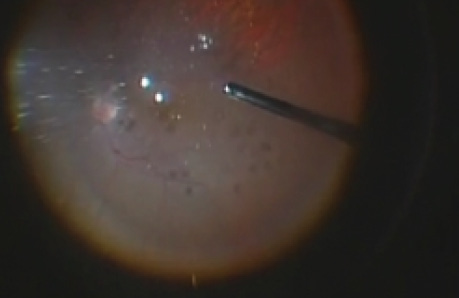
The jet stream from the infusion fluid during vitrectomy creates small bubbles on the large PFCL bubble.
High Velocity of Infusion
Surgeons should pay attention to the flow of infusion during vitrectomy. Turbulence at the interface between PFCL and saline solution caused by the jet stream of the infusion fluid may cause small bubbles of PFCL to form (Video). These bubbles may be noticed at the peripheral edge of the PFCL or as a shadow floating on the surface of the PFCL. A jet stream of infusion fluid may especially develop when scleral indentation is released. Scleral depression should be slowly released to avoid a rapid velocity of infusion. Use of nonvalved 23-gauge needles may also produce a high volume of infusion flow during the time instruments are out of the eye. This can produce numerous small satellite bubbles around the main bubble. Any small bubbles should be removed using aspiration.
Retinal Traction
Retinal traction is another risk factor for subretinal PFCL. One large bubble of PFCL can be injected safely above the level of retinal breaks without migrating into the subretinal space unless retinal traction exists. If there is traction on the retina, any size PFCL bubble could migrate into the subretinal space through a retinal break. Thus, relief of traction is important to prevent migration of PFCL into the subretinal space. When PFCL is injected close to the level of retinal breaks, it is possible to tell whether or not residual retinal traction exists. Traction should be relieved before injecting PFCL above the level of any retinal tear.
REMOVAL TECHNIQUE BASED ON LOCATION
There are several techniques for removing subfoveal PFCL. If subretinal PFCL is detected during or after vitrectomy, the approach to removing it may differ depending on its location.
Retained PFCL Under the Fovea
If the retained PFCL is under the fovea, it should be removed as soon as possible because it can cause visual acuity loss and central scotoma. A small retinotomy can be made at the edge of the subfoveal PFCL, and the PFCL can be aspirated using a fluted or a small-gauge (39-, 41-, or even 47-gauge) needle.
If a small subfoveal PFCL bubble or several subretinal PFCL bubbles are noted, it may be wise to use another technique. One may inject saline solution into the subretinal space using a small-gauge needle from outside the fovea to create an RD, enlarge the small retinotomy, and aspirate the subretinal PFCL along with any subretinal saline solution through the retinotomy using a fluted needle during fluid-air exchange. Note: Surgeons should carefully search for subretinal PFCL before doing a fluid-air exchange because it may be more difficult to identify after fluid-air exchange.
Retained PFCL Outside the Fovea
If a bubble of subretinal PFCL is found outside the fovea postoperatively, one may choose to observe and follow patients carefully, depending on the location of the subretinal PFCL. However, subretinal PFCL should be removed before it gets too close to the fovea. A subretinal PFCL bubble in the superior half of the globe, especially within the vascular arcade, may move closer to the fovea or even into the subfoveal space.
Subretinal PFCL outside the fovea may be removed directly and safely using a small-gauge needle. If the retinal break caused by the needle is small enough and no traction is evident, it may not be necessary to apply laser.
Removal may also not be necessary if the subretinal PFCL stays near or in the inferior half of the globe because it may remain there or move away from the fovea.
Retained PFCL in the Vitreous Cavity
Residual PFCL in the vitreous cavity may migrate into the anterior chamber postoperatively and cause visual disturbance, corneal endothelial loss, or elevation of intraocular pressure. Thus, if PFCL is found in the anterior chamber, it should be removed using a small-gauge needle at the slit lamp. Surgeons should remove PFCL completely from the vitreous cavity during vitrectomy.
Retained PFCL Under Air or Saline
Although PFCL under saline solution is easy to identify, it may be difficult to identify PFCL under air. Therefore, it is better to remove PFCL under saline, before fluid-air exchange, if possible. Saline rinse during fluid-air exchange is a useful technique to ensure complete removal of PFCL. I usually rinse three to four times during fluid-air exchange. After fluid-air exchange, even if one does not see any retained PFCL, it is wise to inject a small amount of saline to help identify PFCL so that it can be removed.
The vapor pressure of perfluoro-n-octane (Perfluoron Liquid, Alcon) is 50 mm Hg, which is higher than that of other PFCLs, and this allows it to evaporate easily. If perfluoro-n-octane is used, one can allow a small amount of it to evaporate under air for several minutes and thus avoid the risk of retained PFCL.
CONCLUSION
PFCL is a useful and indispensable adjunct in vitreous surgery, but complications can and do occur. Although any problems that arise can typically be resolved, they must be addressed as quickly as possible to avoid further issues such as scotoma, loss of visual acuity, retinal thinning, or retinal hole. Caution is key for surgeons using PFCL. n
1. Chang S. Low viscosity liquid fluorochemicals in vitreous surgery. Am J Ophthalmol. 1987;103:38-43.
2. Garcia-Valenzuela E, Ito Y, Abrams GW. Risk factors for retention of subretinal perfluorocarbon liquid in vitreoretinal surgery. Retina. 2004;24(5):746-752.
3. Garg SJ, Theventhiran AB. Retained subretinal perfluorocarbon liquid in microincision 23-gauge versus traditional 20-gauge vitrectomy for retinal detachment repair. Retina. 2012;32(10):2127-2132.
4. Shulman M, Sepah YJ, Chang S, et al. Management of retained subretinal perfluorocarbon liquid. Ophthalmic Surg Lasers Imaging Retina. 2013;44(6):577-583.
Section Editor Albert Augustin, MD
• professor and chairman of the department of ophthalmology, Staedtisches Klinikum Karlsruhe, in Karlsruhe, Germany
Section Editor Ehab N. El-Rayes, MD, PhD
• professor of ophthalmology, Institute of Ophthalmology in Cairo, Egypt; vitreoretinal consultant, The Retina Clinic, in Cairo, Egypt
Section Editor, Stanislao Rizzo, MD
• chair of the department of ophthalmology, University of Florence, in Florence, Italy
Masahito Ohji, MD
• professor and chairman, department of ophthalmology, Shiga University of Medical Science, in Otsu, Japan
• financial interest: grant recipient, consultant and lecturer for Alcon
• member of the Retina Today editorial advisory board and a section editor of Retina Today's Global Perspectives column
• eye.ohji@gmail.com


