



Rhegmatogenous retinal detachment (RRD) is the most common form of retinal detachment, and treatment of patients with RRD is one of the most common indications for vitreoretinal surgery. Ideally, RRD is repaired with a single surgical intervention; however, despite excellent skill and impeccable technique, surgeons are sometimes required to perform additional interventions to ultimately repair an RRD.
Proliferative vitreoretinopathy (PVR) that developsas a complication of RRD can be a frustrating clinical encounter. Indeed, management of recurrent RRD dueto associated PVR can be a humbling experience. Over the years I have collected several helpful tactics formanaging recurrent RRD caused by PVR, and I share these below.
AT A GLANCE
• Before treating recurrent RRD caused by PVR, be sure to thoroughly discuss the clinical situation and network.
• A variety of vital dyes can be used to aid in the removal of tractional PVR membranes.
• When performing retinectomy, stay as far anterior and peripheral as possible, and consider leaving temporary “spokes” to maintain the retina in suspended form until the procedure is complete.
TIPS AND TRICKS FOR TREATING RRD RELATED TO PVR
Patient Education and Chair Time
I thoroughly discuss the patient’s clinical situation and prognosis with the patient and his or her support network. Be sure to distinguish between visual and anatomic prognoses. Give them ample opportunity to ask questions, and make sure your answers are understood.
Take Your Time in the OR
In an era that rewards efficiency and speed, I make an effort to slow down. I do not let the scrub nurse, the clock, or an afternoon clinic rush me. Dean Eliott, MD, gave me this advice early in my career for approaching PVR cases, and it has served me and my patients well. I take my time, peeling every possible membrane thoroughly and deliberately to relieve as much PVR-associated traction on tissues as possible.
Buckle Up
If a scleral buckle was not placed during the previous surgery, I have a low threshold for placing an encircling scleral buckle at the time of reoperation if an extensive relaxing retinectomy is not planned to address the risk of subsequent tractional redetachment. Harry W. Flynn Jr, MD, taught me this, and I have never placed a scleral buckle during a reoperation that I subsequently regretted.
Remove All Tractional PVR Membranes
In order to carefully remove all tractional PVR membranes, I use various stains liberally. Triamcinolone is excellent for identifying residual vitreous; trypan blue is decent for staining PVR-associated tissues, if given sufficient contact time; and indocyanine green (ICG) is my go-to stain for ILM. If the membranes are not readily grasped with forceps, a flexible loop instrument can be useful to peel PVR-associated tissues. Try using a gentle sweeping motion from posterior to anterior in the midperiphery in regions containing membranes you wish to peel.
Peel the ILM
I typically peel ILM in all PVR reoperations unless there is good reason not to do so. The ILM can serve as a scaffold for PVR. I prefer to use ICG to visualize the ILM. I both apply it and remove it under air to minimize subretinal migration. I peel ILM as far into the periphery as possible—even beyond the edge of a planned retinectomy, if this is practical. Do all peeling before you begin a retinectomy.
Not All Subretinal Bands Need to Be Removed
If subretinal bands (SRBs) are extrafoveal and the retina reattaches evenly without tractional points and without removal of SRBs, consider leaving the SRBs in place. However, if the SRBs cause obvious retinal traction, remove them during an extramacular retinotomy.
With PFO, Use Valved Trocars and Lower the IOP
When I was in fellowship, Timothy G. Murray, MD, MBA, demonstrated the difference in fluidics between valved and nonvalved trocars when perfluoro-n-octane (PFO) liquid is used. I adopted the use of valved trocars and have never looked back. By lowering the intraocular pressure and using valved trocars, turbulance is minimized and PFO is stabilized, ensuring stability of the retina and minimizing risk of retained PFO droplets.
Retinectomy Considerations
Watch it Now
Chronic RD With Retinectomy
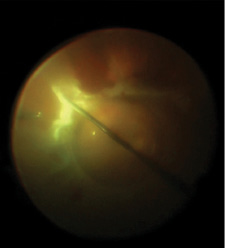
This case of a PVR-associated chronic retinal detachment with multiple inferior retinal breaks also included a macular hole. After peeling all PVR-associated tissues, Charles C. Wykoff, MD, PhD, performed an inferior retinectomy using the Eva vitrectomy system (Dutch Ophthalmic USA). Dr. Wykoff first stabilized the posterior pole with PFO liquid, then used diathermy intraoperatively to demarcate the area of planned retinectomy. He then left “spokes” of retina intact distal to the retinectomy site at every 2 to 3 clock hours to stabilize the retinectomy edge until the retinectomy was complete, at which time the spokes were removed. This reduced the risk of the edge of the retinectomy falling behind the PFO.
When a retinectomy is necessary for dealing with RRD caused by PVR, the pearls below may prove useful.
- Stay as far anterior and peripheral as possible.It is all too easy to remove retina that is more posterior than you initially thought. Place a PFO bubble posteriorly to protect the macula, and use the dynamics and mobility of the detached retina to determine exactly what retina you need to remove.
- Use diathermy to delineate where you plan to cut. Be meticulous with the posterior retinectomy edge, and use light diathermy as needed to avoid (all, if possible) hemorrhage at the edge. Hemorrhage can be a nidus for PVR reproliferation.
- When performing the actual retinectomy, consider leaving temporary sequential “spokes” like those on a bicycle wheel (Video).These will maintain the retina in a suspended form until you have extended the retinectomy as far circumferentially as needed. Take your retinectomy a little farther than needed. When finished with the procedure, remove the spokes and let the posterior retina fall flat under the PFO. If any of the retinectomy edges are rolled more than you like, consider using a flexible loop to flatten them under PFO.
- Do not apply laser too heavily along the posterior retinectomy edges. If all traction is relieved, a single or (at most) a double line of confluent light laser is adequate. One of my most memorable cases of this type was one that I managed with Audina M. Berrocal, MD. The patient developed additional retinal breaks that were likely due to laser that was applied too intensely. If I had followed this pointer, perhaps the breaks would not have occurred. Do not apply your laser too intensely!
I hope you find some or all of the above tips useful. Good luck with your PVR cases.
Section Editor Dean Eliott, MD
• associate director, retina service, Massachusetts Eye and Ear, Boston, Mass.
Section Editor Ingrid U. Scott, MD, MPH
• professor of ophthalmology and public health sciences, Penn State Eye Center, Penn State College of Medicine, Hershey, Pa.
Charles C. Wykoff, MD, PhD
• retina specialist at Retina Consultants of Houston, Blanton Eye Institute, and Houston Methodist Hospital, all in Texas; member of the Retina Today editorial advisory board
• financial disclosure: consultant, Alcon, Allergan, Alimera Sciences, Bayer, Clearside Biomedical, Dutch Ophthalmic USA, Genentech, ONL Therapeutics, Regeneron, ThromboGenics; speaker, Allergan, Regeneron; research support, Alcon, Allegro, Allergan, Apellis Pharmaceuticals, Clearside Biomedical, Iconic Therapeutics, Genentech, Regeneron, DRCR Network, Ophthotech, ThromboGenics, Tyrogenix
• @TXRetinaSurgeon; ccwmd@houstonretina.com


