


The technique of autologous neurosensory retinal transplant for repair of a refractory macular hole (MH) was described several years ago by Grewal and Mahmoud.1 Those authors noted that options are limited for repair of a MH that does not respond to conventional approaches to MH repair, including pars plana vitrectomy and internal limiting membrane (ILM) peeling. They described a technique in which a free flap of autologous neurosensory retina is harvested and positioned over a refractory MH to serve as a plug for the hole and a scaffold for glial cell proliferation.
AT A GLANCE
- Autologous neurosensory retinal transplant for repair of a refractory MH involves harvesting a free flap of autologous neurosensory retina and positioning it over a refractory MH to serve as a plug for the hole and a scaffold for glial cell proliferation.
- Here, the author describes his own technique for the closure of a MH via autologous neurosensory retinal transplant.
An international collaborative group subsequently evaluated autologous retinal transplantation for closure of refractory MH in a series of 41 eyes of 41 patients.2 The group reported anatomic closure of the MH in 88% of eyes. VA improved (≥ 0.3 logMAR units) in 15 eyes (36.6%), was stable in 17 eyes (41.5%), and worsened in 9 eyes (21.9%). In the eyes with anatomic closure, VA improved in 52.3% and worsened in 13.8%, whereas in eyes without closure, VA worsened in 20% and improved in none.
CASE REPORT
An elderly woman presented with a full-thickness MH and fairly long-standing (6 months) symptoms with 20/800 VA. Upon presentation, her MH was stage 4 and she underwent uncomplicated repair with ILM peeling and SF6 gas placement. Her macular hole did not close after the initial repair and she returned to the OR for a second surgery which included an ILM free-flap procedure. Despite the uncomplicated procedure and successful placement and retention of the ILM flap in the macular hole (along with attempts to manipulate the edges of the hole intraoperatively), the macular hole persisted with a size approaching 1,000 µm.
Watch it Now
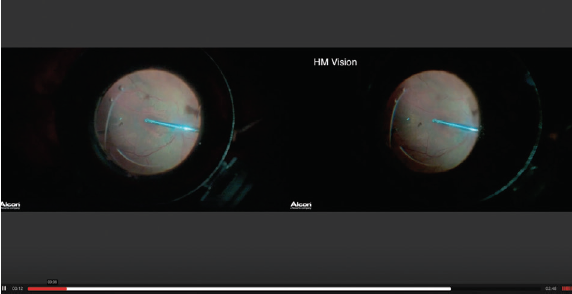
There were few alternatives remaining, and I felt that the best option was to perform an autologous retinal transplant. My technique, which differs somewhat from the published technique, is described below and can be viewed on Eyetube 3D (see Watch It Now). We utilized Alcon 25-gauge instrumentation, along with indocyanine green and perfluoro-octane (PFO) as described in the Video. Chandelier illumination (Alcon, 25 gauge) was essential in performing some of the bimanual portions of the procedure.
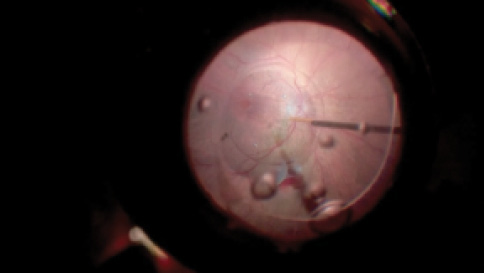
I first stained the ILM of the eccentric retina with ICG. This aided in identifying the inner retina in case the graft tissue was inadvertently “flipped.” I then used a 39-gauge subretinal cannula on the Viscous Fluid Control (Alcon) module to create a bleb of subretinal fluid in the area superior to the optic nerve (midperipheral) by injecting balanced salt solution in a standard subretinal fashion (Figure 1). I used diathermy to cauterize the two vessels leading into the area of the bleb to create hemostasis and minimize bleeding (Figure 2).
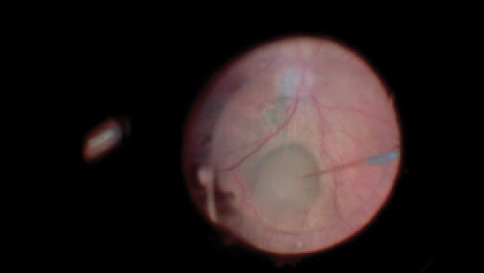
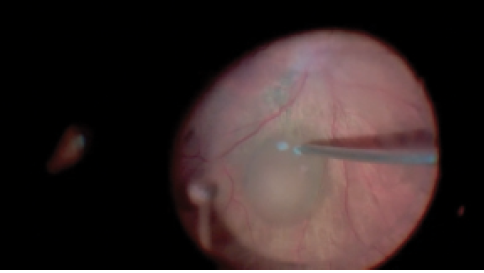
Figure 2. Diathermy is used to cauterize two vessels leading into the area of the bleb to create hemostasis.
I used a bimanual technique with 25-gauge curved scissors (Revolution Curved Scissors, Alcon) and forceps (#44 End Grasping Forceps, Alcon) to create a macular graft about 2 to 3 mm in diameter (Figure 3). I used the forceps to grasp tissue and pull it back while cutting with the scissors in the other hand.
I made the circumferential cut almost complete, leaving about 2 clock hours attached to hold it in place. If this is not done, the fluidics in the eye can cause the tissue to fly off, and the graft can be lost.
Once the flap was almost complete, I placed PFO liquid, not only over the macula but over the whole transplant site (Figure 4). This is important because it helps with control as the graft is moved.
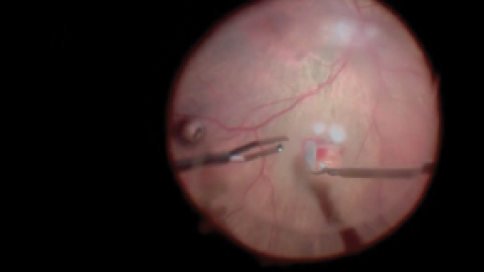
Figure 3. A bimanual technique is used to dissect a macular graft. The graft is almost completed, with about 2 clock hours of tissue left uncut to keep it in place.
With the PFO in place, I completed the dissection of the graft with the scissors, and I used the end-grasping forceps to carefully pull the transplant beneath the PFO and across to the macular area (Figure 5). The staining aided with orientation of the tissue, helping to maintain the ILM facing anteriorly as the graft was moved across the retina.
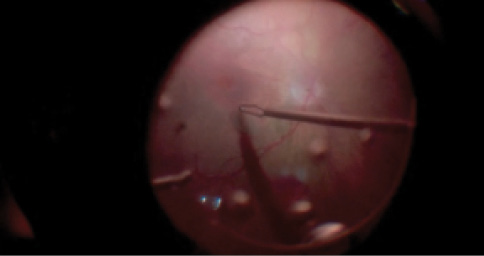
Figure 5. End-grasping forceps are used to carefully pull the transplant, beneath the PFO, across to the macular area.
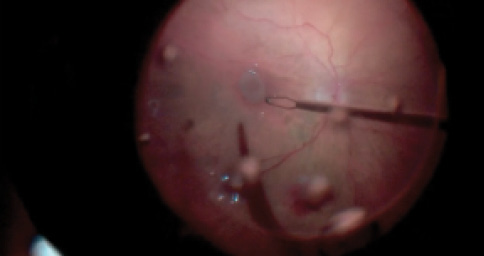
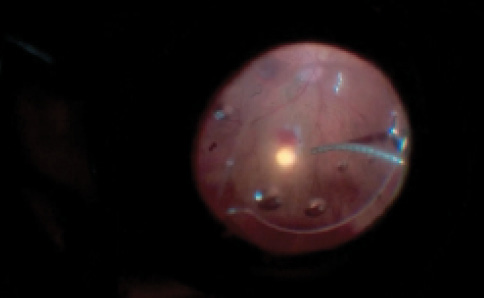
The graft covered the MH nicely, with a rim of about 100 µm of tissue on each side (Figure 6). Finally, I used laser to demarcate the graft harvest site (Figure 7).
Postoperatively, the PFO was left in place for 5 days, and the patient returned for PFO removal. During the 5 days, the patient maintained a prone (face-up) position as much as possible. The patient has done well, with recovery of vision to about 20/400 and a symptomatic improvement in her central scotoma.
In summary, autologous retinal transplantation for patients with recalcitrant, large MHs is a reasonable option. Although the technical procedure is somewhat difficult with the need for infrequently used techniques (subretinal injection, use of scissors, bimanual techniques), it can be a helpful way to approach these patients surgically.
1. Grewal DS, Mahmoud TH. Autologous neurosensory retinal free flap for closure of refractory myopic macular holes. JAMA Ophthalmol. 2016;134(2):229-230.
2. Grewal DS, Charles S, Parolini B, Kadonosono K, Mahmoud TH. Autologous retinal transplant for refractory macular holes: multicenter international collaborative study group [published online ahead of print January 31, 2019]. Ophthalmology.


