


Intraocular foreign body (IOFB) injuries may result in a wide range of pathology and visual outcomes. Metallic IOFBs are often associated with high velocity, and once they penetrate the cornea, they tend to enter the posterior segment.1-3 Additionally, IOFBs may present with varied clinical aspects that may limit their detection, and symptoms may only become apparent after a prolonged period of time.
However, in cases of visible IOFB, there are no clear guidelines regarding the need for additional imaging.
This report describes a unique case of a single penetrating wound with two metallic IOFBs, one of which would have been overlooked on a cursory clinical examination. It highlights the need for suspicion of additional foreign bodies even if one IOFB is clinically evident.
CASE
A healthy 24-year-old man presented urgently with a penetrating corneoscleral injury of the right eye following a reported history of a high-velocity projectile resulting from hammering a nail. He complained of poor vision, pain, and redness in the right eye.
His visual acuity was light perception in the right eye and 20/20 in the left. In the right eye, the conjunctiva was congested with a full thickness corneoscleral tear at 4 o’clock, extending 3 mm onto the cornea and 5 mm radially onto the sclera. The anterior chamber was shallow, and the pupil was mid-dilated with a relative afferent pupillary defect. Although a rosette cataract was present, the fundus could be visualized, showing a metallic IOFB embedded on the retina inferonasally (Figure, A). The macula showed a large retinal tear with an overlying hemorrhage (Figure, B).
The patient underwent fundus photography and emergency CT scan as per institution protocol. To our surprise, CT imaging revealed two separate IOFBs in the inferonasal aspect of the right eye (Figure, C).
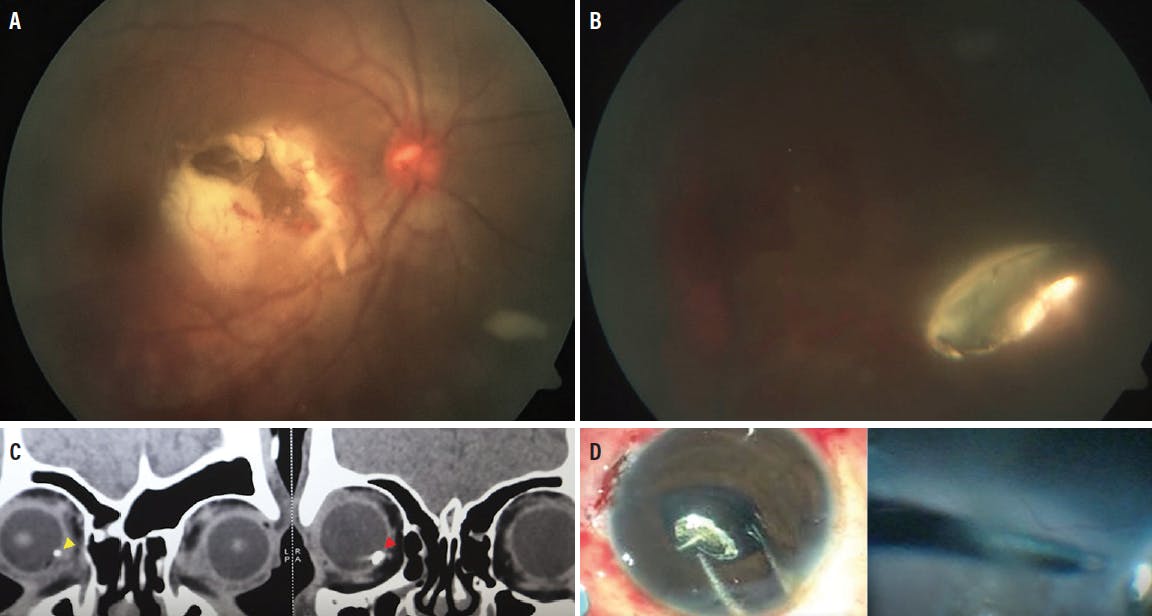
Figure: Fundus imaging reveals a large macular tear caused by a high-velocity impact (A). Note the large visible metallic IOFB on the inferonasal retina (B). A second IOFB, hidden in the inferonasal periphery, was localized with the help of a CT scan (C); the CT scan helped to localize the anterior smaller foreign body (left), while the larger foreign body is visible in a posterior scan (right). The larger visible foreign body was brought into the anterior chamber (left), and the smaller anterior foreign body in the periphery was localized with scleral indentation (right) (D).
The patient was scheduled for emergency 25-gauge pars plana vitrectomy and pars plana lensectomy with anterior capsulotomy. Posterior vitreous detachment nasally helped to avoid the extension of the macular tear. After vitrectomy, the larger of the two foreign bodies was removed through a clear corneal incision, while a thorough search with scleral indentation localized the second IOFB in the peripheral retina close to the ora (Figure, D). The second one was removed in a similar manner. Cryotherapy was applied to the peripheral break, followed by silicone oil tamponade. After silicone oil removal at 3 months postoperatively, visual acuity improved to counting fingers at 3 m with attached retina and scarring at the macula.
DISCUSSION
The identification of an additional foreign body can be challenging when the level of suspicion is low, as can be the case when one IOFB is clinically visible. General consensus is lacking regarding the need for imaging in cases with visible IOFB.
In one interventional case series of 69 eyes with IOFBs, 17 eyes had no imaging when the IOFB was easily visualized.1 The researchers also reported that two eyes had an additional IOFB identified on radiological evaluation. Thus, the authors recommended radiologic imaging even when an IOFB is clearly visible on clinical examination. A retrospective review of imaging techniques in IOFB cases demonstrated the superiority of CT scan over other methods.4
To the best of our knowledge, this is a unique report of two metallic IOFBs from a single entry site caused by a hammering accident. I speculate that the force of the IOFB’s impact on the macula may have caused the IOFB to split in two inside the eye. This case highlights the need for suspicion and imaging for additional IOFBs in the event of high velocity projectile injuries, even when one IOFB is clinically evident.
1. Woodcock MG, Scott RA, Huntbach J, Kirkby GR. Mass and shape as factors in intraocular foreign body injuries. Ophthalmology. 2006;113(12):2262-2269.
2. Roper-Hall MJ. Review of 555 cases of intra-ocular foreign body with special reference to prognosis. Br J Ophthalmol. 1954;38:65-99.
3. Percival SP. A decade of intraocular foreign bodies. Br J Ophthalmol. 1972;56:454-461.
4. Nie S, Wang Z, Liu W, Liang X. Clinical application of X-ray, B-scan, and CT in the diagnosis of ocular foreign bodies. Eye Sci. 2013;28(1):11-4.


