


You have had a eureka moment after identifying a gap in the practice of retina. Now that you have a new idea or product to improve patient care, where do you go from here? Whom should you talk to about this? Has someone already had this idea? Who is going to fund it?
AT A GLANCE
- The Winning Pitch Challenge is an independent organization that empowers ophthalmology innovators with resources and support.
- Participants submit innovation concepts and are paired with experienced industry mentors who provide guidance.
- A total of $45,000 in prize money is awarded to the top three participants.
The Winning Pitch Challenge (https://winningpitchchallenge.net) is an independent organization that empowers nascent ophthalmology innovators with resources and a support network to turn their ideas into reality. The signature event is a “Shark Tank”–style competition to help innovators in retina get their ideas off the ground. Here’s how it works:
(1) Participants submit innovation concepts and are paired with experienced industry mentors who provide guidance and advice on developing a pitch. These ideas are at early stages, generating little or no revenue. It is recommended that applicants have at least submitted a provisional application for a patent.
(2) Judges select three finalists who present their ideas to a panel of venture capital and industry veterans in a live event (the February 2021 presentations will be virtual due to the COVID-19 pandemic). A total of $45,000 in prize money is awarded to these top three participants. Beyond the prize money, participants gain the opportunity to work with industry mentors who critique and refine their ideas and engage with other participants in the ophthalmology innovation ecosystem.
Since 2017, numerous retina innovators have competed in this event, from seasoned clinicians to those just starting in practice. Their proposals have encompassed the full gamut of retina, from surgical devices and diagnostics to pharmacotherapeutics.
We gathered insights from the 2017 finalists of the Winning Pitch Challenge to learn how they began turning their ideas into reality. In a sidebar to this article, we also include comments from a mentor of the Challenge.
David Almeida, MD, MBA, PhD
- Erie Retina Surgery, Erie, Pennsylvania
- Innovation: CTX-1, a new therapeutic for dry AMD
Edwin Ryan, MD
- VitreoRetinal Surgery PA, St. Paul, Minnesota
- Innovation: Strip-based eye medication dispenser
Jeffrey S. Heier, MD (first place)
- Ophthalmic Consultants of Boston
- Innovation: iLoopes, assisted reality software as a low vision aid for smart glasses
How did you come up with your idea?
Dr. Almeida: Eric Chin, MD, (also a vitreoretinal surgeon) and I cofounded Citrus Therapeutics, a company centered around a pharmaceutical design philosophy of using multiple pharmacophores with multiple mechanisms of action to treat complex diseases such as dry AMD.
Dr. Ryan: I had noted when using fluorescein strips that the liquid I placed on the tip of the strip would often bead up as a droplet and wouldn’t fall off the strip. This led to the idea of using a strip dispenser as a new way to administer eye drops.
Dr. Heier: I was approached by an entrepreneur, a patient of mine who knew I was heavily involved in retina research. He asked if I would help him develop a low vision device that could help patients. We began to work with a team to design such a device, and then we had low vision patients test it.
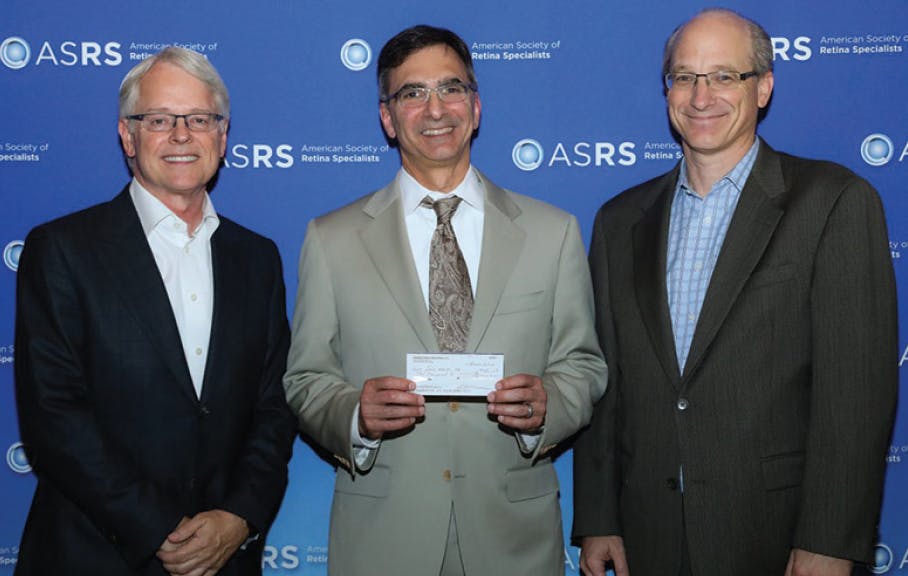
Dr. Heier, center, accepts the first-place prize during the 2017 Winning Pitch Challenge event. Joining him is David Williams, MD, at left, and John Pollack, MD, at right.
What prompted you to take time out of your schedule as a busy retina specialist to develop your idea?
Dr. Almeida: You have to derive satisfaction from the pursuit (pharmaceutical drug design), even if your ultimate destination (approved drug) is not reached. Just as important, having a cofounder like Eric who I trust and value makes the development journey and the associated investment of time a lot of fun.
Dr. Ryan: I have been a tinkerer for many years and have seen a number of inventions in the ophthalmology world become fairly successful, including the stiffening sleeve that Alcon uses to make 25- and 27-gauge tools stiffer. I like to solve problems.
Dr. Heier: My clinic was filled with patients who had vision loss from myriad diseases and who were desperate for any opportunity to improve their vision or their ability to function again. As we began to test our low vision device with patients, we began to realize that it could truly impact patients’ ability to navigate the real world.
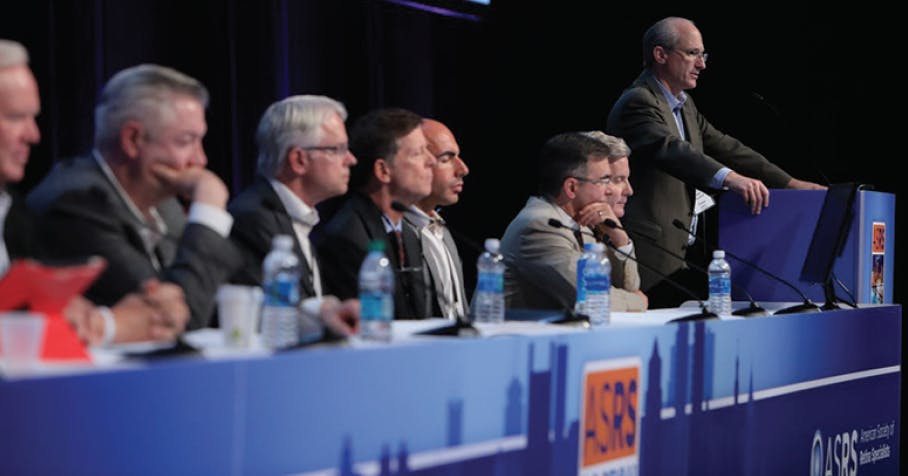
John Pollack, MD, flanked by the Winning Pitch Challenge panel, speaks to the audience during the 2017 presentation event.
Was it worth it, and what is one lesson you learned from going through the process?
Dr. Almeida: I believe it was worth it, but I also realize there is a cost to any project, and this may not hold the same value for everyone. The process of design, development, and testing—win or lose—is enlightening, never for the answers you find but for the questions you raise and the connections you make along the way.
Dr. Ryan: I learned that getting a product through design, development, prototyping, and all the other steps is a lot more involved than simply coming up with an instrument design and going directly to a manufacturer with it. It is safe to say that this was a humbling experience in that regard.
Dr. Heier: It was a remarkably valuable experience. I am heavily involved in retina research and often help with fundraising, but not as a direct participant. In this case, I experienced firsthand what it is like to sell your concept to investors, to strive to convey the value of your work to those who can help to determine whether your idea is worthy.
How did the Winning Pitch Challenge assist you in your project?
Dr. Almeida: The Winning Pitch Challenge was valuable in terms of the “Shark Tank”–style feedback we received and the network we developed in the process. The cross-pollination that occurs at the intersections of medicine, research, marketing, and venture funding has been instrumental in refining our hypotheses and continues to drive us in the pursuit of a successful endpoint.
Dr. Ryan: Having to put together a convincing and compelling pitch that I would be presenting to colleagues and knowledgeable business people without embarrassing myself really forced me to think through every aspect of my product and business model.
Dr. Heier: Winning the Winning Pitch Challenge provided validation of our concept and enabled us to better promote our concept to others. Potential collaborators and investors recognized that if such esteemed experts as the Winning Pitch Challenge panel believed our idea had merit, then they should as well.
Fostering The Next Generation
Michael Fanning, CEO of Vortex Surgical and a long-time mentor for The Winning Pitch Challenge, offered feedback on his experiences with the organization:
What has your experience been like as a mentor for the Winning Pitch Challenge?
Mr. Fanning: It has been amazing. I have greatly enjoyed the innovator engagement component, helping inventors channel their enthusiasm and product concepts into commercialized solutions. Doing so has provided me with a greater appreciation for the bandwidth of innovators—and their insatiable commitment to problem solving, which is the root of most meaningful innovations.
What one piece of advice would you give to young, aspiring retina specialists interested in innovating new products?
Mr. Fanning: Approach any new product development as you would a startup business. Understand what problem you are solving and have an appreciation of how big a problem you are solving.
TAKE THE PLUNGE
What should you do next with your bright idea? Ready to take the plunge? Submit your application for the Winning Pitch Challenge and take your first step toward translating your idea into a reality to help advance the field of retina.


