


AT A GLANCE
- Intraarterial chemotherapy (IAC) allows delivery of a relatively high drug concentration with less associated systemic toxicity than systemic chemotherapy for retinoblastoma.
- The conventional method of IAC for retinoblastoma involves the transfemoral approach that is commonly used in a variety of other neurovascular procedures.
- This article reports the use of a transradial approach in a patient with group D retinoblastoma.
Retinoblastoma is the most common primary intraocular pediatric malignancy, with an incidence of 8,000 cases worldwide each year.1 Goals of care include salvage of life, globe, and vision. Traditionally, this has been attempted through systemic chemotherapy, local thermotherapy or cryotherapy, and plaque or external-beam radiotherapy (EBRT).2
In the early 2000s, intraarterial chemotherapy (IAC) was added to the list of globe-conserving measures for retinoblastoma. Delivery of IAC classically involves catheterization of the ipsilateral femoral artery with transit into the aorta, carotid, and internal carotid arteries and then into the ophthalmic artery orifice, with chemotherapy delivered directly to the affected eye.
Studies show that IAC is remarkably powerful, even for advanced retinoblastoma, as it allows delivery of a relatively high drug concentration but is associated with less systemic toxicity (nausea, ototoxicity, neurotoxicity, pancytopenia, myelosuppression) than systemic chemotherapy.2-4 Ophthalmic complications with vascular occlusion can occur but have been greatly reduced in recent years.5,6 IAC has revolutionized management and become a mainstay of therapy for retinoblastoma over the past decade.3
The conventional method of IAC for retinoblastoma involves the transfemoral approach commonly used in a variety of other neurovascular procedures.2,7 In the adult population, a different approach is possible through the radial artery with catheterization at the wrist. This is used as an alternative route of access in interventional cardiology and, more recently, neurosurgery.2,8 The transradial approach is fast, especially in emergency procedures to remove blood clots in stroke victims, and it leads to short recovery times and low incidence of local complications such as hematoma, paresthesia, hand ischemia, and compartment syndrome.8
Currently, no established criteria exist for choosing the transradial over the transfemoral approach in neurovascular procedures, but some believe the transradial approach could be beneficial in pediatric patients to reduce bleeding complications. The transfemoral approach has been associated with the risk of retroperitoneal compartment bleeding, and it requires postoperative sedation to avoid lower extremity movement.2
In this article, we describe the first case, to the best of our knowledge, of transradial IAC for treatment of retinoblastoma.
CASE REPORT
A 13-year-old White female with no pertinent medical history presented with a report of 5 months of floaters and decreased vision in the right eye. She was found to have a retinal mass in that eye and was referred to the Wills Eye Hospital Ocular Oncology Service for further evaluation and management.
On our initial examination, her BCVA was 20/150 OD and 20/25 OS. The anterior segment examination was unremarkable in both eyes, without leukocoria. Fundoscopic examination of the left eye was normal, but the right eye showed an ill-defined, solid, endophytic mass inferotemporally with extensive large overlying active vitreous seeds (Figure 1A). The mass was estimated to be 20 mm in basal diameter and 8 mm in thickness.
On B-scan ultrasonography, the mass blended into the vitreous seeds and demonstrated a few focal areas of calcification (Figure 1B). Orbital magnetic resonance imaging demonstrated no optic nerve invasion. The eye was classified as group D retinoblastoma based on the International Classification of Retinoblastoma system.
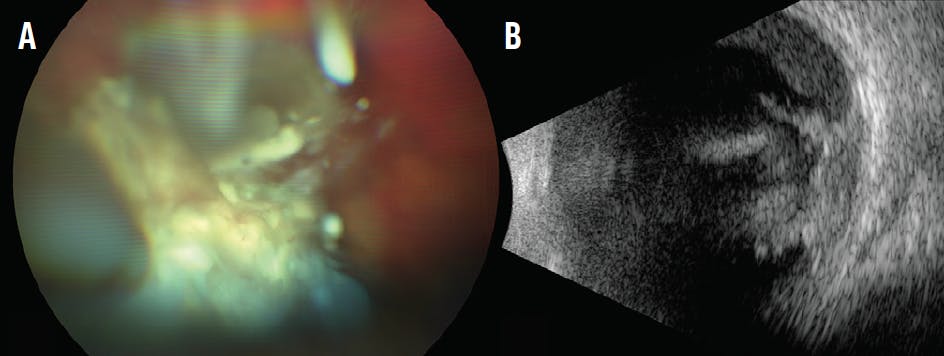
Figure 1. Fundus photograph of the right eye showing group D endophytic retinoblastoma inferotemporally measuring 20 mm in diameter with overlying vitreous seeds (A). On B-scan ultrasonography, the tumor was echodense and measured 8 mm in thickness (B).
Management with enucleation or IAC was discussed with the family, and IAC with the addition of intravitreal chemotherapy was preferred in an attempt to salvage the globe.
Accordingly, IAC was performed. But in this case, the catheterization was achieved through the radial artery, not the femoral artery. Using this method, intraarterial melphalan and topotecan were infused over a span of 30 minutes each into the ophthalmic artery.2,9
At 1-month follow-up, the tumor had regressed to 14 mm in basal diameter and 5.9 mm in thickness (Figure 2). However, due to the continued presence of extensive vitreous seeding, additional management with intravitreal chemotherapy was provided.
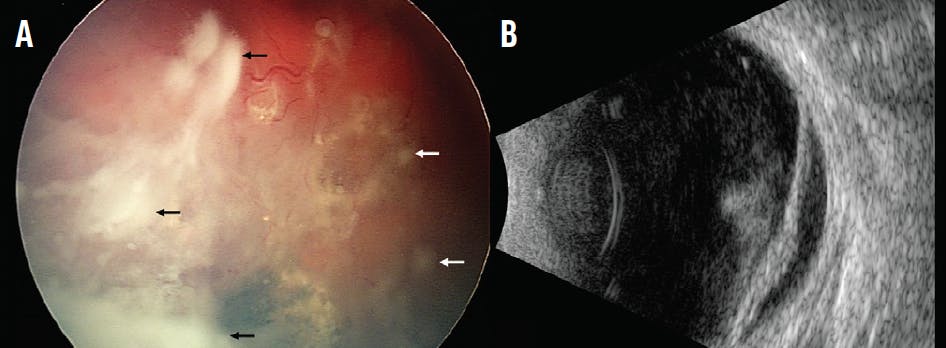
Figure 2. At 1-month follow-up, and after one cycle of IAC using the transradial approach, fundus photograph of the right eye showed significant tumor regression to 14 mm in diameter; however, due to the presence of extensive vitreous seeds (arrows), treatment with intravitreal chemotherapy was initiated (A). On B-scan ultrasonography, tumor thickness had decreased to 5.9 mm (B).
At 3-month follow-up, the patient was noted to have open retinal holes at the site of previous endophytic tumor with rhegmatogenous retinal detachment. This was repaired with a scleral buckle without drainage.10
After four cycles of transradial IAC and five injections of intravitreal chemotherapy, complete tumor control was achieved. At 15-month follow-up, BCVA was 20/70 OD and 20/20 OS. The right eye showed complete regression of the retinoblastoma to a calcified scar with no active vitreous or subretinal seeds and a completely flat retina (Figure 3A and 3B).
Macular OCT of the right eye showed an intact fovea with slight ellipsoid irregularity, likely accounting for the patient’s visual acuity of 20/70 OD (Figure 3C). Macular OCT of the left eye was normal (Figure 3D).
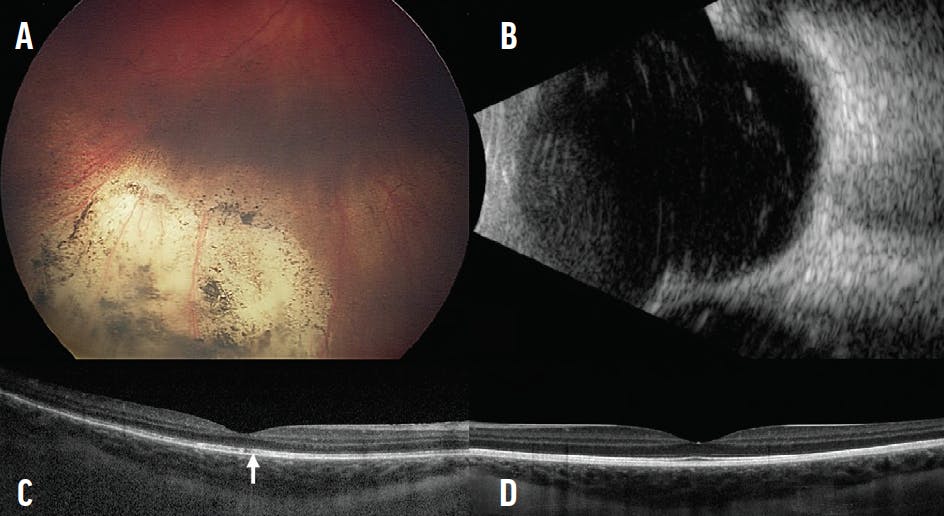
Figure 3. At 15-month follow-up, after four cycles of IAC and five cycles of intravitreal chemotherapy, there was complete regression of the tumor to a flat, calcified scar overlying a recent scleral buckle (A), which can also be seen on B-scan ultrasonography (B). On macular OCT, the fovea in the right eye was intact, but slight ellipsoid irregularity (arrow) was noted, likely accounting for the patient’s visual acuity of 20/70 OD (C). Macular OCT in the left eye was normal (D).
DISCUSSION
Retinoblastoma is a life-threatening but curable intraocular malignancy. Over the past few decades, treatment options have evolved to allow remarkable tumor control and globe salvage.11 Targeted therapy with IAC has quickly gained popularity as a first- and second-line treatment.3,11 IAC is the preferred treatment for patients older than 3 months with nongermline mutation retinoblastoma, unilateral retinoblastoma, recurrent retinoblastoma after previous therapy, and recurrent subretinal or vitreous seeds.9
A recent survey found that 74% of responding centers treating retinoblastoma worldwide use IAC in patients with unilateral advanced disease.12 The availability of IAC has dramatically altered patient outcomes and reduced the need for enucleation from 80% to approximately 28% to 33% in eyes treated with primary IAC.2,6,13
Compared with systemic intravenous chemotherapy for unilateral retinoblastoma, IAC provides significantly better outcomes in control of solid tumor (62% vs 92%, P = .002), subretinal seeds (31% vs 86%, P = .006), and vitreous seeds (25% vs 74%, P = .006), along with significantly higher rates of globe salvage for group D eyes (48% vs 91%, P = .004).14
Moreover, events of metastatic death are rare in patients treated with IAC. A multicenter international survey including 1,139 patients with retinoblastoma found a less than 1% incidence of metastatic death after IAC.15 Similarly, a previous study at a single ocular oncology center analyzed the effectiveness of IAC in patients older than 5 years and found 62% globe salvage with no metastasis or death at 14-month median follow-up.16
Although many studies have demonstrated the safety and efficacy of IAC, the procedure remains technically challenging because it requires the involvement of highly specialized neurosurgical or neurointerventional teams.9,17 For most procedures, including IAC, interventionalists almost exclusively use the transfemoral approach, as data supporting the use of the transradial approach are limited.2 However, studies in interventional cardiology show that the transradial approach decreases overall adverse clinical events by reducing major bleeding and all-cause mortality.18
Al Saiegh et al first demonstrated the safety and feasibility of transradial IAC for retinoblastoma in 10 procedures in five pediatric patients, including our patient described here.2 Because this patient had reached puberty at the time of her first IAC, the neurosurgery team was able to use the same catheter commonly used for a transfemoral approach. In contrast, the other four patients in the series required a more technical procedure due to the smaller caliber of the radial artery.
The authors concluded that, given the technical nuances and limitations of the transradial approach, the transfemoral approach will remain the first choice for infants and young children. Still, as demonstrated by their case series and this case report, the transradial route can be an effective and feasible method for the treatment of retinoblastoma.2
The patient here was discharged home after 1 hour in the postanesthesia care unit and demonstrated treatment results similar to those expected with use of the transfemoral approach. At 15-month follow-up, there was complete regression of the tumor with no evidence of active disease.
CONCLUSION
The emergence of IAC has led to remarkable advances in the treatment of retinoblastoma. Eyes that would previously have been enucleated are now salvaged at rates of 100% for groups B and C, 86% for group D, and 55% for group E at 5 years.19 Increasing surgical experience and technical advances have allowed the introduction of additional indications for IAC and continued improvements in patient outcomes, including vision salvage.20
Although IAC is almost exclusively administered through the femoral artery, implementing the transradial approach could be the next advance in treatment with this modality. As more experience is gained with the transradial approach and more retinoblastoma centers adopt its use, larger studies can further support its effectiveness and safety.
1. Kivelä T. The epidemiological challenge of the most frequent eye cancer: Retinoblastoma, an issue of birth and death. Br J Ophthalmol. 2009;93(9):1129-1131.
2. Al Saiegh F, Chalouhi N, Sweid A, et al. Intra-arterial chemotherapy for retinoblastoma via the transradial route: Technique, feasibility, and case series. Clin Neurol Neurosurg. 2020;194:105824.
3. Batu Oto B, Sarıcı AM, Kızılkılıç O. Superselective intra-arterial chemotherapy treatment for retinoblastoma: Clinical experience from a tertiary referral centre. Can J Ophthalmol. 2020;S0008-4182(19)30821-X.
4. Manjandavida FP, Stathopoulos C, Zhang J, Honavar SG, Shields CL. Intra-arterial chemotherapy in retinoblastoma - a paradigm change [published correction appears in Indian J Ophthalmol. 2019;67(8):1385]. Indian J Ophthalmol. 2019;67(6):740-754.
5. Dalvin LA, Ancona-Lezama D, Lucio-Alvarez JA, Masoomian B, Jabbour P, Shields CL. Ophthalmic vascular events after primary unilateral intra-arterial chemotherapy for retinoblastoma in early and recent eras [published correction appears in Ophthalmology. 2019;126(1):176-177]. Ophthalmology. 2018;125(11):1803-1811.
6. Ancona-Lezama D, Dalvin LA, Lucio-Alvarez JA, Jabbour P, Shields CL. Ophthalmic vascular events after intra-arterial chemotherapy for retinoblastoma: Real-world comparison between primary and secondary treatments. Retina. 2019;39(12):2264-2272.
7. Wolfe TJ, Hussain SI, Lynch JR, Fitzsimmons BF, Zaidat OO. Pediatric cerebral angiography: Analysis of utilization and findings. Pediatr Neurol. 2009;40(2):98-101.
8. Khanna O, Sweid A, Mouchtouris N, et al. Radial artery catheterization for neuroendovascular procedures. Stroke. 2019;50(9):2587-2590.
9. Shields CL, Lally SE, Leahey AM, et al. Targeted retinoblastoma management: when to use intravenous, intra-arterial, periocular, and intravitreal chemotherapy. Curr Opin Ophthalmol. 2014;25(5):374-385.
10. Shields CL, Say EAT, Pefkianaki M, et al. Rhegmatogenous retinal detachment after intraarterial chemotherapy for retinoblastoma: The 2016 Founders Award Lecture. Retina. 2017;37(8):1441-1450.
11. Munier FL, Beck-Popovic M, Chantada GL, et al. Conservative management of retinoblastoma: Challenging orthodoxy without compromising the state of metastatic grace. “Alive, with good vision and no comorbidity” [published correction appears in Prog Retin Eye Res. 2020 Apr 8;100857]. Prog Retin Eye Res. 2019;73:100764.
12. Grigorovski N, Lucena E, Mattosinho C, et al. Use of intra-arterial chemotherapy for retinoblastoma: results of a survey. Int J Ophthalmol. 2014;7(4):726-730.
13. Shields CL, Manjandavida FP, Lally SE, et al. Intra-arterial chemotherapy for retinoblastoma in 70 eyes: Outcomes based on the international classification of retinoblastoma. Ophthalmology. 2014;121(7):1453-1460.
14. Shields CL, Jorge R, Say EA, et al. Unilateral retinoblastoma managed with intravenous chemotherapy versus intra-arterial chemotherapy. Outcomes based on the International Classification of Retinoblastoma. Asia Pac J Ophthalmol (Phila). 2016;5(2):97-103.
15. Abramson DH, Shields CL, Jabbour P, et al. Metastatic deaths in retinoblastoma patients treated with intraarterial chemotherapy (ophthalmic artery chemosurgery) worldwide. Int J Retina Vitreous. 2017;3:40.
16. Selzer EB, Welch RJ, Jabbour P, Leahey AM, Shields CL. Management of retinoblastoma in older children (>5 years) using intra-arterial chemotherapy: Comparison of outcomes to prechemotherapy and intravenous chemotherapy eras. Indian J Ophthalmol. 2019;67(12):2005-2011.
17. Rojanaporn D, Chanthanaphak E, Boonyaopas R, Sujirakul T, Hongeng S, Ayudhaya SSN. Intra-arterial chemotherapy for retinoblastoma: 8-year experience from a tertiary referral institute in Thailand. Asia Pac J Ophthalmol (Phila). 2019;8(3):211-217.
18. Valgimigli M, Gagnor A, Calabró P, et al. Radial versus femoral access in patients with acute coronary syndromes undergoing invasive management: A randomised multicentre trial. Lancet. 2015;385(9986):2465-2476.
19. Shields CL, Dockery PW, Yaghy A, et al. Intra-arterial chemotherapy for retinoblastoma in 341 consecutive eyes (1292 infusions): Comparative analysis of outcomes based on patient age, race, and sex. J AAPOS 2021. In press.
20. Sweid A, Jabbour P. Intra-arterial chemotherapy for retinoblastoma: transradial and transfemoral approach. J Neurointerv Surg. 2020;12(8):828.


