




AT A GLANCE
- Establish goals for surgery, including an estimation of visual potential.
- Many cases can be successfully managed with use of the cutter alone to dissect and/or segment diabetic membranes.
- At the conclusion of surgery, consider lowering the infusion pressure to 10 to 15 mm Hg to look for bleeding that may not occur when the infusion pressure is at 25 mm Hg or higher.
Complications from diabetic retinopathy (DR) are a leading cause of visual impairment in working-aged individuals in the United States.1 Our armamentarium for treating DR in the office continues to grow, now including panretinal photocoagulation (PRP), anti-VEGF therapy, and promising clinical trials of more durable agents, including gene therapy. Nonetheless, many patients still require surgical management for complications of DR.2-4
Indications for pars plana vitrectomy (PPV) in patients with DR include vitreous hemorrhage, retinal detachment, and recalcitrant diabetic macular edema.5,6 Vitrectomy may also benefit patients with neovascular glaucoma and fibrovascular complications such as epiretinal membrane. Case complexity can range from simple to the most advanced, while surgical goals can vary from restoring 20/20 vision to preventing phthisis.
Despite the varied surgical indications and case complexity, surgeons can follow several basic principles to help ensure surgical success. In this article we share nine pearls to help you optimize vitreoretinal surgical outcomes in patients with diabetic retinopathy.
PREOPERATIVE CONSIDERATIONS
Pearl No. 1: Establish Goals and Confirm Informed Consent
This may be the most important tip: be sure that both you and the patient are ready to operate. Establish goals for surgery, including an estimation of visual potential as guided by your preoperative examination and, possibly, fluorescein angiography or OCT angiography.
This is important to ensure that the patient has realistic expectations regarding postoperative vision. Visual acuity in the fellow eye and history of complications from any prior surgery are important for context. Similarly, it is always crucial to ensure the patient understands that multiple surgeries may be necessary if the underlying systemic disease remains uncontrolled. Implementing the best systemic and ocular management of each patient’s diabetes and DR before surgery is critical for surgical success.
Even with the best interventions, some patients will experience poor visual outcomes, as intraoperative bleeding or progression of ischemia can result in irreversible blindness. The patient and surgeon must accept this possibility before agreeing to move forward with surgery.
Pearl No. 2: If Possible, Place PRP
When the view of the retina allows it, placement of PRP in patients with severe or proliferative DR with high-risk characteristics is a critical preoperative step.7 Naïve neovascular fronds and fibrovascular membranes are often more difficult to dissect than inactive, fibrotic plaques and are more likely to bleed intraoperatively (Figure 1). One study found that incomplete PRP prior to vitrectomy was a risk factor for postoperative vitreous hemorrhage.8 In addition, PRP provides an area of tacked-down retina from which the hyaloid can be removed. Even if all quadrants are not visible, placing PRP in a single quadrant can be helpful. In some cases, placement of PRP may stabilize focal extramacular tractional retinal detachments (TRDs) and preclude the need for surgery.
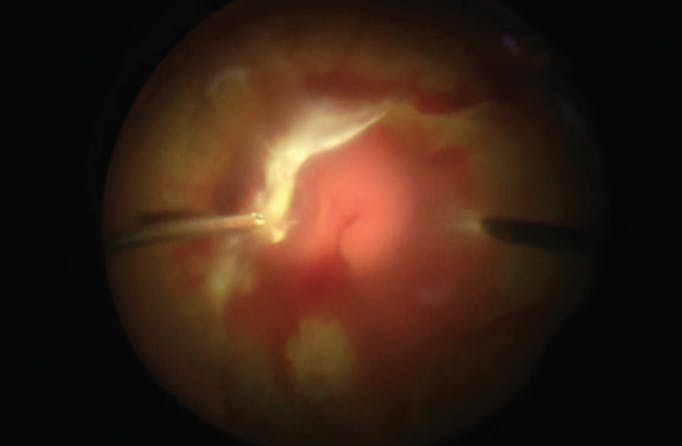
Figure 1. In this left eye undergoing diabetic TRD repair, intraoperative bleeding from neovascular fronds resulted in the formation of a pseudomembrane overlying the macula.
Preoperative PRP treatment also offers a chance to form and foster the treatment pact between the physician and patient—an important aspect of care, particularly for patients who require a long, nuanced course of treatment.
Pearl No. 3: Perioperative Anti-VEGF Therapy Reduces Intraoperative Complications
Several studies have demonstrated that perioperative anti-VEGF therapy results in decreased operative times, fewer iatrogenic breaks, and reduced risk of intraoperative hemorrhage in patients with diabetes undergoing vitrectomy.9-12
Use of perioperative anti-VEGF therapy was previously controversial, particularly in patients with TRD, given the concern for abrupt progression, or “crunch,” of TRD after anti-VEGF injection.13 Thus, we recommend treating with anti-VEGF approximately 3 to 7 days before surgery. This time interval may allow regression of neovascular tissue without significant fibrovascular contraction.
INTRAOPERATIVE CONSIDERATIONS
Pearl No. 4: Handle the Hyaloid
The initial steps of diabetic vitrectomy often include removal of anterior-to-posterior traction and lifting and removal of the posterior hyaloid attachment. No matter how difficult or inoperable a TRD may seem, success can be achieved with a disciplined approach (Figure 2).
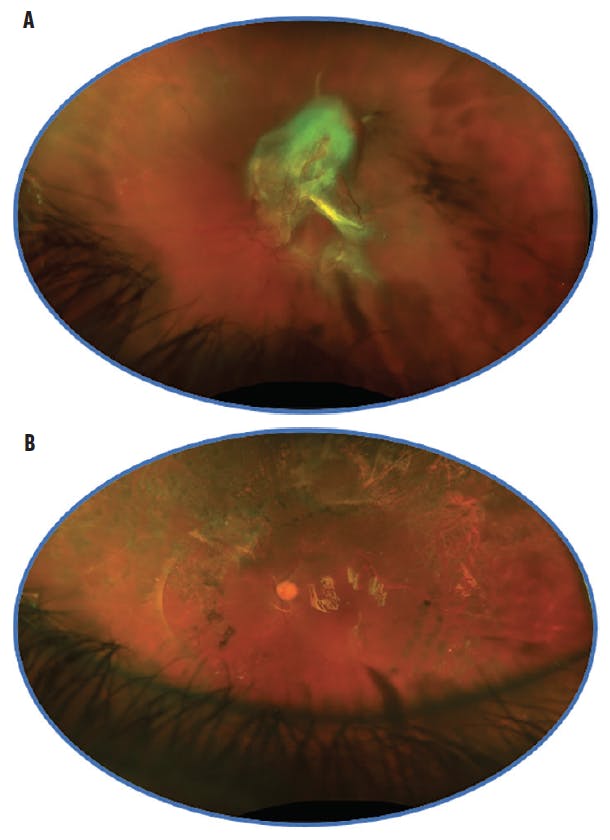
Figure 2. A 47-year-old patient with an advanced, macula-involving TRD (A) underwent vitrectomy, membrane peel, PRP, and silicone oil tamponade. Three months postoperatively, the retina was attached with significant improvement in DR severity (B).
Removal of the hyaloid has numerous benefits, although it can be one of the most difficult aspects of a challenging TRD in a young patient (eg, younger than age 40) with diabetes. In some instances of recurrent vitreous hemorrhage after initial diabetic PPV, persistent traction from a retained hyaloid can lead to traction on neovascularization elsewhere, despite full PRP (Video 1).
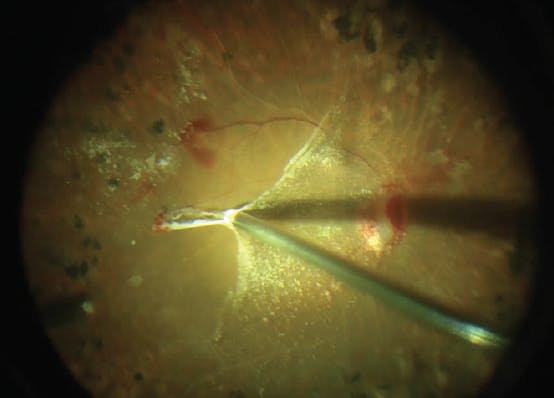
Video 1. Hyaloid Removal in Diabetic Vitrectomy
In addition, removing the hyaloid establishes the correct surgical plane, which can aid in removal of any fibrovascular membranes. Nevertheless, there may be some instances in which the hyaloid is tightly adherent in the periphery, and you may not be able to safely complete its removal during an initial surgery.
Pearl No. 5: Choose the Right Instruments
Use of 23-, 25-, or 27-gauge instrumentation with valved cannulas is now the standard for diabetic vitrectomy.14 Valved cannulas create a closed system, allowing good IOP control that can limit bleeding during instrument exchanges.
Multiple manufacturers offer instruments, in all gauge sizes, commonly used for diabetic vitrectomy, including scissors (horizontal, vertical, or pneumatic), lighted picks, intraocular forceps such as the Maxgrip (Greishaber/Alcon) or ILM-style forceps, and chandelier light sources for use with bimaual techniques. Learning what instrumentation your surgical facility has available is an important exercise to undertake before surgery.
Several factors come into play in choosing gauge size. Larger 23-gauge instrumentation can offer more rigidity, easier and faster clearance of dispersed hemorrhage, and better access to peripheral vitreous gel removal. Smaller-gauge instruments, in particular vitreous cutters, provide a reduced sphere of influence that can make dissection of membranes more precise and reduce iatrogenic breaks. Small-gauge and beveled cutters also place the cutting port closer to the end of the instrument, which may allow better access to membranes and potential space.15
Given the small gauge and improved fluidics of vitreous cutters, many cases can be successfully managed with use of the cutter alone to dissect and/or segment diabetic membranes. Consider switching to a 27-gauge cutter before moving to a bimanual technique.
Because different gauges provide different benefits, hybrid vitrectomy—the use of valved cannulas and instruments with multiple gauges—can be useful in some instances. Hybrid vitrectomy allows the surgeon to capitalize on the entire breadth and variety of tools available (Video 2).16
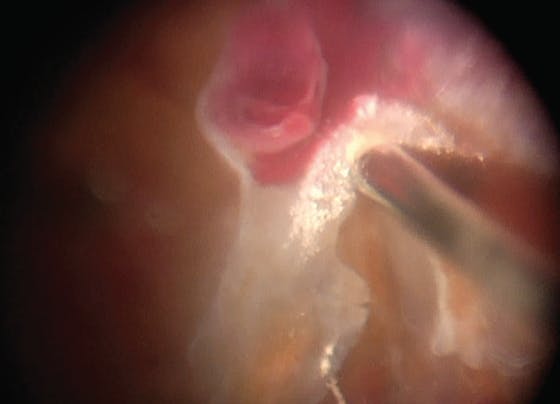
Video 2. Hybrid Vitrectomy in Diabetic Tractional Retinal Detachment
Pearl No. 6: Maintain Hemostasis
You must control bleeding early and throughout surgery. Prolonged and uncontrolled bleeding can obscure the source of the hemorrhage, and pseudomembranes can form as the blood coagulates, leading to further difficulty in dissecting membranes. Elevated tamponade pressure can be helpful, but you must address the underlying source of the bleeding with diathermy or long-duration endolaser. Prolonged tamponade pressure can lead to premature corneal edema, worsening of ischemia, and optic neuropathy.
At the conclusion of surgery, consider lowering the infusion pressure to 10 to 15 mm Hg to look for bleeding that may not occur when the pressure is at 25 mm Hg or higher. Also, have a low threshold to suture sclerotomies to reduce postoperative hypotony that can lead to hemorrhage.
Pearl No. 7: Improve Your View
Visualization is paramount, especially in eyes that require extensive dissection and long operative times. The corneal epithelium is fragile in diabetics, and the benzalkonium chloride in your hydroxypropyl methylcellulose formulation can degrade the cornea; consider using other viscoelastic agents, such as Ocucoat (Bausch + Lomb), Genteal (Alcon), or Refresh gel (Allergan). In phakic patients, adding dextrose to the balanced salt solution infusion helps to minimize lens opacity intraoperatively. In fact, in patients with more advanced cataract it may be best to consider combined cataract extraction to provide a clear view for vitrectomy.
Lastly, intravitreal triamcinolone can be helpful to visualize the hyaloid. Vitreoschisis has been reported in patients with diabetes, highlighting the utility of repeated rounds of triamcinolone staining.17
Pearl No. 8: Identify and Address Rhegmatogneous Breaks
It is vital to identify and address any full thickness breaks, especially in eyes with combined TRD/rhegmatogenous retinal detachment or when an iatrogenic break is encountered during vitrectomy. Ensure that any fibrovascular tissue is dissected away from retinal breaks to achieve anatomic success. Consider using longer-acting tamponade agents, such as C3F8 gas or silicone oil.18
Pearl No. 9: Live to Fight Another Day
Depending on the case, trying to accomplish everything in one surgery may not always be the best option. Prioritize clearance of media, release of anterior-to-posterior traction on the macula and nerve, and placement of PRP. In advanced disease, working in stages with multiple planned surgeries may be the best approach.
Conclusion
Every surgeon can be a CHAMP in diabetic vitrectomy. Follow this acronym to achieve success: a Clear view with Hyaloid removal, use of preoperative Anti-VEGF therapy, Multiple surgical techniques, and Placement of PRP.
1. Zhang X, Saaddine JB, Chou C-F, et al. Prevalence of diabetic retinopathy in the United States, 2005-2008. JAMA. 2010;304(6):649-656.
2. Gross JG, Glassman AR, Jampol LM, et al. Panretinal photocoagulation vs intravitreous ranibizumab for proliferative diabetic retinopathy: a randomized clinical trial. JAMA. 2015;314:2137-2146.
3. Lin J, Chang JS, Smiddy WE. Cost evaluation of panretinal photocoagulation versus intravitreal ranibizumab for proliferative diabetic retinopathy. Ophthalmology. 2016;123:1912-1918.
4. Berrocal MH, Acaba LA, Acaba A. Surgery for diabetic eye complications. Curr Diab Rep. 2016;16:99.
5. Smiddy WE, Flynn Jr HW. Vitrectomy in the management of diabetic retinopathy. Surv Ophthalmol. 1999;43(6):491-507.
6. Berrocal MH, Acaba LA, Acaba A. Surgery for diabetic eye complications. Curr Diab Rep. 2016;16(10):99.
7. Goodart R, Blankenship G. Panretinal photocoagulation influence on virectomy results for complications of diabetic retinopathy. Ophthalmology. 1980;87(3):183-188.
8. Khuthaila MK, Hsu J, Chiang A, et al. Postoperative vitreous hemorrhage after diabetic 23-gauge pars plana vitrectomy. Am J Ophthalmol. 2013;155:757-763.
9. Gupta A, Bansal R, Gupta V, Dogra MR. Six-month visual outcome after pars plana vitrectomy in proliferative diabetic retinopathy with or without a single preoperative injection of intravitreal bevacizumab. Int Ophthalmol. 2012;32:135-144.
10. Oshima Y, Shima C, Wakabayashi T, et al. Microincision vitrectomy surgery and intravitreal bevacizumab as a surgical adjunct to treat diabetic traction retinal detachment. Ophthalmology. 2009;116:927-938.
11. Rizzo S, Genovesi-Ebert F, Di Bartolo E, Vento A, Miniaci S, Williams G. Injection of intravitreal bevacizumab (Avastin) as a preoperative adjunct before vitrectomy surgery in the treatment of severe proliferative diabetic retinopathy (PDR). Graefes Arch Clin Exp Ophthalmol. 2008;246:837-842.
12. Smith JM, Steel DHW. Anti-vascular endothelial growth factor for prevention of postoperative vitreous cavity haemorrhage after vitrectomy for proliferative diabetic retinopathy. Cochrane Database Syst Rev. 2015;2015(8):CD008214.
13. Arevalo JF, Maia M, Flynn Jr HW, et al. Tractional retinal detachment following intravitreal bevacizumab (Avastin) in patients with severe proliferative diabetic retinopathy. Br J Ophthalmol. 2008;92(2):213-216.
14. Yokota R, Inoue M, Itoh Y, Rii T, Hirota K, Hirakata A. Comparison of microincision vitrectomy and conventional 20-gauge vitrectomy for severe proliferative diabetic retinopathy. Jpn J Ophthalmol. 2015;59:288-294.
15. Dugel PU, Zhou J, Abulon DJK, Buboltz DC. Tissue attraction associated with 20-gauge, 23-gauge, and enhanced 25-gauge dual-pneumatic vitrectomy probes. Retina. 2012;32(9):1761-1766.
16. Khan MA, Samara WA, Hsu J, Garg S. Short-term outcomes of hybrid 23-, 25-, and 27-gauge vitrectomy for complex diabetic tractional retinal detachment repair. Retina Cases Brief Rep. 2019;13(3):244-247.
17. Adhi M, Badaro E, Liu JL, et al. Three-dimensional enhanced imaging of vitreoretinal interface in diabetic retinopathy using swept-source optical coherence tomography. Am J Ophthalmol. 2016;162:140-149.e1.
18. Oellers P, Mahmoud TH. Surgery for proliferative diabetic retinopathy: new tips and tricks. J Ophthalmic Vis Res. 2016;11:93-99.


