


Many retina surgical cases involve multiple procedures. In these cases, it is crucial to identify the correct coding in order to reduce denials and maximize reimbursement. Use the 10 steps outlined in this article to ensure accuracy.
Step No. 1: Identify all CPT codes performed, and read the full CPT descriptor.
From the operative report, confirm each procedure performed, select the appropriate CPT code, and review the full CPT code descriptor. Many retina procedures use the same techniques and may appear similar for coding purposes. The CPT code descriptor may provide additional details, however, including the reason for the surgery.
For example, a pars plana vitrectomy is frequently performed during a retina surgical case, but the diagnosis will confirm the correct CPT code based on the definition. Coding for a vitrectomy for endophthalmitis (CPT code 67036, vitrectomy, mechanical, pars plana approach) is much different from coding for a vitrectomy performed during a retinal detachment repair (CPT code 67108, repair of retinal detachment; with vitrectomy, any method including, when performed, air or gas tamponade, focal endolaser photocoagulation, cryotherapy drainage of subretinal fluid, scleral buckling, and/or removal of lens by same technique).
Explore more on CPT code selection based on the reason for surgery in the previous Retina Today article “Properly Coding Retina Surgeries.”1
Step No. 2: Confirm that prior authorization was obtained when required prior to surgery.
For insurance payers that require prior authorization (PA), request and confirm that the approval is on file. Additionally, review that the CPT and ICD-10-CM code or codes, place of service, and surgeon are accurate. If the PA was not obtained or the CPT codes authorized are not correct, a retroactive request should be initiated promptly.
Step No. 3: Meet the specific payer’s preoperative documentation guidelines.
Medicare Administrative Contractors (MACs) provide local coverage determinations (LCDs) and local coverage articles (LCAs) for specific services including testing services, injections, and surgeries. Additionally, CMS provides national coverage determinations (NCDs) that apply to all jurisdictions. Current NCDs relevant to retina cover procedures including vitrectomy and photodynamic therapy (PDT) laser. The policy for PDT laser includes specific documentation and testing service requirements to establish medical necessity. A checklist of these requirements can be found at aao.org/retinapm.
Review all current LCD and NCD policies for all multiple procedures performed, and confirm that documentation, frequency limitations, required testing services, and supporting ICD-10-CM codes are met per policy. These policies are available at aao.org/lcds.
Commercial, Medicaid, and other payers may have unique policies and documentation requirements. If they have been published, they may be available on the payer website or portal or in provider manuals. Confirm each payer’s relevant guidelines for services provided in the retina practice.
Step No. 4: Identify the global period of each CPT code and whether procedures were performed during a global period.
First, confirm the global period of each CPT code selected to identify the procedures as major (90-day global period) or minor (0 or 10-day global period). This would be relevant if an examination was performed the same day as the surgery. Also consider whether modifiers -25 (significant separately, identifiable evaluation and management code the same day as minor surgery) or -57 (decision to perform major surgery) would be appropriate for this case.
Next, determine if the surgery was performed during the postoperative period of another surgery; if so, additional surgical modifiers will be required.
Step No. 5: List the CPT codes in order from highest to lowest relative value unit and/or allowable for that payer.
When multiple procedures are performed during the same session, standard payment adjustment rules apply. This is defined as the multiple procedure indicator of “2” per CPT code, and it results in payment of 100% of the allowable for the first procedure and 50% for the subsequent procedures, regardless of whether performed in the same or both eyes.
Because of the multiple procedure reduction, rank the eligible CPT codes from highest to lowest based on their relative value units (RVUs) or the payer’s fee schedule. This will ensure that the full reimbursement will be received for the primary procedure with the highest value.
Step No. 6: Consider any site of service differential in RVU and/or allowable.
Some surgical CPT codes have different allowables depending on the place of service (POS): that is, whether they are performed in a facility or nonfacility setting. Facility sites of service would include surgery performed in an ambulatory surgery center (POS 24), outpatient hospital (POS 22), or inpatient hospital (POS 21). Nonfacility reimbursement is paid for procedures performed in the office setting (POS 11). Surgeries that are primarily performed only in a facility do not have a site of service differential.
Table 1 provides examples of retina procedures and their corresponding nonfacility and facility reimbursements. It is important to consider the POS and any site of service differential when ranking procedures as primary and subsequent codes based on fee schedules. The examples in Table 1 outline the differences in allowables for CPT codes 67028 and 67228 when performed in a facility or nonfacility POS. Also note that CPT code 67036 does not have a site of service differential.

Step No. 7: Review NCCI edits and commercial payer edits.
For all CPT codes identified, review the National Correct Coding Initiative (NCCI) edits for all codes. Check each code in every combination. For example, is the first code bundled with the second and/or third? Is the second bundled with the first or third?
If codes are bundled and it is not appropriate to unbundle, eliminate the lowest paying code or codes.
NCCI indicators can be defined as mutually exclusive or comprehensive:
- Mutually exclusive codes can never be unbundled and have an indicator of 0.
- Comprehensive codes with an indicator of 1 may be paid separately under limited circumstances and must meet the definition of modifier -59 or per specific LCDs. The most common instances are when two procedures are performed in contralateral eyes or defined as separate structures.
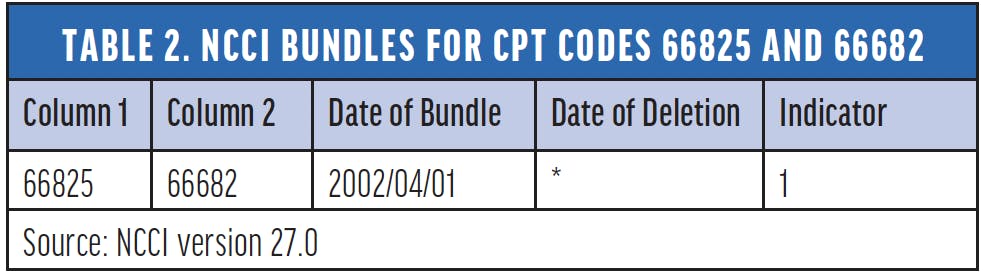
When pars plana vitrectomy (CPT 67036) is performed along with repositioning of an IOL (CPT 66825) and sutured IOL (66825), confirm any NCCI bundles. Table 2 illustrates the NCCI bundles of 66825 and 66682 with an indicator of 1. Because these two codes are bundled when performed the same day and based on RVU value, the case would be billed as 67036 and 66825.
To explore more on NCCI edits and the criteria for unbundling, review the Retina Today article “Become a Master of Retina Coding.”2
Many commercial payers follow the NCCI edits released by CMS. However, some may create their own bundling rules. Prior to submitting multiple procedures to these payers, confirm any unique bundling rules per insurance carrier.
Step No. 8: Append the appropriate modifier(s).
Appropriate anatomic modifiers (-RT, -LT, or -50 for a bilateral procedure) should be appended to surgical codes. In addition, if the surgery is performed during a global period, consider the need for adding the following surgical modifiers preceding the eye modifier:
- -58 modifier: a staged or related procedure or service by the same physician during the postoperative period.
- -78 modifier: unplanned return to the OR or procedure room by the same physician following an initial procedure for a related procedure during the postoperative period.
- -79 modifier: unrelated procedure or service by the same physician during the postoperative period.
10 STEPS TO ENSURE CORRECT CODING OF MULTIPLE PROCEDURES
1. Read the full CPT code descriptor
2. Confirm prior authorization
3. Meet payer policy documentation guidelines
4. Identify global periods
5. Order CPT codes from highest to lowest RVU
6. Consider site of service differential
7. Review NCCI edits
8. Append appropriate modifier(s)
9. Link appropriate ICD-10-CM codes
10. Submit claim and confirm proper payment
Step No. 9: Link the appropriate ICD-10-CM codes to CPT codes.
On form CMS 1500 (Health Insurance Claim Form), link the appropriate ICD-10-CM code to each CPT code that supports medical necessity. Each CPT code may have multiple ICD-10-CM codes linked or different diagnosis codes per CPT code on the claim. Confirming that the diagnosis link is accurately completed on the claim form will reduce denials.
Step No. 10: Submit the claim and watch the remittance advice to ensure that proper payment is received.
The final step is to submit the claim and monitor for correct reimbursement. When the remittance advice is received, verify that the multiple procedure reduction is appropriate (ie, 100% for primary procedure, 50% for subsequent procedures) and that full reimbursement has been received for the entire claim per the payer fee schedule.
Make it a Habit
Whenever multiple procedures are performed during the same surgical session, use the checklist of 10 steps outlined in this article to ensure proper coding, reduce denials, and appropriately maximize your practice’s reimbursement.
1. Woodke J. Properly Coding Retina Surgeries. Retina Today. Coding Advisor Supplement. July/August 2019.
2. Woodke J. Become a Master of Retina Coding. Retina Today. Coding Advisor Supplement. September 2019.


