


The great biologist Georges Cuvier1 helped establish the field of paleontology and devised classification systems for animals that included the order Pachydermata, or thick skin. In this order he included horse, pig, elephant, rhinoceros, and hippopotamus because he thought they all had a thick skin. Later, substantial differences were found among these animals, most notable being that they did not have common ancestors. The attempted unifying principle, thick skin, proved illusory.
The choroids in patients with central serous chorioretinopathy (CSC) were found to be thick compared with normal eyes.2 Curiously, the choroids in the fellow eyes were typically greater than normal eyes, and the same for eyes that had resolved CSC.
A link was made between choroidal vascular hyperpermeability seen during indocyanine green (ICG) angiography, a hallmark finding for CSC, and increased choroidal thickness. The choroid is also thicker for other diseases, such as Vogt-Koyanagi-Harada (VKH) disease.3
The term pachychoroid, pachy meaning thick, was developed to denote a thick choroid. Soon, pachychoroid as an entity was expanded to the pachychoroid spectrum that, in addition to pachychoroid, included entities such as pachychoroid pigment epitheliopathy, pachychoroid neovasculopathy, peripapillary pachychoroid syndrome, and focal choroidal excavation. Somehow, VKH was not included in the list of the pachychoroid spectrum.4
INCONSISTENCY IN THE LITERATURE
I recently conducted a literature review of the term pachychoroid and its spectrum.4 I found that the definitions of conditions within the pachychoroid spectrum varied substantially from one study to the next, even among those published by the same group. Among the 44 papers about pachychoroid examined, nearly half did not include a definition. For those that had a definition of pachychoroid, there were more than 18 different ones. Some were as simple as “choroidal thickening” or similar. In some, the definition was “choroidal thickening or dilated vessels or a history of CSC.” Other studies had specific choroidal thicknesses that the authors considered to be abnormal such as ≥ 200 µm, ≥ 220 µm, or > 270 µm, with or without the various modifiers such as dilated vessels or a history of CSC. Having a choroidal thickness in an extrafoveal location 50 µm greater than the subfoveal choroidal thickness was thought to be a diagnostic criterion.4
The Euretina Lecture 2020
Dr. Spaide presented his keynote lecture, “Reconsidering Pachychoroid and What it Means” during the Euretina 2020 virtual conference.
The lack of uniformity makes comparison between studies nearly impossible. But what about a choroidal thickness of 270 µm, is that abnormal? What about 220 µm or 200 µm? In a series of children between ages 3.5 and 14.9 years, Bidaut-Garnier et al found the average choroidal thickness was 342 µm.5 Xiong et al found that in a group of myopes between ages 6 and 16 years, the mean subfoveal choroidal thickness was 303 µm, and many had an extrafoveal location 50 µm thicker than the fovea.6 Thus, most children, including myopic children, would be considered to have pachychoroid by published definitions. The mean choroidal thickness in a group of 30-year-olds, as published by Tan et al, was 372 µm, and Entezari et al found the mean subfoveal choroidal thickness in a group with a mean age of 34.6 years was 363 µm.7,8 Many published studies found that mean subfoveal choroidal thickness did not dip below 300 µm until the mid-40s to early 50s. A cutoff of 200 µm, 220 µm, or 270 µm as a threshold for various pachychoroid definitions would imply most people would be considered to have pachychoroid.
AN INCOMPLETE SPECTRUM
Many diseases associated with a thick choroid—such as VKH, choroidal melanoma, lymphomatous infiltration, nanophthalmos, Behcets disease, sarcoidosis, and hypotony—are not included in the pachychoroid spectrum.4
The definition of pachychoroid has been changing. More recently, the diagnosis of pachychoroid could be made even if the choroid was not thin, despite the name. One characteristic thought to be important, but not mandatory, was choroidal vascular hyperpermeability seen during ICG angiography. However, many entities associated with hyperpermeability on ICG angiography are not currently listed as being pachychoroid disorders, such as hypertensive choroidopathy, trauma, lupus nephropathy, choroidal hemangioma, and Behcets disease, among many others.4
There is a huge variability in the definitions for each of the elements in the pachychoroid spectrum, if they are stated at all, and they have questionable sensitivity and specificity. Therefore, pachychoroid and pachychoroid spectrum are both incomplete and poorly defined. The terms lack thematic focus, particularly because an eye does not need to have a thick choroid to have pachychoroid. One should question the validity of the “spectrum” purported if there are many diseases that potentially could be included but are not.
CSC is one condition well-known to cause a thick choroid, likely as an epiphenomenon. Pathophysiologic changes that occur in CSC appear to be present in other diseases, and these findings may help offer a pathophysiologic explanation. For example, a recent study using ICG angiography offered interesting findings in a series of eyes with either CSC or peripapillary pachychoroid syndrome (Figures 1 and 2).9 Ordinarily, the vortex vein systems empty the choroid in a quadrantic fashion. The vortex veins in each quadrant course toward the vortex vein ampulla and exit the eye near the equator. Each system is independent of the others, and there is a watershed zone between them.10 In both CSC and peripapillary pachychoroid syndrome, large anastomotic connections were seen between the vortex vein systems—a finding that was uncommon in control eyes.10 In CSC eyes, these occurred in the central macular region; in peripapillary pachychoroid syndrome, they appeared around the nerve. The same pattern, large intervortex venous anastomoses, was present in eyes with CSC that progressed to neovascularization or polypoidal choroidal vasculopathy.10
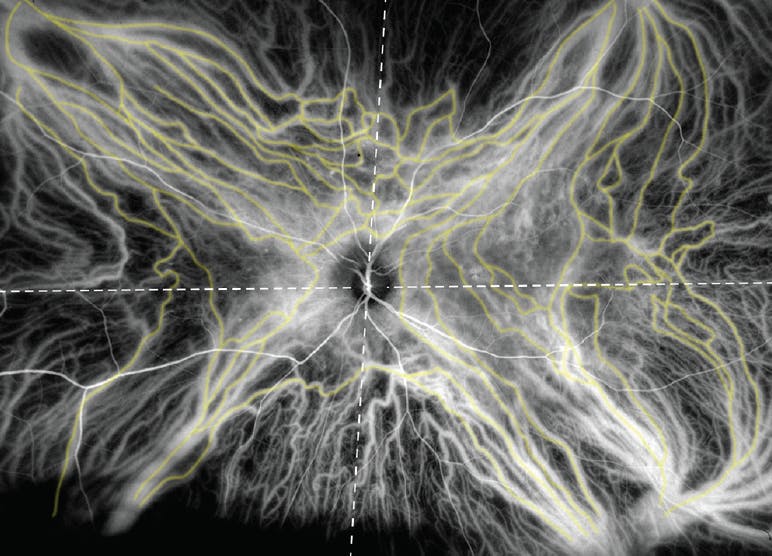
Figure 1. An ICG angiogram of a patient with CSC. Ordinarily, the venous drainage of the choroid is segmental and there would be watershed zones demarcated by the dashed white lines. This eye does not have watershed zones and there are intervortex venous anastomoses (some of which are highlighted in yellow) crossing over the watershed zones.
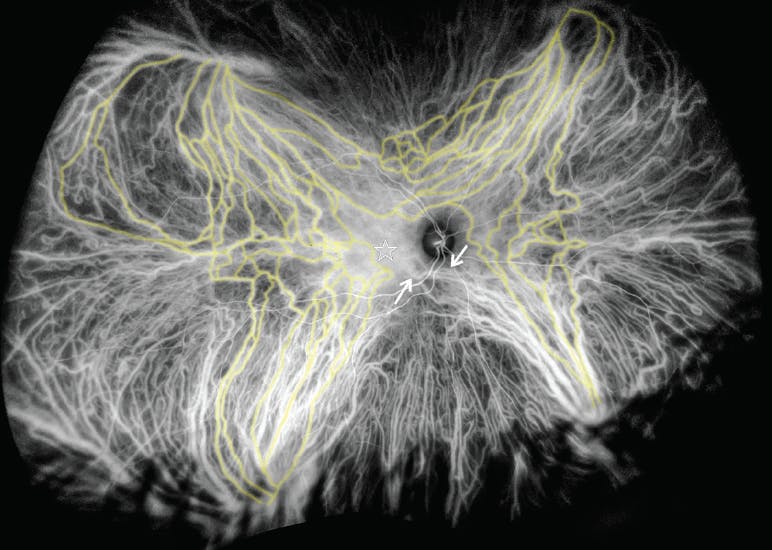
Figure 2. This patient has CSC. The ICG angiogram shows the venous drainage, with some of the intervortex venous anastomoses highlighted in yellow. There were vessels from the inferonasal vortex vein system that crossed over the expected vertical venous watershed zone (arrows) but, because there already is significant leakage in the submacular choroid (star), anastomoses could not be identified.
FUTURE DIRECTIONS
The intervortex vein anastomoses fit into larger theories of venous congestion and overloading as mechanistic features leading to disease. The exciting aspect of venous overload choroidopathy as a mechanism of disease is the future possibilities. Theories, by their nature, suggest testable hypotheses. In medicine these testable hypotheses frequently lead to new treatments. The naming system and disease concepts involved in CSC and its related disorders are likely to undergo significant change and refinement in the near future with insights into the appropriate taxonomy and pathophysiology driving disorders of the choroid. These changes will likely create a new system that is more specific, less ambiguous, and related to underlying disease pathogenesis instead of epiphenomena.
1. Cuvier G. The Animal Kingdom of the Baron Cuvier, Enlarged and Adapted to the Present State of Zoological Science. London; Smith, Elder, and Co.: 1839.
2. Imamura Y, Fujiwara T, Margolis R, Spaide RF. Enhanced depth imaging optical coherence tomography of the choroid in central serous chorioretinopathy. Retina. 2009;29(10):1469-1473.
3. Maruko I, Iida T, Sugano Y, et al. Subfoveal choroidal thickness after treatment of Vogt-Koyanagi-Harada disease. Retina. 2011;31(3):510-517.
4. Spaide RF. The ambiguity of pachychoroid. Retina. 2021;41(2):231-237.
5. Bidaut-Garnier M, Schwartz C, Puyraveau M, et al. Choroidal thickness measurement in children using optical coherence tomography. Retina. 2014;34(4):768-774.
6. Xiong F, Tu J, Mao T, et al. Subfoveal choroidal thickness in myopia: An OCT-based study in young Chinese patients. J Ophthalmol. 2020;2020:5896016.
7. Tan CS, Ouyang Y, Ruiz H, et al. Diurnal variation of choroidal thickness in normal, healthy subjects measured by spectral domain optical coherence tomography. Invest Ophthalmol Vis Sci. 2012;53(1):261-266.
8. Entezari M, Karimi S, Ramezani A, et al. Choroidal thickness in healthy subjects. J Ophthalmic Vis Res. 2018;13(1):39-43.
9. Spaide RF, Ledesma-Gil G, Gemmy Cheung CM. Intervortex venous anastomosis in pachychoroid-related disorders [published online ahead of print, 2020 Oct 26]. Retina.
10. Hayreh SS. Segmental nature of the choroidal vasculature. Br J Ophthalmol. 1975;59(11):631-648.


