


AT A GLANCE
- Autologous retinal transplant achieved anatomic closure in 89% of macular holes (MHs) and 95% of MH retinal detachments.
- Researchers have identified two patterns of subclinical nonexudative macular neovascularization (MNV): short-term activation and quiescent MNV.
- Vitrectomy including internal limiting membrane (ILM) peeling can allow surgeons to improve myopic retinoschisis in some cases.
- Recent findings with widefield indocyanine green angiography suggest that inter–vortex venous anastomoses are common in eyes with polypoidal choroidal vasculopathy and central serous chorioretinopathy.
- Examination of members of three unrelated families with a rare hereditary neurological condition confirmed that macular telangiectasia type 2 was present in nearly everyone over age 30.
- An inverted ILM technique for MH repair can induce glial cell proliferation, filling the MH and supporting closure.
Despite the pandemic, our colleagues around the world continue to explore ways to improve the diagnosis and management of various retinal conditions. Because of COVID-19, perhaps the world has become smaller, as we share information in virtual settings. During the virtual 2020 annual meeting of the AAO, we gathered an international group of experts to share their knowledge and learn the latest research findings from various corners of the world. We are excited to share with you their summaries of the research they presented.
– Judy E. Kim, MD, and Lihteh Wu, MD
ART FOR MACULAR HOLES: OUTCOMES OF THE WORLD STUDY
By Tamer H. Mahmoud, MD, PhD
A multicenter international interventional study with 33 participating surgeons looked at 130 eyes that underwent autologous retinal transplant (ART) for repair of macular holes (MH) and MH retinal detachment (MHRD) to determine anatomic and functional outcomes.1
Of the 130 eyes, 35 (27%) had primary and 76 (58%) had refractory MHs; 19 (15%) patients had an MHRD that was recurrent in 13 cases, 12 of which had undergone previous internal limiting membrane (ILM) peeling.
The mean maximum and minimum hole diameters were 1,470 ±160 μm and 840 ±94 μm, respectively. Preoperative BCVA was approximately 20/500.
Grafts were 90% neurosensory retina without choroid, and most (70%) ranged in size from 0 to 1 disc diameter (DD). ARTs were positioned preretinal in 81% and subretinal in 19%. The mean follow-up was 8.6 ±0.8 months.
In this study, we introduced the term alignment of the neurosensory layers (ANL). When the graft is first placed, vertical lines appear on OCT between the graft and surrounding macular tissue. Within weeks, these lines gradually fade, details of the graft layers can be detected, and they align with similar layers in the surrounding host macular tissue (ie, plexiform to plexiform, nuclear to nuclear, etc.). This could suggest that the macular tissue recognizes the peripheral retinal tissue and may be trying to connect to corresponding layers, leading to integration of the transplant and, thus, better visual outcomes.
Anatomic closure was achieved in 89% of MHs and 95% of MHRDs. Visual acuity gains were substantial: 29% of eyes had at least a 5-line gain, and 43% had at least a 3-line gain. Better final VA was associated with MH closure (P < .001), reconstitution of the ellipsoid zone band (P = .02), and ANL on OCT (P = .01). Fifteen (12%) eyes had a final VA of 20/50 or better, most of which had refractory MHs. The mean preoperative and final BCVAs in this subgroup were, respectively, approximately 20/125 and 20/40 (P < .001). Two-thirds of eyes gained more than 3 lines and 40% more than 5 lines; in all of these eyes the holes closed.
With a better understanding of prognostic factors and the refinement of surgical techniques, anatomic closure can be achieved in most large MHs, providing better visual outcomes. This study paves the way for further research into the role the peripheral retina may play in acquiring macular function and its potential in many macular diseases.
1. Moysidis SN, Koulisis N, Adrean SD, et al. Autologous retinal transplantation for primary and refractory macular holes, and macular hole retinal detachments: The Global Consortium [published online ahead of print, 2020 Oct 10]. Ophthalmology.
TREATMENT-NAÏVE NONEXUDATIVE MNV IN AMD
By Giuseppe Querques, MD, PhD
AMD has been historically classified as exudative based on the presence of macular neovascularization (MNV). Treatment-naïve nonexudative MNV, by contrast, is characterized by a type 1 neovascular network without any sign of exudation. My colleagues and I coined the term quiescent MNV in 2013,1 to refer to treatment-naïve MNV in AMD without intraretinal or subretinal exudation on repeated structural OCT imaging for at least 6 months. Roisman et al described subclinical MNV in AMD as type 1 MNV without evidence of exudation at the time of diagnosis.2 We provided the specification of 6 months without exudation to distinguish quiescent MNV from a pre-exudative stage (an early stage when blood flow is sluggish) of an ordinary exudative type 1 MNV.3
In a series of 31 patients with treatment-naïve nonexudative MNV secondary to AMD,4 we characterized the natural history of the condition over a 6-month period and identified three groups: (1) a short-term activated MNV group (with exudation occurring before 6 months) and a quiescent MNV group (no exudation during a minimum 6-month follow-up) showing either (2) no activation (persistently quiescent) or (3) late activation during follow-up (long-term activated MNV).
Interestingly, the monthly MNV growth rate was significantly higher in the short-term activated MNV group (13.30%/month) than in the persistently quiescent MNV group (0.64%/month, P < .001) and the long-term activated quiescent MNV group (1.07%/month, P < .001). Moreover, the baseline perfusion density in the short-term activated MNV group was significantly greater than in the persistently quiescent MNV group (P = .001) and long-term activated MNV group (P = .106).
Of note, Capuano et al reported a protective role of quiescent MNV in the prevention of geographic atrophy progression and speculated that quiescent MNV may supply oxygen to the hypoxic outer retina and choriocapillaris.5 Arteriogenesis could be the main driving force of quiescent MNV, explaining the low rate of activation and the inclination to supply oxygen and nutrients to the outer retina.
In summary, we reported two different patterns for subclinical MNVs: subclinical MNV characterized by short-term activation that could represent a pre-exudative stage, and quiescent MNV characterized by a low growth rate and possible long-term activation. OCT angiography features may help to predict short-term activation for subclinical MNV. We recommend not treating quiescent MNV with intravitreal anti-VEGF injections until exudative changes develop.
1. Querques G, Srour M, Massamba N, et al. Functional characterization and multimodal imaging of treatment-naive “quiescent” choroidal neovascularization. Invest Ophthalmol Vis Sci. 2013;54:6886-6892.
2. Roisman L, Zhang Q, Wang RK, et al. Optical coherence tomography angiography of asymptomatic neovascularization in intermediate age-related macular degeneration. Ophthalmology. 2016;123:1309-1319.
3. Agarwal A. Gass’ Atlas of Macular Diseases. 5th ed. Elsevier; 2012:24-27.
4. Querques G. What is treatment-naïve quiescent macular neovascularization really? The 2019 Young Investigator Lecture. Presented at: the Annual Meeting of the Macula Society; February 13-16, 2019; Bonita Springs, FL.
5. Capuano V, Miere A, Querques L, et al. Treatment-naïve quiescent choroidal neovascularization in geographic atrophy secondary to nonexudative age-related macular degeneration. Am J Ophthalmol. 2017;182:45-55.
TREATING MYOPIC TRACTION MACULOPATHY
By Kazuaki Kadonosono, MD, PhD
Myopic traction maculopathy, also known as retinoschisis,1 is characterized by significant separation between the inner and outer retinal layers.2 It is often seen in eyes with staphyloma, and there is a higher incidence in Asian populations.3 Prognosis for the natural course of the condition tends to be poor. In one study, 3.8% of highly myopic eyes showed resolution of macular retinoschisis, but in most cases retinoschisis worsened and was accompanied by decreased visual acuity.4
Kobayashi and Kishi used OCT to study vitrectomy as a possible treatment for myopic traction maculopathy.5 However, it is difficult to determine an indication for vitrectomy for highly myopic eyes with traction maculopathy because the prognosis after surgery is unclear.
We studied highly myopic eyes with traction maculopathy and compared our surgical results based on the type of maculopathy identified using OCT. We identified four types of traction maculopathy: retinoschisis with subretinal fluid (SRF), retinoschisis without SRF, lamellar MH (LMH) retinoschisis, and retinoschisis with MH.
In our study, a significant improvement in visual acuity was seen after vitrectomy with ILM peeling and gas injection in retinoschisis with SRF and retinoschisis with MH; there was no significant improvement in visual acuity in eyes with LMH retinoschisis or retinoschisis without SRF.
A surgical technique for myopic traction maculopathy was recently developed. Long forceps specifically designed for highly myopic eyes are now available, allowing us to peel membranes more effectively. We can also use a promising new surgical technique in which LMH-associated epiretinal membrane is intentionally left around the foveal region.
In summary, vitrectomy including ILM peeling allows us to anatomically and functionally improve myopic retinoschisis in some cases. Myopic retinoschisis with subfoveal detachment seems well-suited to surgery, but more research is needed to determine the best course of treatment for other types of myopic retinoschisis.
1. Kishi S, Takahashi H. Three-dimensional observations of developing macular holes. Am J Ophthalmol. 2000;130(1):65-75.
2. Panozzo G, Mercanti A. Vitrectomy for myopic traction maculopathy. Arch Ophthalmol. 2007;125(6):767-772.
3. Morgan I, Rose K. How genetic is school myopia? Prog Retin Eye Res. 2005;24(1):1-38.
4. Shimada N, Tanaka Y, Tokoro T, Ohno-Matsui K. Natural course of myopic traction maculopathy and factors associated with progression or resolution. Am J Ophthalmol. 2013;156(5):948-957.e1.
5. Kobayashi H, Kishi S. Vitreous surgery for highly myopic eyes with foveal detachment and retinoschisis. Ophthalmology. 2003;110:1702-1707.
UPDATE ON POLYPOIDAL CHOROIDAL VASCULOPATHY
By Gemmy Cheung, MD
Polypoidal choroidal vasculopathy (PCV) is a subtype of wet AMD. Unfortunately, the differentiation of PCV from wet AMD relies on indocyanine green angiography (ICGA), a diagnostic modality that is not routinely used.
Recently, the PCV workgroup of the Asia-Pacific Ocular Imaging Society evaluated a set of diagnostic features based on OCT and color fundus photographs that may be helpful to distinguish PCV from typical wet AMD in treatment-naïve eyes.1 The combination of three OCT-based criteria of the retinal pigment epithelium (RPE)—sub-RPE ring-like lesion, en face OCT complex RPE elevation, and sharp-peaked pigment epithelial detachment—achieved an area under the receiver operating characteristic curve of 0.90 for identifying eyes with PCV. This set of practical diagnostic criteria can be easily applied in clinic to differentiate PCV from wet AMD without the need for ICGA.
However, ICGA remains an important tool for evaluating alterations in the choroid in eyes with PCV. Recent findings with widefield ICGA suggest that inter–vortex venous anastomoses are commonly present in eyes with PCV and central serous chorioretinopathy (CSCR).1 Dynamic ICGA further revealed pulsatile flow within segments of these anastomotic vessels. These new findings based on ICGA suggest that a disturbance in choroidal perfusion pressure may play a role in the pathogenesis of PCV and CSCR.
1. Cheung CMG, Lai TYY, Teo K, et al. Polypoidal choroidal vasculopathy: consensus nomenclature and non-indocyanine green angiograph diagnostic criteria from the Asia-Pacific Ocular Imaging Society PCV Workgroup. Ophthalmology. 2020:S0161-6420(20)30784-3.
UPDATE ON MACTEL TYPE 2
By Paul S. Bernstein, MD, PhD
Recent advances in retinal imaging have revealed that macular telangiectasia (MacTel) type 2 is more common than originally described, and that, in its early stages, it has prominent nonvascular features such as retinal cavitations on OCT images.
The development of MacTel also has a significant genetic component, but its late onset and variable expressivity make identification of causative genes a challenge. A large genome-wide association study (GWAS) identified several loci linked to incidence of MacTel,1 and our research group at the Moran Eye Center took advantage of the large families in Utah and Idaho to determine the frequency of MacTel in parents and siblings of MacTel patients.2 We examined 52 of 71 living siblings and 11 of 12 living parents of 17 MacTel probands and found that 19% of first-degree relatives over age 30 years also had MacTel. This confirms that MacTel is indeed an inherited retinal disease, but with moderate genetic penetrance and multiple genes and environmental factors likely influencing the condition’s expression.
In one multigenerational Utah MacTel family, all affected individuals also had a debilitating peripheral neuropathy (Figure 1). Whole exome sequencing revealed they had a C133Y mutation in SPTLC1, the causative gene for hereditary sensory and autonomic neuropathy 1 (HSAN1). Examination of unrelated HSAN1 families with the same variant in Pennsylvania and Australia confirmed that MacTel was present in nearly every member over age 30. We had identified the first highly penetrant genetic cause for MacTel.3
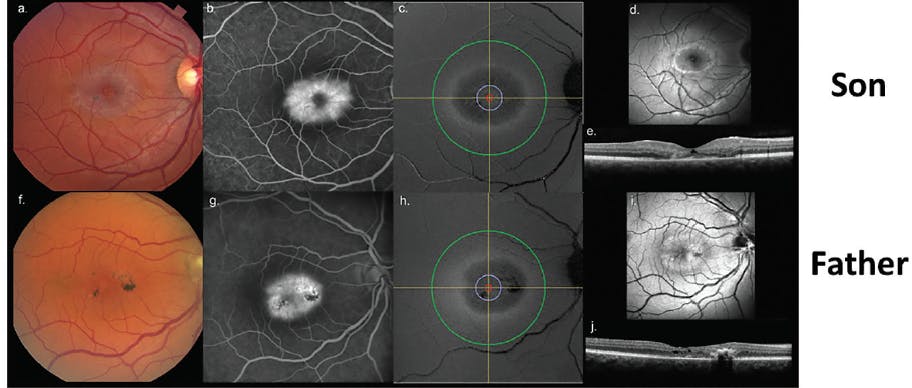
Figure 1. Father–son pair with HSAN1 and MacTel: color fundus photographs (A, F), late-phase fluorescein angiograms (B, G), macular pigment images showing the displacement of the foveal carotenoid pigment into a ring at the edge of the MacTel zone (C, H), blue light reflectance images
(D, I), and OCTs (E, J).
Although mutations in SPTLC1 are infrequent causes of MacTel (< 2% of cases), this finding provides valuable insights into novel pathways and treatments for MacTel. SPTLC1 encodes a subunit of serine palmitoyl transferase (SPT), the enzyme responsible for condensing serine with palmitoyl-CoA, the first step in synthesis of sphingolipids and ceramides. The C133Y–SPTLC1 mutation changes the substrate specificity of SPT to accept alanine instead of serine, which generates a series of deoxysphingolipids that are toxic to peripheral neurons and, presumably, the retina. We have found that many other MacTel patients also have low serine levels and high deoxysphingolipid levels, suggesting similar genetic or environmental abnormalities of serine and sphingolipid metabolism.
Neurologists already treat HSAN1 with high-dose serine supplements, and the MacTel Consortium researchers are gearing up to conduct comparable trials for MacTel.
1. Scerri TS, Quaglieri A, Cai C, et al; MacTel Project Consortium. Genome-wide analyses identify common variants associated with macular telangiectasia type 2. Nat Genet. 2017;49(4):559-567.
2. Ronquillo CC, Wegner K, Calvo CM, Bernstein PS. Genetic penetrance of macular telangiectasia type 2. JAMA Ophthalmol. 2018;136(10):1158-1163.
3. Gantner ML, Eade K, Wallace M, et al. Serine and lipid metabolism in macular disease and peripheral neuropathy. N Engl J Med. 2019;381(15):1422-1433.
ILM FLAP IN MACULAR HOLE SURGERY
By Jose A. Roca, MD
In 1991, Kelly and Wendel described the role of pars plana vitrectomy and the removal of posterior hyaloid for the closure of MH, reporting an anatomic closure rate of 58%.1 Since then, various techniques and postoperative strategies have been introduced to improve anatomic and visual outcomes and patient comfort. The inverted ILM flap technique described by Michalewska et al was effective for treating full thickness MHs, particularly those over 400 µm, with a 98% success rate, whereas conventional vitrectomy with ILM peeling technique yielded only an 88% closure rate.2
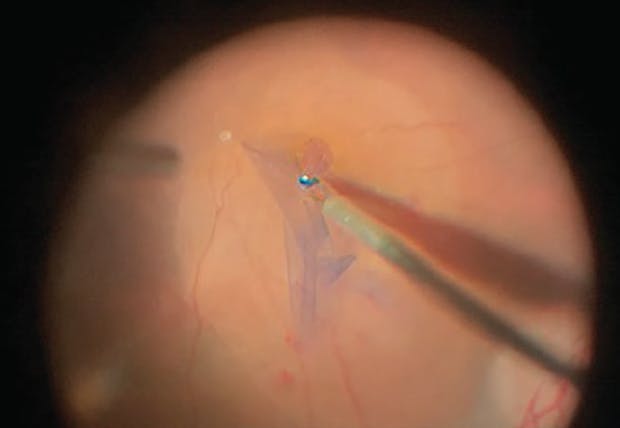
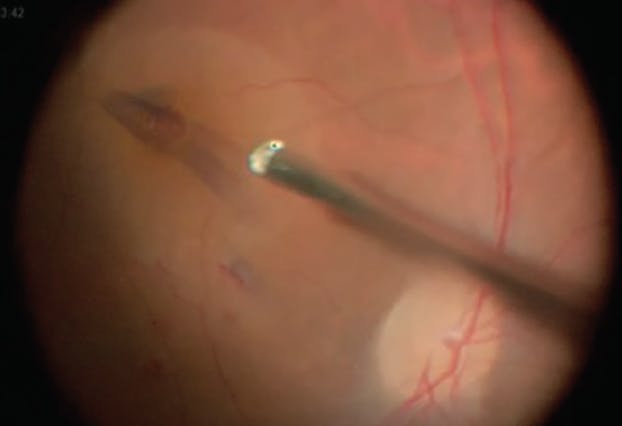
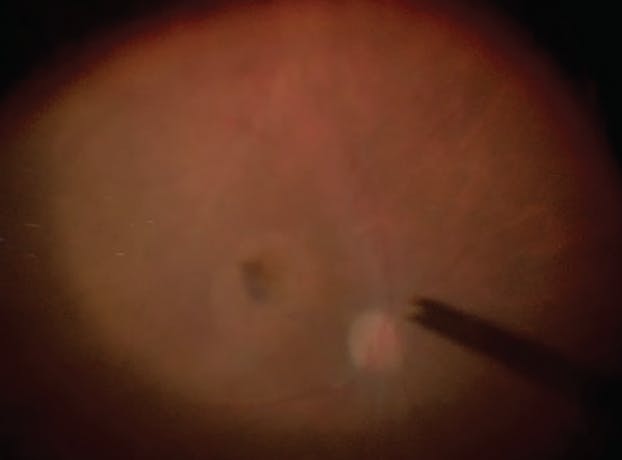
My usual approach is to perform a three-port 25-gauge vitrectomy and posterior vitreous detachment assisted by triamcinolone. Then I stain the ILM with brilliant blue and peel the ILM around the hole, keeping the temporal ILM in place (Figure 2). This temporal ILM remnant is inverted and placed over the MH (Figure 3). Finally, fluid-air exchange is performed, and SF6 at 20% is injected (Figure 4). I usually ask patients to maintain a facedown position for 3 to 5 days.
Peeling the ILM helps to relieve tractional forces acting on the fovea, enhancing the extensibility of the retina and Müller cell gliosis, both of which help in MH closure. The inverted ILM, which has Müller cell fragments, may induce glial cell proliferation, filling the MH and supporting closure. It may also work as a scaffold, encouraging the proliferation of myofibroblasts, fibrocytes, and RPE cells; creating a microenvironment that encourages correct photoreceptor positioning; and improving postoperative anatomic and functional outcomes.3 Rizzo et al reported a 97.5% single-surgery closure rate with this technique, with improvements in BCVA and multifocal electroretinography; their OCT images showed the appearance of a hyperreflective material filling the MH; gradually, this material contracted, inducing MH closure.4
Vitrectomy with the inverted ILM flap technique seems to be a safe and effective surgical approach for large MHs, improving both functional and anatomic outcomes.
1. Kelly NE, Wendel RT. Vitreous surgery for idiopathic macular holes. Results of a pilot study. Arch Ophthalmol. 1991;109(5):654-659.
2. Michalewska Z, Michalewski J, Adelman RA, Nawrocki J. Inverted internal limiting membrane flap technique for large macular holes. Ophthalmology. 2010;117:2018-2025.
3. Hayashi H, Kuriyama S. Foveal microstructure in macular holes surgically closed by inverted internal limiting membrane flap technique. Retina. 2014;34(12):2444-2450.
4. Rizzo S, Bacherini D. Treatment of macular hole with inverted flap technique. Retina Today. March 2017;35-37.


