


This year, the editors of Retina Today chose to expand our usual women in retina issue to encompass diversity and inclusion more broadly, to allow more voices to be heard within these pages. To that end, our guest editors María H. Berrocal, MD, and Audina M. Berrocal, MD, moderated a roundtable with three new department chairs—Sophie J. Bakri, MD, MBA; R.V. Paul Chan, MD, MSc, MBA, FACS; and Shlomit Schaal, MD, PhD, MHCM—each of whom brings much-needed diversity to the leadership within their organizations. Here, we highlight excerpts from their conversation. You can hear the full conversation in the accompanying New Retina Radio Podcast.
– Rebecca Hepp, Editor-in-Chief
María H. Berrocal, MD: The field of retina has evolved a lot, and we see many more women in retina than when I started. Still, we should look at the study recently published in the New England Journal of Medicine.1 When researchers compared the advancement of women through the ranks of academia to professorships and heads of department, they found that we are doing much worse in the past 20 years than in the 20 years prior.
Dr. M. Berrocal: It would be great to hear how you think we can overcome barriers to advancement and have more diverse departments, and the importance of this moving forward.
Sophie J. Bakri, MD, MBA: It is absolutely important. I consider diversity to be diversity of thought, which you get from people of different backgrounds bringing ideas to the table. Department chairs are role models, and if you want a diverse pipeline, you have to have diverse role models and diverse mentors. If people look at the department chairs and see a lack of diversity, they think those positions are not attainable. It’s important that the department chairs represent the future of ophthalmology and the people coming through our pipeline, which is the reason we need department chairs from all different backgrounds.
R.V. Paul Chan, MD, MSc, MBA, FACS: Yes, it’s an active process. It doesn’t change unless we’re actively thinking about it, mentoring, and making conscious decisions about putting women on the podium and supporting underrepresented minorities in medicine. In ophthalmology, we are all consciously thinking about promoting diversity at every level, and there are a number of excellent programs that have been developed to help with these initiatives—for example, the AAO’s Minority Ophthalmology Mentoring (MOM) program.2 That has been a tremendous success over the years.
Something like 17% of all department heads in ophthalmology are women. But if you look further to underrepresented minorities, there are even less.
I agree with Dr. Bakri in saying that leadership should represent the future of our profession. Look at who are becoming doctors now. Over 50% of the medical students coming in are women, and there are growing numbers of Latinos and African Americans. We already know there are a lot of Asians, yet there aren’t many Asian leaders. My dad, Guy H. Chan Jr, MD, FACS, was actually the first ophthalmology chair of Chinese descent in the United States, almost 40 years ago now.
We have a responsibility to future generations to mentor and give them examples and the tools to lead and serve.
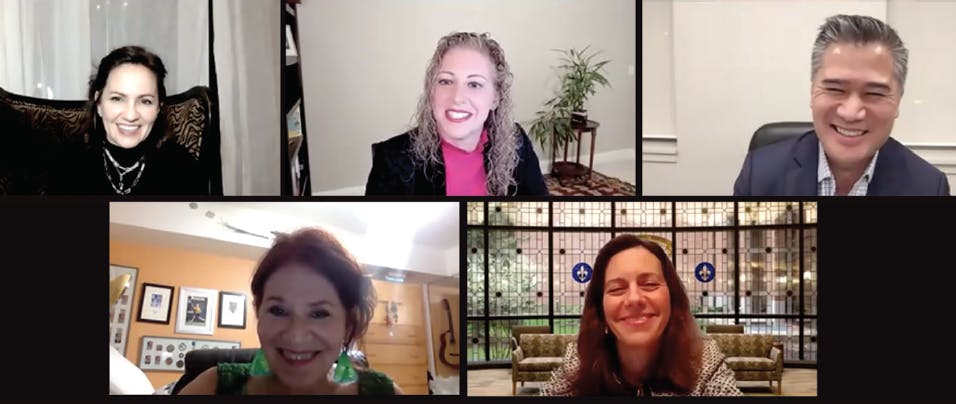
Top: Audina M. Berrocal, MD; Shlomit Schaal, MD, PhD, MHCM; R.V. Paul Chan, MD, MSc, MBA, FACS. Bottom: María H. Berrocal, MD; Sophie J. Bakri, MD, MBA.
Shlomit Schaal, MD, PhD, MHCM: My perception is that there has been progress. For example, when I became department chair in June 2016, there were only six women chairs, and I became the seventh; today there are 22 women chairs. We have women chair meetings and leadership groups, and we support each other. The key to progress is having this kind of group support.
Quite frankly, when I was offered the job as chair, I was scared, and I was afraid to take it. It was much more convenient for me to stay where I was and take care of my patients. The chairs that I knew were all men, and I didn’t know if I would be good in this role.
One of the reasons I took the job is that a woman, the former dean at the University of Louisville, said to me, “What a wonderful opportunity.” I will never forget those words from a woman leader. They gave me the courage to do it, while other people tried to discourage me.
Now, as the UMass Memorial Medical Group President, I have the opportunity to affect and influence the entire health care organization. If no one encouraged me and I hadn’t taken the job as chair, I wouldn’t be here today. This is the number one message: encourage, support, and believe in women, underrepresented minorities, and people born in other countries who speak different languages and come from other cultures and religions.
Audina M. Berrocal, MD: I think that happens to a lot of women in power positions. Many times, you don’t have an example, somebody who supports you, who is not a male. The courage you had to take a job like that is going to change things because you’re in power. The change comes from above, and people from different backgrounds open the door to other people who are different.
Dr. Chan: Diversity in any organization promotes better decision-making and better outcomes in general. When we look at residents, fellows, medical students, and even faculty, diversity is critical to evolve and build a better program and a better culture.
I’m a very new chair, and one of my priorities was to have a vice-chair for diversity and inclusion. I’m fortunate to have Jenny Lim, MD, in our department. Jenny is a retina specialist who has a lot of experience promoting young women. She’s been a great partner with a lot of great ideas about how we can build our diversity initiatives.
If you don’t see people who are succeeding or leading who you think you can model after, that can create a hurdle. Some of the most important people in my life, my mentors, were women. My mother, Nongnart Romayanda Chan, MD, was among the first fellows of William Richard Green, MD, at Wilmer Eye Institute, and I would hear stories about her time as an ophthalmologist in an era when there were not as many women in academic ophthalmology leadership. Joan Miller, MD, who is the chair at Harvard, started her tenure as chair not long before I first started my fellowship there. She has mentored and supported me throughout my career. You have to have mentors, faculty, and leadership who are diverse.
Dr. Schaal: One thing that I would add is that, in medicine, we have a responsibility to our patients. Here in Worcester, Massachusetts, we take care of a diverse population. In our clinic every day, we speak 72 languages with the help of interpreters. It’s critical to have a workforce that looks like our patients, in color, shape, language, and culture, to increase the sense of belonging.
When patients come to the clinic and see a physician who looks like them or, better yet, speaks their language, they immediately have a sense of trust, increased belonging. We as leaders have an obligation to support as many caregivers as possible who are representatives of the populations we serve.
Dr. Chan: That is a great point. When we talk about this gap in health equity, it’s fundamental that we have physicians and faculty who are representative of the population that we serve. It’s been shown that people trust people who speak their own language and are from similar backgrounds.
Dr. A. Berrocal: One criticism you hear often when you’re discussing diversity or trying to create a diverse faculty is that you’re compromising quality to become diverse. What do you think of this argument?
Dr. Schaal: I hear it a lot in academic medicine. But diversity is an added value. It’s not only how good you are as a researcher, clinician, communicator, teammate, mentor, or author. Diversity is one extra thing that you have.
If I have someone who is a good clinician, a good scientist, and diverse, I think it’s superior, because diversity is a value. If someone can increase the diversity of my team, that’s a big plus for me.
Dr. M. Berrocal: If we are just focused on grades, we will only have very traditional applicants who will all likely look the same. Someone who comes from a more affluent background may get better board scores than someone who has to work two jobs to make it through medical school. Changing what we value is key.
Dr. Schaal: There is the concept of miles traveled. If you take my example, I traveled across the ocean, had to do all of my training twice and take my board exam twice, just to get to the same level as my peers. When I look at an underrepresented minority, it’s about miles traveled, and that’s how I try to evaluate our residents. What hurdles did they need to overcome? What mountains did they need to climb? What river did they need to cross to get here?
Dr. A. Berrocal: Some people who make objections to increasing diversity say that it penalizes the efforts of people who grew up in this country because we are giving an opportunity to someone who doesn’t have the same scores or qualities.
Dr. Schaal: You should consider both and take both types of candidates. With the US Medical Licensing Examination scores going away, it’s going to make our traditional decision-making much more difficult. But that’s a very good change. Right now, we are making decisions according to scores. Without these scores in the future, we will be able to select people according to their miles traveled and the level of effort they put into getting here. For example, if someone took a year off to do research or gain experience in other ways, that sets them apart and shows their commitment to the profession.
WOMEN IN RETINA: A GLOBAL PERSPECTIVE
One expert shares her experiences as a retina specialist in Israel.
An interview with Anat Loewenstein, MD, MHA
Retina Today: What is it like as a leader in retina in your country, especially as a woman?
Being a leader is the only way to become independent in your thoughts and actions. Early on, I was really against differentiating between men and women in leadership, and I thought that you should do the best you can at every point, regardless of gender. Now I understand that there are boundaries women face due to cultural and transitional issues. As a woman who has “made it” in a field that for many years was a boy’s club, I need to support women in their careers, young ophthalmologists or retina specialists, to help them achieve their potential.
RT: What hurdles did you have to overcome?
In my institute being a woman did not cause any significant issues. The director of the hospital did not consider gender as an obstacle and supported me in becoming a chair. I did face difficulties in some leadership positions in committees, boards, and advisory boards, which are mainly composed of men who tend to support each other and keep the same traditions.
RT: What advice would you give to aspiring women in retina?
The first piece of advice I would give is to make sure everything is balanced in their personal lives. Then they can devote all their time and energy to developing the field of retina. I would also advise that they share responsibilities both at home and at work—find people they trust and pass on some of their responsibilities. I would recommend they find a mentor, usually a woman, who can help them overcome challenging situations, such as not being promoted or not being entrusted with a leadership position.
Anat Loewenstein, MD, MHA
• Director, Division of Ophthalmology, Tel Aviv Medical Center, Tel Aviv, Israel
• Vice Dean, Sackler Faculty of Medicine, Tel Aviv University, Tel Aviv, Israel
• President, Israeli Ophthalmological Society
• anatl@tlvmc.gov.il
• Financial disclosure: Consultant (Allergan, Bayer Healthcare, Beyeonics, Notal Vision, Novartis, Roche)
Dr. A. Berrocal: Dr. Bakri, when you were offered your position, was it easy for you to say yes, or were you holding yourself back because of the few female chairs?
Dr. Bakri: I was appointed to my position through an internal search. That’s the way the chair searches are typically done at Mayo Clinic—it is important for Mayo chairs to deeply understand the Mayo Clinic values and culture. Before I even got to the final three, the search committee knew everything about me from my peers and colleagues, and they knew all of the pluses and minuses. I went through the process intrigued as to what they wanted, and whether or not I was the person they wanted in terms of what I could do for the department, but also in terms of my phenotype.
And that I wasn’t sure about. I’m certainly different in many ways. When they called to offer me the position, I thought, “Well, they went for me, so then I guess they know what I have to offer, they know who I am.”
I had worked at Mayo Clinic for 15 years, and so they had input from all kinds of stakeholders in the department and the institution as a whole, and they were obviously ready for the change.
Dr. Schaal: As I’m listening to you talk, I hear you say, “Okay, well, if they said it’s OK, then it’s OK.” But you have the inner feeling of, “Am I good enough for this? Does a chair look like that?” There is always an internal voice that kind of holds you back, and maybe it comes from the way we were raised as little girls and what we were encouraged or not encouraged to do.
Recently, I was a candidate in the search for a president of the medical group here. There had never been a woman president of our medical group. As I was preparing for the interview with the search committee, I really thought that the other candidates were better because they fit the mold of what you think a successful president looks like.
Often, we hold ourselves back, and we need people from the side to say, “Yes, you can do it, you would be fantastic.”
Dr. Chan: I think we also have to take into account cultural considerations. As an Asian-American man—my parents were immigrants to this country—you’re told early on, do your work, keep your head down, don’t make a fuss, and, often, don’t ask for what you want. Just serve. There are a lot of cultural issues around this as well.
Dr. Bakri: Like you, Paul, I don’t like to ask for things. But as a department chair, you ask for things for others, which is much easier. You can deflect attention off yourself, empower others, give others roles and help them shine. That’s a good way of building a talent pipeline. When I go and ask for things, I’m not asking for myself, I’m asking for colleagues and other people in my department.
Dr. Schaal: That’s interesting, and I can tell you a quick related story. I had just graduated from a master’s in health care management, and there were many physician leaders in the class. We talked about salary and salary negotiations, and one of the physicians talked about his wife, who is a physician, who, when she negotiated for her salary, basically took whatever they gave her and didn’t ask for anything. But when he was negotiating, she said, “You should ask for this and ask for that.” We are used to fighting for others, and we’re comfortable with that. But we are not so comfortable saying, “I deserve to be paid more, and you need to pay me equal or even more because I’m that good.” We still have a journey to get there.
Dr. A. Berrocal: What do you think is needed to really promote diversity? Where are we in 2021, in our field?
Dr. Schaal: The most important thing is to keep discussing it and keep putting it as a priority. In our medical group, we call it the LEAD Initiative: Leadership, Engagement, Access, and Diversity. Every single month, we discuss diversity, and we involve the entire organization with diversity initiatives. When you hear other departments’ efforts to promote diversity and health care equity, you think about it, too.
However, you have to not only talk and think about it, but also you have to have people in place, specifically in leadership positions, who are diverse and will promote the next generation of diverse people.
I know the statistics on diversity in leadership are grim. However, I believe that after all we’ve been through, specifically in the last year in this nation, people have really felt the inequities. We have the obligation to make that better, make the access to care easier, make the communication clearer, and regain the trust and the sense of belonging.
There’s no quick remedy for that, so the three things I would say are, one, keep diversity as a top priority for your organization and your department; two, find leaders from diverse backgrounds; and three, connect with the patients and see how they respond to the changes that you make.
Dr. Bakri: I think it takes role models, leaders at the top, commitment, investment, and developing the talent pipeline with careful mentorship. All patients have to be able to relate to the entire care team. Not just the physicians, but the nurses, the technicians, everybody who takes care of patients. It’s important to partner with the community, and partner with local schools, and hire from the community.
Dr. Chan: It also goes beyond the leadership in our departments or how our departments are built; we need programs like the American Society of Retina Specialists’ Women in Retina program (WinR) and the AAO’s MOM program. An additional factor that is incredibly important is philanthropy. We need endowments to help promote and recruit good people who are diverse and underrepresented in medicine.
Dr. M. Berrocal: This has been wonderful, and I want to thank you all for leading the way into a more diverse environment in retina and ophthalmology, which is so needed in these upcoming years.
Editorial disclosure: This roundtable is based on conversations from an episode of New Retina Radio and has been edited for brevity and clarity.
1. Richter KP, Clark L, Wick JA, et al. Women physicians and promotion in academic medicine. N Engl J Med. 2020;383:2148-2157.
2. American Academy of Ophthalmology. Minority Ophthalmology Mentoring. www.aao.org/minority-mentoring. Accessed January 28, 2021.


