


In part 1 of this series, I covered how to differentiate your practice brand and ensure your practice is visible online. In this article, I take a closer look at ways to build your new patient pipeline, including how search engines work; the role of content; and the importance of paid online media, patient nurturing, and assessing return on investment (ROI).
FIND PROSPECTIVE PATIENTS
Nowadays, when people are looking for answers about their health, they go to Google. In fact, “one in 20 searches are for health-related information,” according to the internet giant.1 A 2018 survey further supported this notion, finding that 80% of respondents used the internet to research health care within the past year—including 76% of respondents who were 60 years of age or older.2 Simply put, your prospective patients explore their health-related questions and follow their health care journey online, and you need to meet them there.
You’ll notice, too, that we’re talking about Google specifically. Just as Kleenex is often used interchangeably with tissue, searching online is almost always called Googling for a reason: Google owns 96% of all mobile searches and 92% of all desktop searches.3 With that kind of market share supremacy, it makes the most sense to focus your digital marketing strategy on Google and then let the chips fall where they may regarding other search engines, such as Bing and Duck Duck Go.
THE IMPORTANCE OF OPTIMIZATION
It’s great that your practice shows up on a Google search somewhere, but that isn’t enough. It’s paramount that your practice website appears near the top of the organic search results, directly under the paid ads.
Those first few organic search result positions are a hot commodity, and they are incredibly important. An extensive study found that the number one result in Google’s organic search provides an average click-through rate of 31.7%—and that number one result is also 10 times more likely to receive a click compared with a page that appears in the tenth spot (Figure).4 If you want prospective patients to find your website and engage with your content, you want your website to appear as high as possible in an organic search. Ranking high in an organic search is the Holy Grail for ensuring that you’re meeting patients exactly where they are—online.
While these statistics shift slightly year-to-year, the prevailing takeaway remains the same: effective search engine optimization, which leads to a strong organic ranking for key retina terms and queries, is critical for practices to grow their patient volume.
Google Ads can be a powerful tool for driving traffic to a landing page tied to a specific campaign. Investing in a Google Ad campaign can be a quick way to help your website climb to the top of the first page, but your long-term goal should be to claim that real estate without paying Google each month for it.
Keep in mind that if you are in a competitive market or your organic ranking isn’t at the top of the page, adding paid ads to your arsenal will help you to achieve page dominance.
KNOW YOUR AUDIENCE
Once you know where to find prospective patients, you then need to define who exactly those prospective patients are. You need to understand the types of questions they are asking and the information they are searching for. Knowing exactly who you’re speaking to will make it easier to create compelling content, both on your website and for downloadable thought-leadership content. Think of thought-leadership content as a deep dive into a very specific topic that is of great interest to searchers—it helps to position you and your practice as a leader in your narrow and unique field of expertise.
For example, the type of patients who are looking for a retina specialist are usually older, especially those with chronic diseases such as AMD and diabetic retinopathy (DR). Thus, a significant portion of your target audience is over the age of 65. However, you must also remember that it’s highly likely that young adults are often searching on behalf of their aging parents and relatives. If mom and dad have compromised vision and aren’t comfortable using a computer to begin with, it is likely that they are getting some help with their internet searching. This means you are trying to reach internet users who are related to your desired patient, and you should adjust your content messaging accordingly.
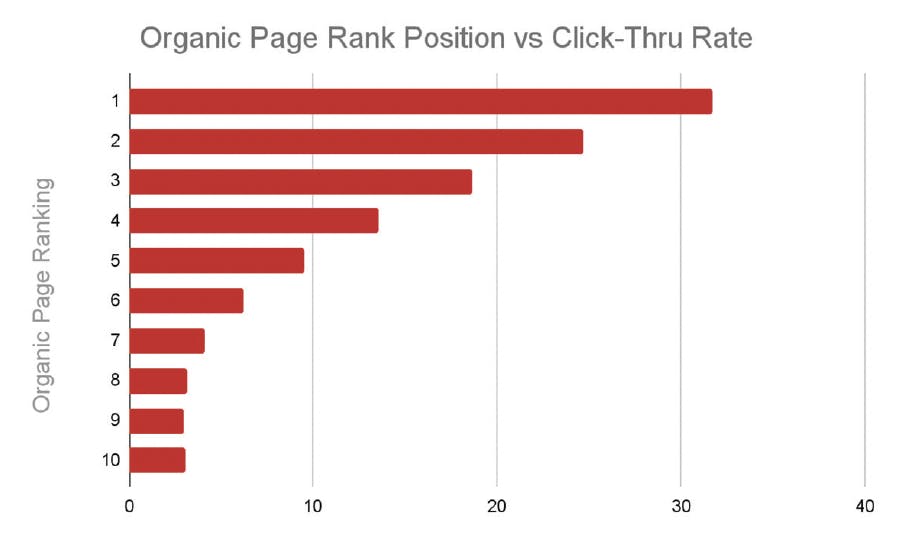
Figure. The higher your website ranks on an organic search, the better your odds of getting prospective patients to click through to your site.
PATIENT PERSONAS
After some strategic thought around who you’re trying to reach (or who is searching for you), it’s time to document it. Creating a list of patient personas is an effective means of humanizing a prospective patient population by giving a name, backstory, and other personal details to an otherwise cold set of data points. For retina specialists, this could be broken up a few ways.
Patients Versus Caregivers
The most obvious approach, which I covered above, is to create content that is designed for both the older patients themselves and their caregivers.
Chronic Versus Acute Condition
Another effective approach could be to focus your content creation efforts on two different clinical angles: information about acute conditions (such as treatment options for a retinal tear or retinal detachment) and information about chronic conditions (such as the current treatment strategies for AMD or DR).
Referral Sources
Finally, it is important to include content on your website that is geared toward your referral sources. Whether your prospective patients make an appointment through a referral from their primary care provider, go to the emergency room with an urgent condition, or are referred by their general ophthalmologist, you want to be sure that you provide each of those referral sources with thought-leadership content that effectively establishes your practice as the clear choice for their next referral.
Remember, referring physicians look to you to help them better understand a part of the eye that they don’t understand as well as you.
HOW TO ATTRACT NEW PATIENTS
Once you know where your website needs to be and who you’re trying to reach, you are ready to tackle digital strategies for attracting new patients to your website and, ultimately, your practice. For this, you need to understand how Google works and why it is a destination for valuable health care practice traffic.
How Google Works
They ask, you answer. That’s the best way I’ve found to sum up Google for retina practices. The first part is self-explanatory—your prospective patients are asking for information about their visual complaints. The second part is trickier. What does it mean for a retina practice to answer an online search query? To properly answer your prospective patients’ questions, you must create content that speaks directly to those questions or pain points. If you listen effectively and give valuable answers, you’ll quickly find yourself on the short-list of potential providers.
As a bonus, the more often you create authoritative thought-leadership content (a blog post about the signs and symptoms of a retinal tear, for example), the more Google will see you as a trusted resource, and your website will climb higher in the organic rankings.
Google loves fresh and relevant content that a searcher clicks on and spends time reading, and it is part of the algorithm that increases the quality score that helps you move up in the page ranking.
Content Strategy
Original content creation is the most effective way to provide the answers prospective patients, their caregivers, or your referral sources are searching for. Think about what retina patients would be searching for (ie, what keywords they might use), and that will drive your content creation.
If you get stuck, type common questions or terms into the search bar, and Google will pre-populate frequently searched-for terms and queries. There are also several free and inexpensive keyword planning tools you can use.
A regularly updated blog (maybe twice a month) is an excellent way for retina practices to provide resources that speak to patients; it can show empathy or give hope to patients looking for treatment options. Likewise, remember that referral sources look to you as an expert, so having a special resource section on your website is an excellent way to teach referral sources about retinal pathologies.
Videos are another good platform for sharing information. Patient-facing videos can feature doctors discussing various conditions and treatments. Doctor-facing videos could include walk-throughs on complex treatments and educational series describing the role of retina specialists.
Conversion Paths
Finally, it’s important to outline how to turn the prospective patient traffic into a lead that can be nurtured into a new patient. This is done by creating clear conversion paths for website visitors. A conversion path works like this: let’s say a prospective patient enters your website after finding a blog on Google about flashes and floaters. At the end of the blog, they see a call-to-action button that invites them to Schedule an Appointment. Clicking the button sends them to a landing page where they fill out a quick HIPAA-compliant form with the information necessary to proceed. From there, nurturing elements are put into action, such as an automated follow-up email or a reminder about their appointment date and time.
Another conversion path may be offering premium content that’s accessible only after website users provide specific information, such as their name and email address. They may not be ready to make an appointment (remember, they are searching for answers), but they may be willing to provide their contact information in exchange for a downloadable doctor discussion guide, a checklist that helps them identify a condition, or a patient handout about their suspected condition.
For referring physicians, a simple online referral form goes a long way. Busy practices tend to make referrals to specialists they trust, and it is in your best interest to make that referral process simple. Rather than providing forms that have to be hand-written, provide a fillable PDF or a webform that can be completed online.
MEASURING ROI
At the end of the day, you want all of these marketing strategies to provide a good ROI. When looking to invest in attracting new patients with certain conditions, “it is a good practice to consider patient lifetime value (PLV),” according to Tim McCormack, Executive Director at Illinois Eye Center, a multispecialty ophthalmology clinic in Peoria, Illinois. PLV is the amount of collected revenue a certain type of patient is likely to provide your practice per year, multiplied by the number of years they are likely to be a patient. To find this number, you will need to do some research using your practice management system and bruch up on yor math skills. Remember, every practice will be different based on local costs, market competition, outside marketing agency expenses, staff costs, insurance discounts, and other factors.
Below is a hypothetical 12-month example for a retina practice with two doctors using the diagnosis codes exclusive to AMD and DR (E10.3200-E10.3599, E11.3200-E11.3599, H35.3100-H35.3299).
Calculating Average PLV
$10,000,000 – Total charges
- $4,500,000 – Write-offs, negotiated insurance discounts, etc.
= $5,500,000 – Net total payments
$5,500,000 – Net total payments
- $3,530,000 – High-dollar drug costs
= $1,970,000 – Net revenue
$1,970,000 – Net revenue
÷ 2,250 – Unique count of patients
= $876 – Average annual net charges per patient
$876 – Average annual net charges per patient
x 10 – Average number of years a patient is with the practice
= $8,760 – PLV
Patient Acquisition Cost
Next, divide your annual marketing expenses specific to the diagnoses, AMD and DR in our example, with the number of new patients you generated in a year. This will give you the patient acquisition cost (PAC). Below is a hypothetical 12-month example for a retina practice with two doctors who conducted an annual digital media campaign to grow their practice with AMD and DR patients.
Calculating PAC
$15,000 – Annual digital media campaign
÷ 200 – New patients (influenced to join the practice by the campaign)
= $75.00 – PAC
PLV to PAC
Next, calculate a ratio to see what your ROI is for acquiring your new patients. In this example, $8,760 to $75 translates to an ROI of 117 to 1—$117 in revenue is generated for every $1 spent on paid digital media. Of course, we are only analyzing the paid digital media expenses; in reality, there are other factors, such as the services of an outside marketing agency and internal staff costs. Even if you handle all aspects of these campaigns internally, there is still a very real staff cost associated with success.
In addition, we are assuming the PAC is a one-time cost amortized against the long-term value of the patient. You pay the acquisition cost one time, but you benefit from the patient revenue for the entire time you keep the patient in your practice.
CONCLUSION
Differentiating and marketing your practice has far more nuance and complexity than the strategies outlined here. “There are a host of factors, including the patient experience, office staff, and local competition, to name a few, that play a role in practice success,” Mr. McCormick says. Still, incorporating these simple marketing steps can make your website more visible on Google, help you create thought-leadership content, and lead patients to your practice—all of which will pay off in the long run.
1. Ramaswami P. A remedy for your health-related questions: health info in the knowledge graph. Google. February 10, 2015. Accessed November 4, 2021. Blog.google/products/search/health-info-knowledge-graph
2. 2018 customer experience trends in healthcare. Doctor.com. Accessed November 4, 2021. www.doctor.com/cxtrends2018#download-report
3. Heitzman A. Organic vs. paid search: (66 astonishing) statistics for 2021. HigherVisibility.com. March 3, 2021. Accessed November 4, 2021. www.highervisibility.com/blog/organic-vs-paid-search-statistics
4. Dean B. Here’s what we learned about organic click through rate. Backlinko. August 27, 2019. Accessed November 4, 2021. Backlinko.com/google-ctr-stats


