




When Retina Today launched 15 years ago, the anti-VEGF era was in its infancy, with the first intraocular agent, pegaptanib (Macugen, Bausch + Lomb), gaining approval just 2 years prior. In fact, we were reporting on the 2-year safety data for pegaptanib in our very first issue in March 2006, published mere months before ranibizumab (Lucentis, Genentech) was approved.1 Everyone who was practicing at the time will never forget the excitement—and relief—we felt to finally have access to approved therapies that made a real difference for our patients with macular degeneration. Today, intravitreal injection of anti-VEGF agents encompasses a vast majority of our clinic hours, and this issue even includes a discussion of long-term outcomes in 130,247 eyes as far out as 5 years.
That first whirlwind of anti-VEGF approvals changed the face of retina care forever (check out this infographic to see what we mean). And now, it seems oddly fortuitous to be celebrating Retina Today’s 15th anniversary the same year the first extended-duration anti-VEGF option is approved. In our first year of publication, we rejoiced finding a treatment option that works; 15 years later, we are eager to welcome an approach that extends that efficacy up to 6 months. It’s no wonder that the approval of the port delivery system (PDS) with ranibizumab (Susvimo, Genentech/Roche) gave us a little déjà vu. It’s hopefully the first of many products that may help to reduce the treatment burden for our wet AMD patients.
But the PDS approval isn’t the only event making us feel a little nostalgic. We are seeing promising phase 3 data for therapeutics to treat patients with geographic atrophy (GA) who currently have no treatment options. GA has remained an unmet need for so long, and the hope for an approved therapeutic to slow GA progression is tantalizing. Still, we have seen large prospective phase 3 studies that didn’t meet their primary endpoints (think lampalizumab), reminding us to be cautious in our optimism.
Other therapies have made advances in drug delivery as well. In our first issue, we published an article detailing the pros and cons of off-label intravitreal triamcinolone use, in which Nancy M. Holekamp, MD, said she uses triamcinolone as a “salvage therapy when patients fail standard of care or if no standard of care is approved.” Today, that treatment is FDA approved and uses a novel suprachoroidal delivery.2
This month’s pipeline issue is the perfect space in which to explore the latest clinical trials—successful or otherwise—as well as celebrate the last 15 years that got us here. The plethora of trial data presented at The Retina Society, ASRS, and AAO is a testament to the drive that researchers, clinicians, and industry have to bring therapies to the patients who need them the most.
With so many groundbreaking developments rolling out and much more to come, we are more excited than ever to marry the old with the cutting-edge in this dual focus anniversary/pipeline issue. Within each of the featured pipeline articles, we added fun snippets of information from our first few issues to highlight just how far we have come regarding treatments for wet AMD, GA, biosimilars, diabetic eye disease, and surgical innovation.
When we look back fondly on where we started, we are astounded to see just how much has changed, for the better, in what feels like a very short amount of time.
1. Koury CB. Pegaptanib safety profile maintained through 2 years. Retina Today. 2006;1(1).
2. Suarez L. Considerations for intravitreal triamcinolone use. Retina Today. 2006;1(1).
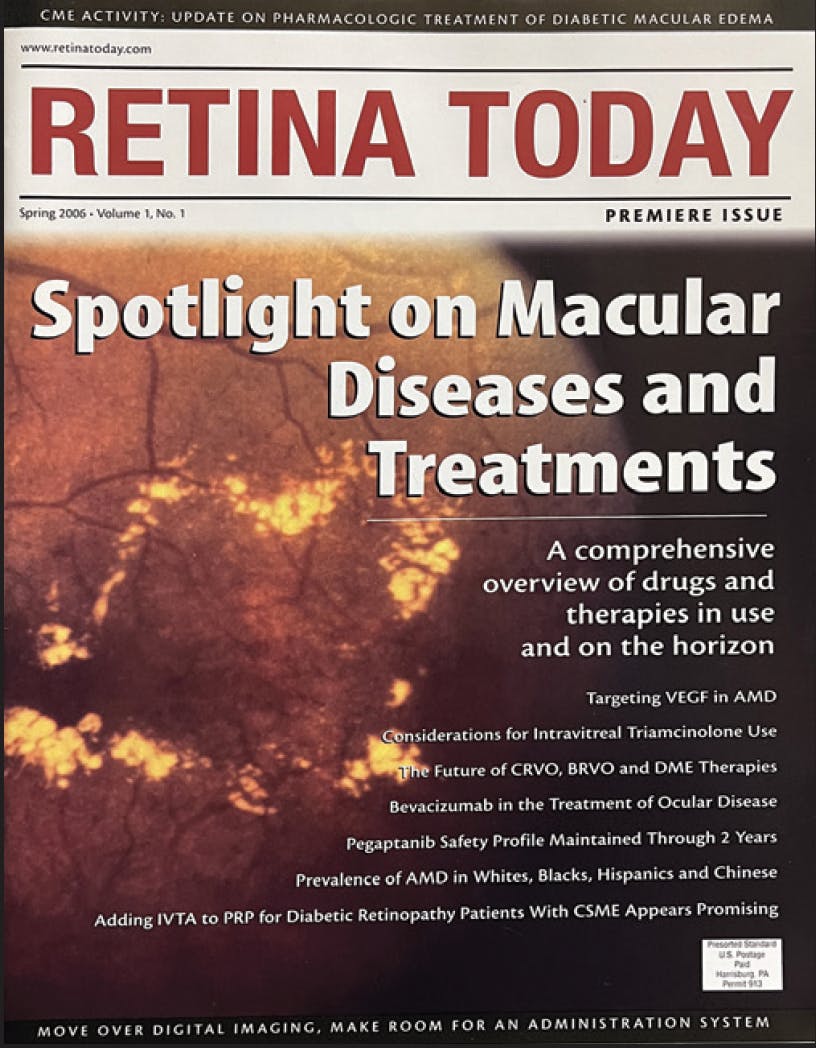
Retina Today’s inaugural issue focused on macular diseases and treatments; because most of the latter were still under investigation, it felt much like a pipeline issue.
-1_1643042672.jpg?auto=compress,format&w=70)

-1_1643727930.jpg?auto=compress,format&w=70)


