




Wet AMD, diabetic macular edema (DME), and retinal vein occlusion–related macular edema (RVO-ME) are leading causes of legal blindness in the industrialized world. In randomized clinical trials (RCTs), anti-VEGF agents have yielded meaningful improvements in vision for patients with these conditions. However, outcomes studies have demonstrated that patients in real-world situations receive fewer anti-VEGF injections and experience less visual improvement after 1 year than do those receiving protocol-based anti-VEGF therapy in large RCTs, with underperformance by approximately 8 to 9 letters for branch RVO-ME (BRVO-ME), 6 to 9 letters for central RVO-ME (CRVO-ME), 5 to 8 letters for DME, and 4 to 8 letters for wet AMD.1-15
There is a dearth of large long-term clinical outcomes studies of anti-VEGF therapy for these disorders. In wet AMD, small extension studies of RCTs have shown that visual acuity declines over time with a gain from baseline of only 2 letters by year 4,16 loss of 3 letters by 5.5 years,17 and loss of 8.6 letters by 7.3 years.18 In these studies, injection frequency declined meaningfully after cessation of the initial clinical trial protocol–mandated treatments. Similarly, in a DME extension study, mean VA improved from baseline by 7.4 letters at 5 years, but it had decreased by 4.7 letters between 2 and 5 years.19
REAL-WORLD STUDY
We recently assessed clinical outcomes in 130,247 eyes out to 5 years for DME and wet AMD and 3 years for RVO-ME using a large database of electronic health records (EHRs) from a demographically and geographically diverse panel of retina specialists in the United States.
Mining EHR data has many limitations, including its retrospective nature, the use of aggregated data, and lack of standardization of visual acuity assessments. Still, the data can yield important longitudinal insights to better understand patient outcomes in clinical practice.
Treatment-naïve wet AMD, DME, CRVO-ME, and BRVO-ME patients who underwent anti-VEGF injections between 2014 and 2019 were included in this study. To understand how treatment intensity and initial visual acuity influenced outcomes, results were also stratified by number of anti-VEGF injections and by baseline visual acuity.
With respect to baseline features, two-thirds of wet AMD patients were women, whereas sex distribution was more equal for RVO-ME and DME patients (Table 1). DME patients were the youngest on average (mean age of 60). Mean age for RVO-ME and wet AMD patients was in the early 70s and late 70s, respectively. The mean baseline visual acuity was lowest for CRVO-ME and highest for DME.
_1639675609.png?auto=compress,format)
OUTCOMES
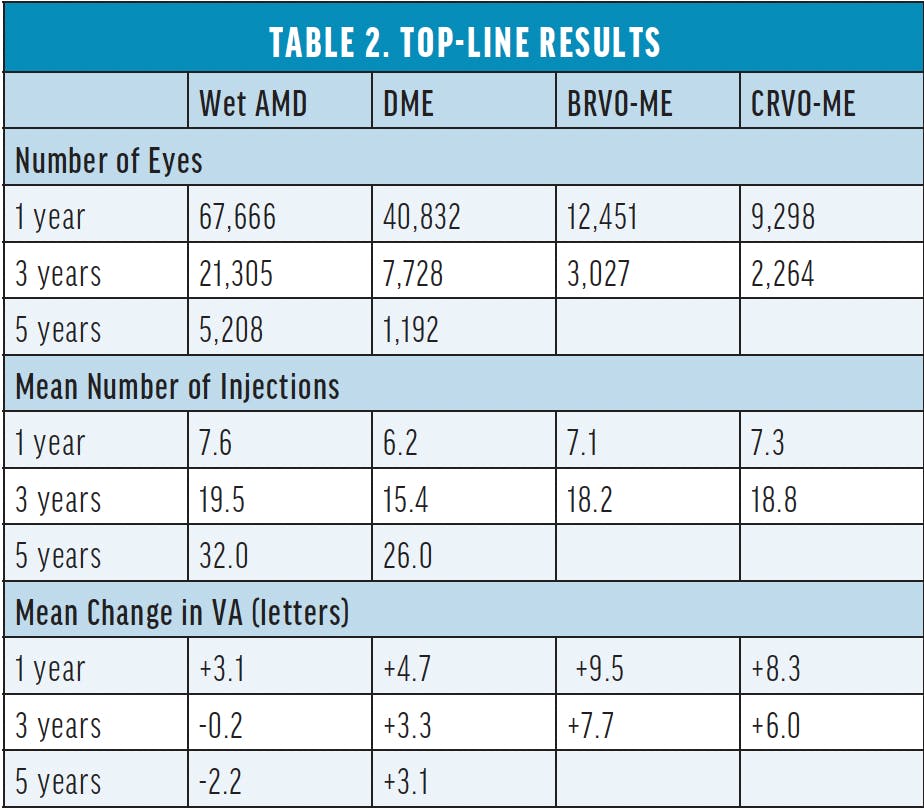
DME patients received the fewest injections on average and wet AMD patients received the most during each period studied (Table 2). Despite receiving the most injections, wet AMD patients gained the fewest letters at each point, whereas BRVO-ME patients gained the most. Across all disorders, 3- and 5-year data showed worse outcomes compared with 1-year outcomes. This study’s 1-year outcomes are consistent with those from earlier smaller studies that used the same database, revealing underperformance compared with RCTs (Figure). Across all disorders, the greatest number of injections occurred in year 1, which may partially account for the declining visual acuity results over time.
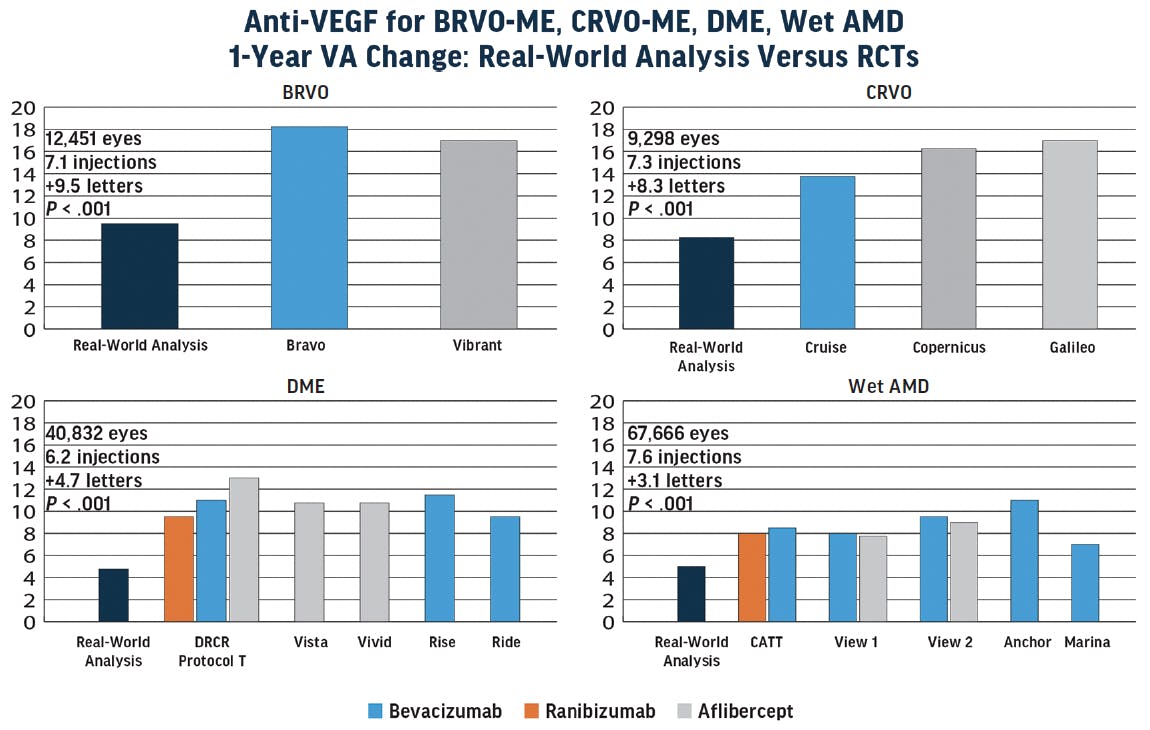
Cross-trial comparisons are limited by differences in eligibility criteria, therapeutic regimens, and endpoint evaluations, including nonstandardized visual acuity assessments in real-world studies. Nevertheless, the results presented here are similar to those of other long-term real-world studies with smaller sample sizes. The LUMINOUS study was a 5-year global, multicenter, open-label observational study evaluating real-world ranibizumab use in wet AMD.20 Recent data from the Belgian cohort of 229 wet AMD patients showed that injection frequency declined over time irrespective of prior treatment status, with treatment-naïve eyes receiving a mean of 4.2 ± 2.9 yearly injections and those with prior ranibizumab treatment receiving 3.6 ± 2.7. Regression analysis confirmed visual acuity increases for treatment-naïve eyes of 3.9 letters (P = .002) in year 1, followed by a slight decrease of 1.8 letters per year.20
Another retrospective study of 95 eyes reported 8-year real-world outcomes in eyes with wet AMD receiving as-needed ranibizumab treatment.21 A mean of 31.6 injections were given over the 8-year period, with a median of six injections in the first year and three injections in the eighth year. Baseline median VA was 61 ETDRS letters, increasing to 70 letters after initial loading doses but decreasing to 55 letters by year 8 (mean VA change from baseline -9.1 letters). Stable or improved vision was maintained in 47% of eyes at year 8.21
A 12-year retrospective study of 7,802 wet AMD patients reported that patients were more likely to experience positive visual outcomes (70 letters) within 2 years of beginning treatment, maintaining this vision for 1.1 years before deteriorating to poor vision (35 letters) within 8.7 years.22
The visual outcomes for DME and RVO patients were less favorable in our study compared with other smaller long-term studies. With respect to DRCR Retina Network’s Protocol T, approximately two-thirds of DME patients had 5-year follow-up data and had been managed at clinician discretion (simulating real-world treatment patterns) during the 3 years after Protocol T completion. Between years 2 and 5, 68% of eyes had at least one anti-VEGF injection (a median of four injections). Mean VA improved by 7.4 letters from baseline (compared with +3.1 letters in our study) but had decreased by 4.7 letters between year 2 and 5.19
Compared with our study, 8-year vision outcomes for anti-VEGF treatment in RVO were favorable in a retrospective multicenter study of 94 eyes.23 Despite being followed for 5 years longer than our study, BRVO-ME eyes gained 14.3 letters and CRVO-ME eyes gained 14.4 letters from baseline (compared with +7.7 and +6.0 in our study, respectively), while receiving a mean of four injections in year 8.23
UNDERTREATMENT
A common explanation for poor visual outcomes in real-world studies is undertreatment. For all disease states in our study, final visual acuity generally increased with greater treatment intensity. Of note, wet AMD patients who were treated with ≤ 43 injections over 5 years lost visual acuity on average, and the greatest losses were seen in those that received ≤ 21 injections. BRVO-ME and CRVO-ME patients at 3 years and DME patients at 5 years generally did not lose vision in any of the subgroups of treatment intensity.
One reason for fewer injections in the real world than in RCTs is the adoption of variable-frequency anti-VEGF therapy regimens that aim to decrease treatment burden for patients. The 2015 American Society of Retina Specialists Preferences and Trends survey of over 2,700 retina specialists in 60 countries found that more than 90% of responding retina specialists used OCT-guided variable-frequency anti-VEGF treatment protocols for patients with wet AMD.
Multiple prospective RCTs have demonstrated that variable-frequency anti-VEGF therapy for wet AMD results in a less favorable visual outcome compared with fixed, frequent anti-VEGF injections.24-28 In CATT, for example, patients assigned to monthly treatment experienced a statistically significant greater benefit in visual acuity gain compared with those receiving as-needed therapy (difference, 2.4 letters at 2 years; P = .046).24
Two studies have shown favorable outcomes for a treat-and-extend (TAE) regimen: the LUCAS study, which compared ranibizumab and bevacizumab for wet AMD,29 and the small, prospective, controlled TREX-AMD study, which compared TAE versus monthly dosing of ranibizumab.30 The mean number of treatments in the first year was 10.1 in the TREX study and 8.0 for ranibizumab and 8.9 for bevacizumab in the LUCAS study. Like the fixed, frequent regimens, the treatment intensity in these TAE studies also exceeded that of the current study, further supporting that relative undertreatment takes place in the real world.
BASELINE VISION AND OUTCOMES
When eyes were stratified by baseline visual acuity, the mean number of injections was similar across all groups; however, there was a consistent trend of diminishing improvement with better baseline visual acuity for all disease states at the end of year 3. Eyes with a mean baseline visual acuity of 20/40 or better had worsening vision for all conditions at the end of year 3, with losses of 6.4, 3.5, 2.9, and 8.0 letters in eyes with wet AMD, DME, BRVO-ME, and CRVO-ME, respectively.
Conversely, eyes with mean baseline visual acuity worse than 20/200 had the most impressive improvement, with gains of 16.3, 32.8, 36.9, and 23.0 letters for wet AMD, DME, BRVO-ME, and CRVO-ME, respectively. Generally, wet AMD eyes had worse outcomes compared with the other disease states, with visual acuity gains obtained only in eyes with baseline VA of 20/70 or worse.
BRVO-ME eyes had the best visual acuity outcomes across all groups, gaining up to 36 letters if baseline VA was 20/200 or worse, and losing only 3 letters if baseline VA was 20/40 or better. DME and CRVO-ME eyes followed a similar trend, although DME eyes had better outcomes than CRVO-ME eyes by approximately 5 letters across all subgroups.
THE FUTURE
Given the limited outcomes of anti-VEGF therapy for AMD in the real world, as highlighted by the studies discussed here, along with the burden of repeated intravitreal injections to sustain efficacy, long-acting therapies are under development. In addition, therapies that address pathways beyond the VEGF axis are being studied. These sustained-delivery treatments, new classes of therapies, and even combinations of therapies may meaningfully enhance outcomes for patients with wet AMD, DME, and RVO—leading causes of legal blindness. These innovations may not only durably restore vision but may also prevent vision loss in patients with good baseline visual acuity who may be more prone to vision loss in the long term.
1. Ciulla T, Pollack JS, Williams DF. Visual acuity outcomes and anti-VEGF therapy intensity in macular oedema due to retinal vein occlusion: a real-world analysis of 15,613 patient eyes. Preprint. Published online October 14, 2020. Br J Ophthalmol.
2. Ciulla TA, Pollack JS, Williams DF. Visual acuity outcomes and anti-VEGF therapy intensity in diabetic macular oedema: a real-world analysis of 28,658 patient eyes. Br J Ophthalmol. 2021;105(2):216-221.
3. Ciulla TA, Bracha P, Pollack J, Williams DF. Real-world outcomes of anti-vascular endothelial growth factor therapy in diabetic macular edema in the United States. Ophthalmol Retina. 2018;2(12):1179-1187.
4. Ciulla TA, Hussain RM, Pollack JS, Williams DF. Visual acuity outcomes and anti-vascular endothelial growth factor therapy intensity in neovascular age-related macular degeneration patients: a real-world analysis of 49,485 eyes. Ophthalmol Retina. 2020;4(1):19-30.
5. Brown DM, Campochiaro PA, Bhisitkul RB, et al. Sustained benefits from ranibizumab for macular edema following branch retinal vein occlusion: 12-month outcomes of a phase III study. Ophthalmology. 2011;118(8):1594-1602.
6. Campochiaro PA, Brown DM, Awh CC, et al. Sustained benefits from ranibizumab for macular edema following central retinal vein occlusion: twelve-month outcomes of a phase III study. Ophthalmology. 2011;118(10):2041-2049.
7. Brown DM, Heier JS, Clark WL, et al. Intravitreal aflibercept injection for macular edema secondary to central retinal vein occlusion: 1-year results from the phase 3 COPERNICUS study. Am J Ophthalmol. 2013;155(3):429-437.e427.
8. Clark WL, Boyer DS, Heier JS, et al. Intravitreal aflibercept for macular edema following branch retinal vein occlusion: 52-week results of the VIBRANT study. Ophthalmology. 2016;123(2):330-336.
9. Korobelnik JF, Holz FG, Roider J, et al. Intravitreal aflibercept injection for macular edema resulting from central retinal vein occlusion: one-year results of the phase 3 GALILEO study. Ophthalmology. 2014;121(1):202-208.
10. Brown DM, Kaiser PK, Michels M, et al. Ranibizumab versus verteporfin for neovascular age-related macular degeneration. N Engl J Med. 2006;355(14):1432-1444.
11. Rosenfeld PJ, Brown DM, Heier JS, et al. Ranibizumab for neovascular age-related macular degeneration. N Engl J Med. 2006;355(14):1419-1431.
12. CATT Research Group; Martin DF, Maguire MG, et al. Ranibizumab and bevacizumab for neovascular age-related macular degeneration. N Engl J Med. 2011;364(20):1897-1908.
13. Korobelnik JF, Do DV, Schmidt-Erfurth U, et al. Intravitreal aflibercept for diabetic macular edema. Ophthalmology. 2014;121(11):2247-2254.
14. Nguyen QD, Brown DM, Marcus DM, et al. Ranibizumab for diabetic macular edema: results from 2 phase III randomized trials: RISE and RIDE. Ophthalmology. 2012;119(4):789-801.
15. Diabetic Retinopathy Clinical Research Network; Wells JA, Glassman AR, et al. Aflibercept, bevacizumab, or ranibizumab for diabetic macular edema. N Engl J Med. 2015;372(13):1193-1203.
16. Singer MA, Awh CC, Sadda S, et al. HORIZON: an open-label extension trial of ranibizumab for choroidal neovascularization secondary to age-related macular degeneration. Ophthalmology. 2012;119(6):1175-1183.
17. CATT Research Group, Maguire MG, Martin DF, et al. Five-year outcomes with anti-vascular endothelial growth factor treatment of neovascular age-related macular degeneration: the comparison of age-related macular degeneration treatments trials. Ophthalmology. 2016;123(8):1751-1761.
18. Rofagha S, Bhisitkul RB, Boyer DS, et al. Seven-year outcomes in ranibizumab-treated patients in ANCHOR, MARINA, and HORIZON: a multicenter cohort study (SEVEN-UP). Ophthalmology. 2013;120(11):2292-2299.
19. Glassman AR, Wells JA, 3rd, Josic K, et al. Five-year outcomes after initial aflibercept, bevacizumab, or ranibizumab treatment for diabetic macular edema (Protocol T extension study). Ophthalmology. 2020;127(9):1201-1210.
20. Leys AM, Ramboer E, Favreau M, et al. Long-term ranibizumab treatment in neovascular age-related macular degeneration: a Belgian subanalysis from the global real-world LUMINOUS study. Clin Ophthalmol. 2020;14:1473-1481.
21. Horner F, Lip PL, Clark H, et al. Real-world visual and clinical outcomes for patients with neovascular age-related macular degeneration treated with intravitreal ranibizumab: an 8-year observational cohort (AMD8). Clin Ophthalmol. 2019;13:2461-2467.
22. Fu DJ, Keenan TD, Faes L, et al. Insights from survival analyses during 12 years of anti-vascular endothelial growth factor therapy for neovascular age-related macular degeneration. JAMA Ophthalmol. 2021;139(1):57-67.
23. Spooner KL, Fraser-Bell S, Hong T, Wong JG, Chang AA. Long-term outcomes of anti-VEGF treatment of retinal vein occlusion. Preprint. Published online June 11, 2021. Eye (Lond).
24. CATT Research Group, Martin DF, Maguire MG, et al. Ranibizumab and bevacizumab for treatment of neovascular age-related macular degeneration: two-year results. Ophthalmology. 2012;119(7):1388-1398.
25. Regillo CD, Brown DM, Abraham P, et al. Randomized, double-masked, sham-controlled trial of ranibizumab for neovascular age-related macular degeneration: PIER study year 1. Am J Ophthalmol. 2008;145(2):239-248.
26. Abraham P, Yue H, Wilson L. Randomized, double-masked, sham-controlled trial of ranibizumab for neovascular age-related macular degeneration: PIER study year 2. Am J Ophthalmol. 2010;150(3):315-324.e311.
27. Chakravarthy U, Harding SP, Rogers CA, et al. Alternative treatments to inhibit VEGF in age-related choroidal neovascularisation: 2-year findings of the IVAN randomized controlled trial. Lancet. 2013;382(9900):1258-1267.
28. Schmidt-Erfurth U, Eldem B, Guymer R, et al. Efficacy and safety of monthly versus quarterly ranibizumab treatment in neovascular age-related macular degeneration: the EXCITE study. Ophthalmology. 2011;118(5):831-839.
29. Berg K, Pedersen TR, Sandvik L, Bragadottir R. Comparison of ranibizumab and bevacizumab for neovascular age-related macular degeneration according to LUCAS treat-and-extend protocol. Ophthalmology. 2015;122(1):146-152.
30. Wykoff CC, Croft DE, Brown DM, et al. Prospective trial of treat-and-extend versus monthly dosing for neovascular age-related macular degeneration: TREX-AMD 1-year results. Ophthalmology. 2015;122(12):2514-2522.


-1_1643727930.jpg?auto=compress,format&w=70)
-1_1643042672.jpg?auto=compress,format&w=70)


