


In the United States, choroidal nevus—a stable, melanocytic tumor—is found in up to 6.5% of the White population, 0.6% of the Black population, and 2.7% of the Hispanic population.1,2 Choroidal nevi can grow into melanoma, or they can enlarge slowly over a long period of time without melanoma transformation.3
Although choroidal nevi can affect vision, most are asymptomatic with little impact on visual function or refractive error. Shields et al evaluated a cohort of 3,422 consecutive eyes with choroidal nevi, categorized as either subfoveal or extrafoveal, and found that the median VA at presentation was 20/20 in both cohorts. However, at the 15-year follow-up, vision loss of ≥ 3 logMAR lines of vision was observed in 26% of eyes with subfoveal tumors compared with only 2% of eyes with extrafoveal tumors.4 Vision loss due to a subfoveal choroidal nevus is most often related to tumor-induced retinal pigment epithelial (RPE) alterations (especially RPE detachment), lipofuscin pigment, and foveal edema.4
Regarding progression to melanoma, Qiu and Shields used the US National Health and Nutrition Examination Survey to identify 5,575 participants 40 years or older and found no association between choroidal nevus and skin melanoma; however, there was a relationship with uveal melanoma.2 Singh et al retrospectively estimated that one in 8,845 choroidal nevi demonstrated evolution into choroidal melanoma, presuming that all melanoma arises from a nevus.5 Shields et al longitudinally studied the growth of choroidal nevi into melanoma and found that growth occurred in 2% at 1 year, 9% at 5 years, and 13% at 10 years.6 Shields and colleagues subsequently identified objective criteria, based on multimodal imaging, to identify at-risk nevi for early treatment.7
Choroidal nevi that slowly enlarge without progressing to melanoma are poorly understood. Growth of a choroidal nevus has been considered a key determining feature suggestive of melanoma transformation.8 However, recent literature shows that some choroidal nevi can enlarge slowly during a patient’s younger years and thereafter remain stable.9 Here we describe a case of slow enlargement of a benign choroidal nevus. Importantly, this case emphasizes that slow nevus growth in the absence of risk factors can represent benign enlargement, especially in young patients.
CASE REPORT
A 28-year-old White woman was diagnosed, using wide-angle imaging, with a choroidal nevus 4 years prior to presentation to our clinic (Figure 1A). The nevus was monitored annually and remained stable for 3 years, according to the referring physician. However, in year 4, enlargement was noted, and the patient was referred for our opinion. Medical and ocular history were noncontributory. Family history revealed cutaneous melanoma in a paternal grandparent.
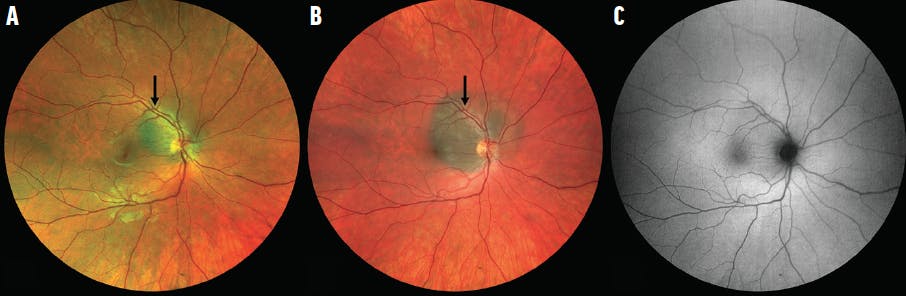
Figure 1. Wide-angle photography of the right eye shows a pigmented juxtapapillary choroidal nevus (arrow, A). Four years later, wide-angle photography reveals enlargement of the choroidal nevus (arrow denoting original margin, B) and fundus autofluorescence demonstrates absence of orange pigment or subretinal fluid (C).
On examination, BCVA was 20/20 OU. The pupils, IOP, and anterior segment findings were within normal limits in each eye. The left fundus was unremarkable. The right fundus revealed a juxtapapillary pigmented choroidal mass measuring 7 mm in basal diameter, appearing approximately 1 mm larger than was documented 4 years prior (Figure 1B). Fundus autofluorescence (FAF) showed no areas of orange pigment or subretinal fluid (Figure 1C). Ultrasonography demonstrated a flat, dense choroidal mass with a thickness of 1.83 mm (Figure 2A). OCT showed an intact retina with no subretinal fluid (Figure 2B). Multimodal imaging revealed only one risk factor: diameter > 5 mm. A diagnosis of benign, slow enlargement of choroidal nevus was made, and observation was recommended.
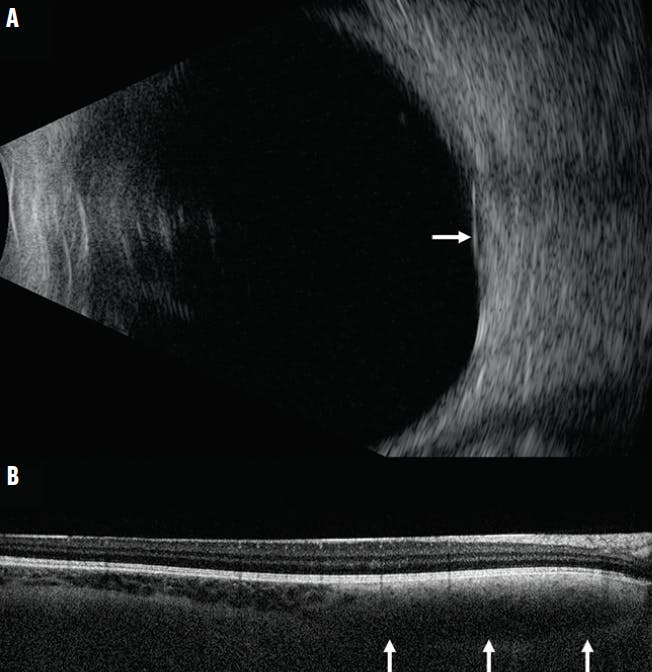
Figure 2. Ultrasonography of the right eye shows a flat, dense choroidal mass with thickness of 1.83 mm (arrow, A). OCT shows an intact retina with no subretinal fluid and the deep choroidal mass with loss of vascular markings (arrows, B).
DISCUSSION
Evaluation and imaging are important steps to determine if a choroidal nevus is at risk for progression into melanoma. There are six important risk factors related to the transformation of a choroidal nevus into melanoma, remembered by the mnemonic to find small ocular melanoma doing imaging (TFSOM-DIM), which represents Thickness > 2.0 mm on ultrasonography, Fluid (subretinal) on OCT, Symptoms (VA ≤ 20/50) on Snellen acuity, Orange pigment on FAF, Melanoma acoustic hollowness on ultrasonography, and DIaMeter > 5.0 mm on fundus photography (Table).7 Each of these risk factors is identified by imaging or visual acuity testing using objective criteria.
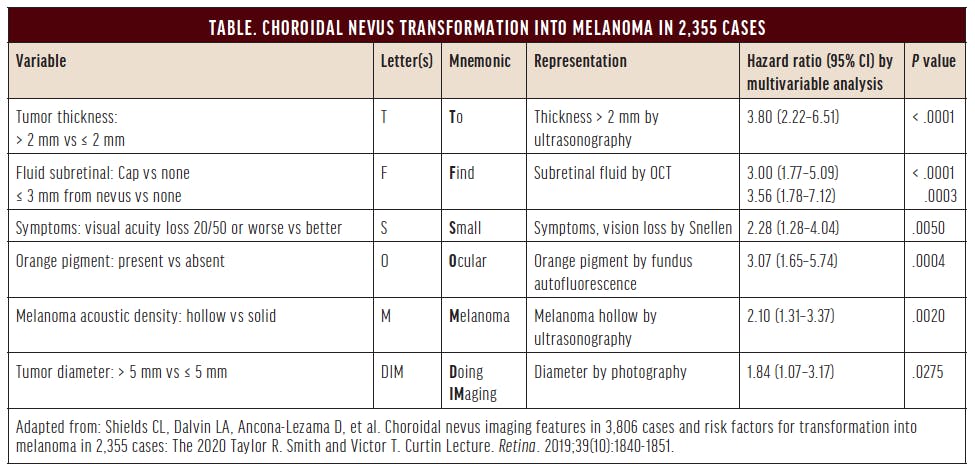
In this patient, all imaging risk factors were absent except for nevus diameter > 5.0 mm. Based on the mean 5-year estimates, patients with one risk factor have an overall 11% rate of growth into melanoma.7 Furthermore, tumor diameter > 5.0 mm was found to be the weakest risk factor (P = .0275; hazard ratio, 1.84).7 Thus, cautious observation was advised for our patient with the intent to treat if further growth or development of other factors was observed.
Choroidal nevus with growth into melanoma tends to occur with a mean 1.0 mm/year diameter growth rate and 0.5 mm/year increase in thickness, often with development of other features such as subretinal fluid (63%), orange pigment (40%), and acoustic hollowness (30%).7 Benign choroidal nevus enlargement, however, is a relatively slow process with a mean diameter increase of only 0.06 mm/year.9 In a study of 284 choroidal nevi, researchers observed 31% of the nevi with very slow enlargement on follow-up over a mean 15 years.9 Enlargement was inversely related to age, with 54% of nevus growth observed in patients < 40 years, 34% in patients between 41 and 60 years, and 19% in patients > 60 years.9
We speculate that benign nevus enlargement may be more common in young adults. Most notably, patients with slow enlargement of choroidal nevus demonstrate further stability without the development of melanoma features over a mean follow-up of 15 years.9
In this case, the patient had only one risk factor, a basal diameter of 7 mm, with slow nevus enlargement of approximately 0.25 mm/year. Although this is faster than most nevi enlargement, it is slower than melanoma growth. Thus, we recommended cautious observation with long-term follow-up. This case highlights that slow growth of choroidal nevus, especially in young patients, is not a definitive sign of melanoma transformation.
Clinicians must assess all six risk factors of choroidal nevus when making a judgement regarding the potential for future growth, keeping in mind that a subset of patients might show slow enlargement of nevus without risk factors and without transformation into melanoma. For those patients, observation may be a suitable management option.
Support provided in part by the Eye Tumor Research Foundation, Philadelphia (CLS). The funders had no role in the design and conduct of the study, in the collection, analysis and interpretation of the data, and in the preparation, review or approval of the manuscript. Carol L. Shields, MD, has had full access to all the data in the study and takes responsibility for the integrity of the data.
1. Sumich P, Mitchell P, Wang JJ. Choroidal nevi in a white population: The Blue Mountains Eye Study. Arch Ophthalmol. 1998;116(5):645-650.
2. Qiu M, Shields CL. Choroidal nevus in the United States adult population: racial disparities and associated factors in the national health and nutrition examination survey. Ophthalmology. 2015;122(10):2071-2083.
3. Shields CL, Furuta M, Mashayekhi A, et al. Clinical spectrum of choroidal nevi based on age at presentation in 3422 consecutive eyes. Ophthalmology. 2008;115(3):546-552.
4. Shields CL, Furuta M, Mashayekhi A, et al. Visual acuity in 3422 consecutive eyes with choroidal nevus. Arch Ophthalmol. 2007;125(11):1501-1507.
5. Singh AD, Kalyani P, Topham A. Estimating the risk of malignant transformation of a choroidal nevus. Ophthalmology. 2005;112(10):1784-1789.
6. Shields CL, Furuta M, Berman EL, et al. Choroidal nevus transformation into melanoma: Analysis of 2514 consecutive cases. Arch Ophthalmol. 2009;127(8):981-987.
7. Shields CL, Dalvin LA, Ancona-Lezama D, et al. Choroidal nevus imaging features in 3,806 cases and risk factors for transformation into melanoma in 2,355 cases: The 2020 Taylor R. Smith and Victor T. Curtin Lecture. Retina. 2019;39(10):1840-1851.
8. Char DH, Heilbron DC, Juster RP, et al. Choroidal melanoma growth patterns. Br J Ophthalmol. 1983;67(9):575-578.
9. Mashayekhi A, Siu S, Shields CL, et al. Slow enlargement of choroidal nevi: a long-term follow-up study. Ophthalmology. 2011;118(2):382-388.


