


Performing in-office procedures comes with the territory of being a vitreoretinal surgeon. You can often use these techniques to resolve common problems, even selected postoperative complications, without a trip to the OR. By minimizing repeat operations, you can save time and costs, and give patients a positive experience.
This article reviews the most effective approaches to several in-office retinal procedures.
IN-OFFICE BASICS
Almost all in-office retina procedures start with the same basic steps.
- You, the patient, and your technician should all wear surgical masks due to the proximity of oral and nasal bacteria. You can also tape the patient’s mask over the nose to further minimize transmission of oral and nasal bacteria to the procedure site.
- Lay instruments on a sterile drape.
- Wear sterile gloves while manipulating the sterile eyelid speculum and in case of inadvertent contact with any needles.
- Clean the eyelids and lashes with povidone iodine. You can instill topical 2% lidocaine, proparacaine, or tetracaine prior to 5% povidone iodine (betadine) to further minimize discomfort. Povidone iodine is currently the proven antiseptic. Because iodine is required for essential functions of the thyroid gland, an allergy to iodine cannot exist.1 You can reduce irritation of the skin and corneal epithelium with post-procedure irrigation with sterile saline or balanced salt solution. Additionally, use of preservative-free artificial tear lubricants may greatly reduce irritation and discomfort after the procedure, as well as a drop of a topical NSAID before.2
- Depending on the procedure in question, subconjunctival lidocaine may be required.
- Use a sterile, bladed eyelid speculum to expose the procedure site and contain the eyelashes. Use a separate sterile eyelid speculum for each eye.
INTRAVITREAL INJECTIONS
Do not perform an intravitreal injection in the presence of blepharitis or conjunctivitis, unless for the treatment of endophthalmitis. Complete an appropriate slit lamp examination of the eyelids and conjunctiva before performing intravitreal injections to ensure these conditions are not present. In addition, do not stop anticoagulants prior to intravitreal injection or other procedures; doing so places patients at increased thromboembolic risk, for which the anti-VEGF medication may be incorrectly blamed.3
Patients are first prepped using the steps outlined above. Subconjunctival lidocaine is usually not required, as the risk of perforation, pain of anesthetic injection, and patient discomfort outweigh the value of additional anesthesia. The injection site should be 3.5 mm to 4 mm posterior to the limbus, depending on lens status. Instill a drop of povidone iodine over the injection site after placing the eyelid speculum and immediately before injection. Give the patient a fixation point. We typically perform injections in the inferotemporal quadrant due to the natural Bells reflex many patients experience; it also helps to avoid the superior quadrants in patients who have had prior glaucoma filtering surgery. Assess retinal circulation with indirect ophthalmoscopy and confirm counting fingers VA after each injection.
PARS PLANA TAP WITH AND WITHOUT ANTIBIOTIC INJECTION
A pars plana tap is necessary in the case of IOP elevation with excessive oil or gas, with gas mixture–related overexpansion, and for removal of a sufficient sample for microbiologic laboratory analysis in the setting of endophthalmitis. After the initial preparation, we typically use subconjunctival 2% lidocaine, in addition to topical anesthetic drops, to obtain adequate anesthesia.
For gas overfills or gas mixture–related overexpansion, a 30-gauge needle on an empty tuberculin syringe with the plunger removed (thus open to the atmosphere) inserted through the pars plana will allow passive egress of gas to equilibrate the IOP. For removal of silicone oil, a 25-gauge needle on a tuberculin syringe open to the atmosphere or a 25-gauge non-valved trocar, inserted at a 15° angle to create a self-sealing wound, is required. The elevated IOP is sufficient to allow for egress of excess silicone oil through a non-valved trocar or empty tuberculin syringe.
In cases of endophthalmitis, insertion of a 27-gauge valved trocar through the pars plana 3.5 mm to 4 mm from the limbus, at a 15° angle, is ideal. The trocar method allows for the collection of vitreous sample and injection of antibiotics through a single injection site, as opposed to multiple injections, reducing patient discomfort. In the setting of inadequate vitreous sample volume removal with intravitreal injection of antibiotics, an anterior chamber paracentesis (outlined below) is required to sufficiently lower IOP.
PNEUMATIC RETINOPEXY
This is a highly effective method of primary repair for superior retinal detachments (RDs) with single or multiple closely grouped breaks. Although pneumatic retinopexy has been a useful technique since the late 1980s, it has been used less frequently in recent years due to the advent of and greater reattachment success rates with transconjunctival, sutureless 25- and 27-gauge pars plana vitrectomy (PPV).4
We typically use topical tetracaine, proparacaine, or 2% lidocaine, along with subconjunctival 2% lidocaine anesthesia. Rarely, retrobulbar or peribulbar anesthesia is required. Prep the patient using the steps above, and position the patient on his or her side, rather than in a supine or seated position.
We use C3F8 gas, rather than SF6 gas or air, due to the three-to-four times greater expansion of C3F8 compared with air (SF6 expands two times greater than air). We inject 0.6 cc of 100% C3F8 gas using a 1-cc tuberculin syringe on a 30-gauge needle, although the optimal volume is controversial.5 Slower gas injection, along with injection at the highest point with the needle inserted just through the pars plana, is key to avoiding multiple small bubbles, or “fish eggs.” The use of 0.6 cc C3F8 gas requires an anterior chamber paracentesis after the procedure, given the increase in IOP. Use of a small-diameter needle and changing the patient’s position immediately following the injection will minimize the risk of gas leaking through the injection site.
Retinal breaks are typically treated 1 to 2 days, followed with laser indirect ophthalmoscope (LIO) retinopexy after reattachment. If there is an insufficient view, limiting the use of LIO, you can perform pre- or post-reattachment transscleral cryotherapy.
ANTERIOR CHAMBER PARACENTESIS
In our clinical practice, anterior chamber paracentesis is used after pneumatic retinopexy or anti-VEGF injection and to relieve IOP for the urgent treatment of viscosity or particulate glaucoma.6
Perform anterior chamber paracentesis at the slit lamp with an eyelid speculum in place and the patient seated upright. Instill 5% povidone iodine, unless it was recently used for intravitreal injection or pneumatic retinopexy. Place a 30-gauge needle through the inferior limbus parallel to the iris plane at an oblique angle into the anterior chamber. Needle placement over the iris, as opposed to directed toward the pupil, decreases the risk of inadvertent lens touch or damage. Entering at an oblique angle also ensures a self-sealing wound. You can repeat anterior chamber paracentesis as needed to adequately lower IOP once the chamber sufficiently refills.
Do not use anterior chamber paracentesis in cases of elevated IOP secondary to anterior chamber silicone oil emulsification while silicone oil remains in the vitreous cavity or to relieve IOP secondary to gas mixture–related overexpansion. These complications require a repeat PPV with silicone oil removal and a pars plana tap, respectively.6
TWO-NEEDLE ANTERIOR CHAMBER WASHOUT
In cases of particulate glaucoma due to retained perfluoro-carbon-liquid (PFCL) or emulsified silicone oil in the anterior chamber, perform a two-needle anterior chamber washout to remove the causative agent.6 For this technique, use one needle to infuse balanced salt solution and a second needle for droplet egress—maintaining the anterior chamber throughout the procedure.
Prep the patient as outlined above. Fill a 10-cc syringe with balanced salt solution and attach it to sterile 7-inch extension tubing and a 30-gauge needle. Attach the second 30-gauge needle to a tuberculin syringe open to the atmosphere to allow for droplet egress.
For retained PFCL, position the patient seated at the slit lamp. Place the infusion needle superiorly at an oblique angle into the anterior chamber through the limbus parallel to the iris plane. Insert the egress needle in a similar manner, while staying over the iris with the bevel facing upward at the 6:00 clock position to facilitate PFCL egress. The assistant then slowly pushes the balanced salt solution syringe to allow egress of fluid through the empty tuberculin syringe. Once sufficient PFCL droplets have been removed, turn the egress needle to the bevel down position to remove any additional PFCL droplets in the angle. Remove the egress needle, and adjust IOP with the balanced salt solution syringe.
In the case of silicone oil emulsification in the anterior chamber, the procedure is similar to that for PFCL droplet removal. Unlike PFCL, however, silicone oil emulsification floats in aqueous, and the patient must be supine while you use an operating microscope or loupes. Place the infusion and egress needles at comfortable locations for you to insert the needles at an oblique angle, again parallel to the iris plane and staying over the iris. Insert the egress needle with the bevel facing upward and rotate it along the limbal axis to the proper location to avoid lens damage. The assistant then slowly pushes the balanced salt solution syringe to allow egress of fluid. Be careful to avoid damaging the corneal endothelium during silicone oil removal.
TWO-NEEDLE FLUID-GAS EXCHANGE
Occasionally, patients may develop recurrent RDs or vitreous hemorrhage following PPV. Additionally, some macular holes fail to close following repair. In these scenarios, assuming prior adequate vitreous removal, perform an in-office two-needle fluid-gas exchange through the pars plana using an iso-expansile concentration of SF6 gas (25%).
The preparation is similar to that of a pneumatic retinopexy, with the patient positioned on his or her side with the eye in question down (ie, for right eyes, patients should be on their right side). In this position, the nasal side of the eye is the highest point, at which you can insert a 30-gauge needle 3.5 mm to 4 mm posterior and perpendicular to the limbus. Advance the needle 2 mm to 3 mm through the pars plana to minimize the formation of “fish eggs.” Attach this superior injection needle to 7-inch extension tubing and a 60-cc iso-expansive air-gas filled syringe operated by an assistant (Figure).
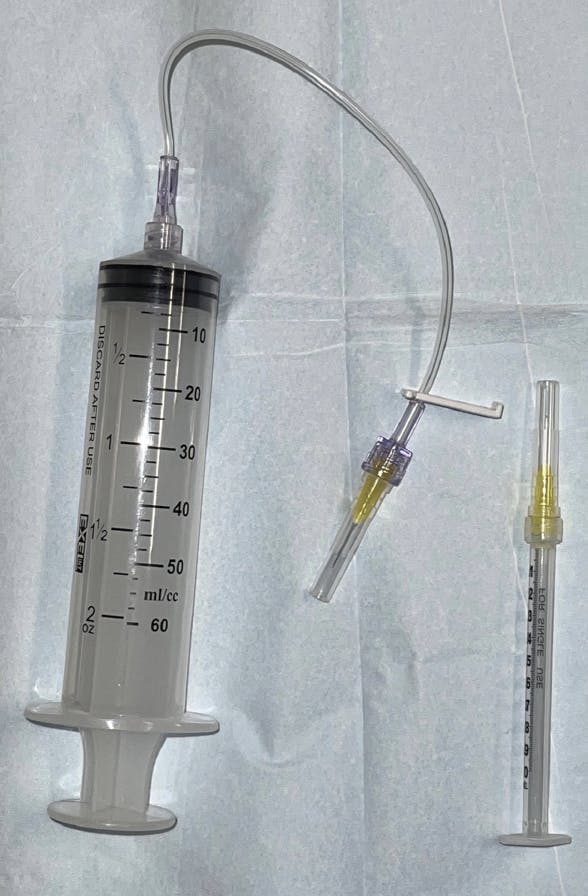
Place a second 27- or 30-gauge egress needle at the lower most part of the eye, temporally, again 3.5 mm to 4 mm from the limbus. Attach the needle to a tuberculin syringe with the plunger removed to act as a handle. Direct the open end of the tuberculin syringe over a waste can to collect the fluid. The assistant slowly pushes the iso-expansile gas mixture syringe, and egress of fluid may be noted through the lower syringe. Continue the exchange until the air-gas mixture is observed through the egress needle. Slowly withdraw the egress needle while tilting it slightly to ensure a full gas fill. Adjust IOP using the air-gas infusion syringe, along with tactile assessment of the IOP with a gloved fingertip.
Once IOP has been appropriately adjusted, remove the nasal air-gas infusion needle, and position the patient based on lens status and tear/hole location. In the case of post-PPV RD, you can often perform LIO laser retinopexy the same day as the two-needle fluid-gas procedure, if reattachment has occurred.
CONCLUSION
Using the above in-office procedures, many problems encountered in the retina practice can be effectively and efficiently resolved, minimizing costly and frustrating repeat trips to the OR.
1. Krohne TU, Allam JP, Novak N, Holz FG. [“Iodine allergy”: a medical myth with risks for the ophthalmological patient]. Ophthalmologe. 2016;113(12):1023-1028. [German].
2. Popovic MM, Muni RH, Nichani P, Kertes PJ. Topical nonsteroidal anti-inflammatory drugs for pain resulting from intravitreal injections: a meta-analysis. Ophthalmol Retina. 2020;4(5):461-470.
3. Charles S, Rosenfeld PJ, Gayer S. Medical consequences of stopping anticoagulant therapy before intraocular surgery or intravitreal injections. Retina. 2007;27(7):813-815.
4. Hillier RJ, Felfeli T, Berger AR, et al. The pneumatic retinopexy versus vitrectomy for the management of primary rhegmatogenous retinal detachment outcomes randomized trial (PIVOT). Ophthalmology. 2019;126(4):531-539.
5. Charles S, Huddleston S, Wood B. Vitreous Microsurgery. 6th ed. Philadelphia, PA; Lippincott Williams and Wilkins; 2021
6. Charles S, Pflugrath A. Glaucoma in the Retina Practice: Part 2. Retina Today. 2021;16(4):47-49.


