


Uveal melanoma expresses VEGF, which promotes tumor angiogenesis and growth.1-3 A study by Missotten et al found that eyes with uveal melanoma displayed median VEGF concentrations of 146 pg/mL compared with 50.1 pg/mL in controls.2 Eyes with retinal detachment had median VEGF levels of 43.5 pg/mL, suggesting the high VEGF levels in uveal melanoma cannot be explained by the presence of retinal detachment alone.2 The study also demonstrated eyes that underwent radiation therapy for uveal melanoma had even higher median VEGF concentrations at 364 pg/mL.2 Specifically, after proton beam radiotherapy, VEGF levels were 1,058 pg/mL and 3,000 pg/mL in two eyes; after plaque radiotherapy, VEGF levels ranged from 79 pg/mL to 555 pg/mL in four eyes.2
Despite elevated levels of intraocular VEGF in uveal melanoma, cystoid macular edema (CME) is rarely found prior to treatment.1,4 We describe a patient who presented with unilateral CME and was later detected to have a post-equatorial extra-macular choroidal melanoma.
CASE REPORT
A healthy 42-year-old Hispanic man noted blurred vision in his right eye and was found to have “fluid” in the retina, initially diagnosed at another clinic as central serous chorioretinopathy (CSCR). At 10 months follow up, there was persistent fluid, and further inspection revealed a newly detected choroidal mass. He was referred to our Ocular Oncology Service for evaluation.
The patient denied diabetes mellitus and was otherwise healthy. On presentation, VA was 20/200 OD and 20/40 OS. The anterior segment was unremarkable in each eye. Dilated fundus examination demonstrated no abnormalities in the left eye. In the right eye, a pigmented choroidal melanoma was noted inferotemporally, measuring 14 mm in basal diameter and 4.2 mm in thickness. The mass was 8 mm from the foveola and 10 mm from the optic disc. Subretinal fluid was present surrounding the mass but not at the foveola. Notably, there was retinal invasion of the mass with mild, fresh, and chronic vitreous hemorrhage (Figure 1A). A dilated retinal arteriole feeding the tumor was slightly beaded (Figure 1B), and a venule draining the tumor, which was best observed on fluorescein angiography, was nondilated. OCT of the right eye confirmed the presence of CME, measuring 640 µm in central macular thickness (CMT; Figure 1C). B-scan ultrasonography demonstrated a somewhat echodense mass without extrascleral extension. These features were suggestive of choroidal melanoma with retinal invasion and remote CME.
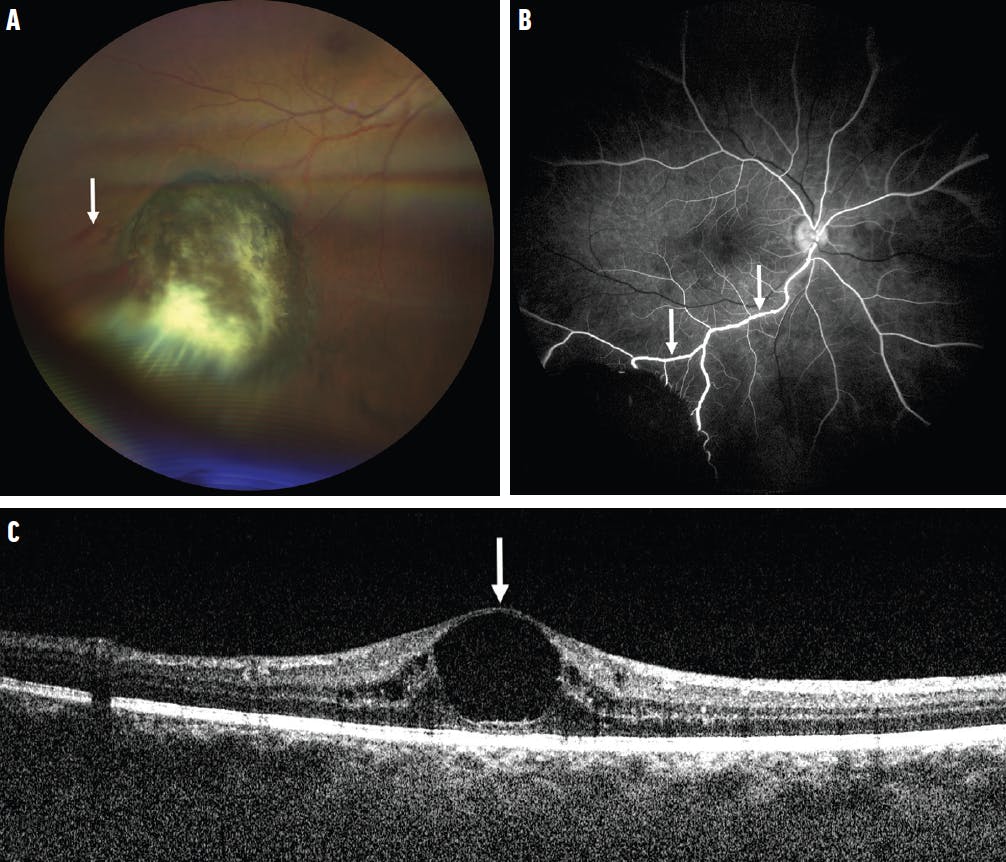
Figure 1. Wide-angle fundus photography revealed a choroidal melanoma with overlying acute vitreous hemorrhage (arrow, A). There is also white vitreous fibrosis from chronic hemorrhage. Intravenous fluorescein angiography showed a slightly dilated and beaded feeding retinal arteriole (arrows, B). Note the melanoma is hypofluorescent due to retinal invasion. OCT revealed prominent CME with 640 µm in average central thickness (arrow, C).
The melanoma was treated with iodine-125 plaque radiotherapy. Intravitreal anti-VEGF therapy with bevacizumab (Avastin, Genentech) was administered at 1 month to reduce CME and subretinal fluid to improve visual acuity. During this visit, VA was steady at 20/200 OD. OCT demonstrated stable CME with a CMT of 660 µm, and tumor thickness was reduced from 4.2 mm to 3.8 mm. Monthly injections of bevacizumab until CME resolution was suggested.
DISCUSSION
The most common etiologies of CME include post-cataract extraction; diabetic or hypertensive retinopathy; central or branch retinal vein occlusion; and post-radiation therapy.5-7 Among intraocular tumors, there is a higher incidence of CME with retinal hemangioblastoma and vasoproliferative tumors than with uveal melanoma.8
A PubMed search for the key words “cystoid macular edema,” “melanoma,” and “choroid” revealed 11 published cases of CME secondary to choroidal melanoma.4,5,9-13 The average age of affected individuals was 58 years (range 13-80 years). Like our patient, nine of the 11 patients were otherwise healthy with no medical comorbidities. One patient had diabetes mellitus and unrelated prior radium radiation treatment.5 Another patient had a history of metastatic colon cancer.11 Mean logMAR VA was 0.83 (20/134) and ranged from 20/20 to counting fingers on initial presentation. Seven cases showed signs of retinal detachment or retinal invasion. This may suggest that CME is more likely present in tumors that disrupt the retina.4,5,9-13 Patients with a concurrent retinal detachment or retinal invasion also had poorer VA at initial presentation (logMAR of 1.09 [20/246]) compared with patients who did not (logMAR of 0.28 [20/38]). This is consistent with our patient, who demonstrated retinal invasion from choroidal melanoma with VA of 20/200 at initial presentation.
CONCLUSION
Several mechanisms have been proposed for the pathogenesis of CME in eyes with choroidal melanoma. These include chronic retinal degeneration, chronic retinal pigment epithelium alterations, chronic retinal detachment, inflammation from tumor necrosis, and remote development of edema via intravitreal tumor-related factors.4
In our patient, we believe the retinal invasion from the underlying choroidal melanoma resulted in retinal disruption that possibly allowed for elevated VEGF levels in the vitreous cavity. However, in most cases, this rarely leads to CME remote from the tumor site. Further study is needed to determine whether VEGF levels in uveal melanoma with retinal invasion match or exceed VEGF levels in uveal melanoma without retinal invasion, as well as to elucidate the mechanism underlying this process.
Support provided in part by the Eye Tumor Research Foundation, Philadelphia. The funders had no role in the design and conduct of the study, in the collection, analysis and interpretation of the data, and in the preparation, review or approval of the manuscript. Carol L. Shields, MD, has had full access to all the data in the study and takes responsibility for the integrity of the data.
1. Boyd SR, Tan D, Bunce C, et al. Vascular endothelial growth factor is elevated in ocular fluids of eyes harbouring uveal melanoma: identification of a potential therapeutic window. Br J Ophthalmol. 2002;86(4):448-452.
2. Missotten GS, Notting IC, Schlingemann RO, et al. Vascular endothelial growth factor a in eyes with uveal melanoma. Arch Ophthalmol. 2006;124(10):1428-1434.
3. Logan P, Burnier J, Burnier MN Jr. Vascular endothelial growth factor expression and inhibition in uveal melanoma cell lines. Ecancermedicalscience. 2013;7:336.
4. Garoon RB, Shields CL, Kaliki S, Shields JA. Cystoid macular edema as the initial manifestation of choroidal melanoma. Oman J Ophthalmol. 2012;5(3):187-188.
5. Fine BS, Brucker AJ. Macular edema and cystoid macular edema. Am J Ophthalmol. 1981;92(4):466-481.
6. Rotsos TG, Moschos MM. Cystoid macular edema. Clin Ophthalmol. 2008;2(4):919-930.
7. Horgan N, Shields CL, Mashayekhi A, Shields JA. Classification and treatment of radiation maculopathy. Curr Opin Ophthalmol. 2010;21(3):233-238.
8. Shields JA, Shields CL. Intraocular Tumors. An Atlas and Textbook, 3rd ed. Lippincott Williams and Wilkins; 2016:1048-1136.
9. Brownstein S, Orton R, Jackson B. Cystoid macular edema with equatorial choroidal melanoma. Arch Ophthalmol. 1978;96(11):2105-2107.
10. Newsom WA, Hood CI, Horwitz JA, Fine SL, Sewell JH. Cystoid macular edema: histopathologic and angiographic correlations. A clinicopathologic case report. Trans Am Acad Ophthalmol Otolaryngol. 1972;76(4):1005-1009.
11. Wolter JR. Three basic types of foveal involvement in choroidal melanomas. Graefes Arch Clin Exp Ophthalmol. 1982;218(5):237-243.
12. Gass JD, Anderson DR, Davis EB. A clinical, fluorescein angiographic, and electron microscopic correlation of cystoid macular edema. Am J Ophthalmol. 1985;100(1):82-86.
13. Michael JC, De Venecia G. Retinal trypsin digest study of cystoid macular edema associated with peripheral choroidal melanoma. Am J Ophthalmol. 1995;119(2):152-156.


