


AT A GLANCE
- Symptoms of photopsias and floaters after a posterior vitreous detachment often resolve within 3 to 6 months, obviating the need for any further intervention in most patients.
- Significant visual opacities are common findings in other conditions, such as intermediate uveitis, ocular amyloidosis, and intraocular lymphoma.
- Spending time with patients to ensure you have the appropriate surgical candidate for vitrectomy and taking into account the various surgical pearls can yield an excellent surgical outcome.
Vitreous opacities (VOs), or floaters, are a common finding usually related to a posterior vitreous detachment (PVD). For the vast majority of patients, VOs are bothersome but do not significantly affect their quality of life or activities of daily living. However, when they do become visually significant, pars plana vitrectomy (PPV) may be a viable treatment option. This surgical approach was initially discussed more than 20 years ago, but additional evidence now suggests that PPV for the treatment of visually significant VOs is effective and generally safe.1
As vitrectomy technology evolves and becomes safer and better tolerated, an increasing number of vitreoretinal surgeons are beginning to offer PPV for patients with symptomatic VOs. In fact, results from a global online survey showed that the majority of respondants believe that symptomatic VOs are a condition that warrants treatment, and this was consistent across geographical regions.2
The surgical intervention itself is often straightforward; the real challenge is careful patient selection and extensive patient education.
HOW TO SELECT THE RIGHT PATIENT
Before you recommend PPV as a treatment option for a patient complaining of floaters, consider these five factors.
Duration of Symptoms
When addressing a patient bothered by VOs, you should first determine the duration of symptoms. Often, when patients initially develop an acute PVD, they tend to be symptomatic with photopsias and floaters. For most patients, these symptoms will resolve within 3 to 6 months, obviating the need for any further intervention. Within this timeframe, most patients simply need reassurance that their symptoms should resolve on their own.
If a patient with visually significant VOs remains symptomatic after 6 months, we believe it is reasonable to offer vitrectomy.
Informed Consent
Going over a detailed informed consent process with these patients is extremely important. This patient population typically presents with excellent vision and an unremarkable posterior segment examination. Patients need to understand that even though the vitrectomy surgery may be brief, there are inherent risks to every surgery that they must be willing to accept prior to proceeding with surgery.
Discuss these risks (including the possibility of retinal tears/detachment, bleeding, infection, etc.) with the patient, and be sure to document the conversation.
Lenticular Status
Although many reports have involved phakic patients over the years, we recommend a patient be pseudophakic prior to undergoing vitrectomy for symptomatic VOs. Performing surgery in a phakic patient can often result in an incomplete vitrectomy, with residual vitreous remaining posterior to the lens capsule. This residual vitreous can cause postoperative visual disturbances in patients. However, when the patient is pseudophakic, the surgeon can place the vitrector directly posterior to the IOL and clear any anterior vitreous present.
PVD Status
Ensure the presence of a PVD prior to considering vitrectomy to avoid inducing a PVD intraoperatively; this can result in iatrogenic retinal breaks, retinal detachment (RD), or hemorrhage.3 A PVD can often be confirmed clinically by the presence of a Weiss ring. Various imaging modalities, such as B-scan ultrasonography and OCT, can also help you to confirm a PVD.
If a PVD is not present and you decide to proceed with vitrectomy, counsel the patient that symptoms may reoccur if a PVD develops in the future.
Mimickers
It is important to remember that not all VOs are due to a PVD or vitreous syneresis. Significant VOs are common findings in other conditions, such as intermediate uveitis,4 ocular amyloidosis,5 and intraocular lymphoma (Figure).6
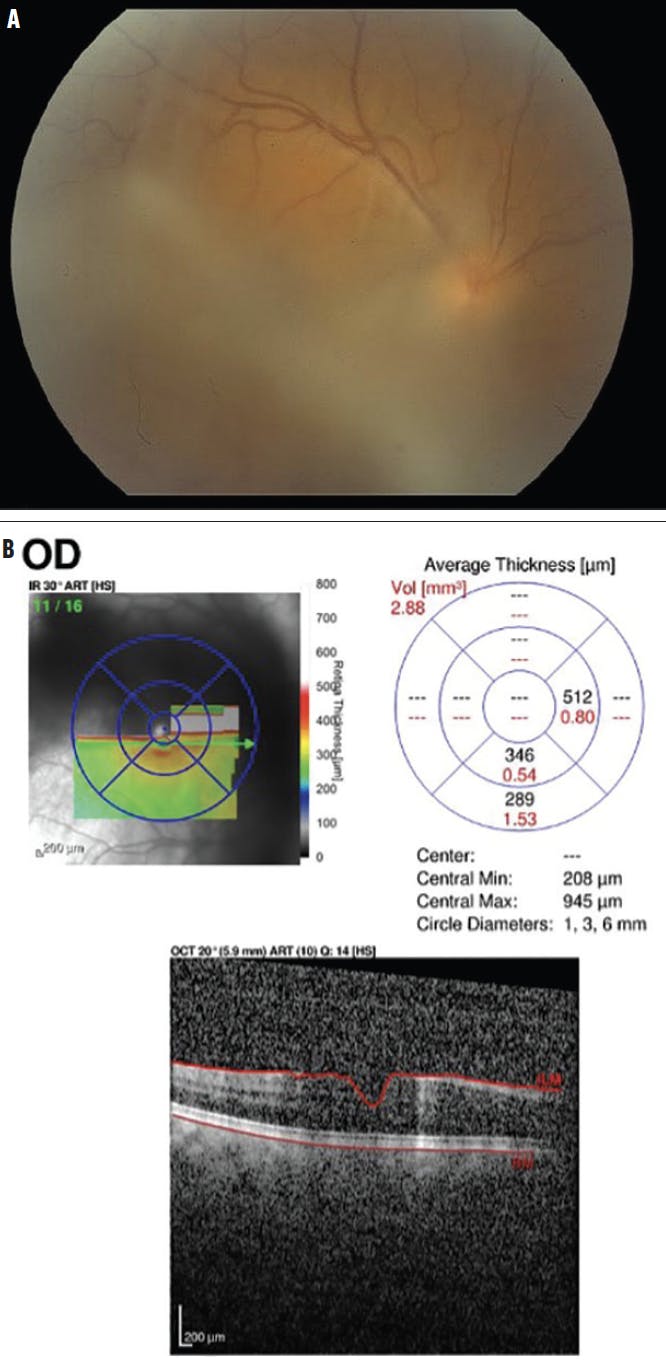
Figure. This 40-year-old man presented with bilateral, visually significant VOs (A). The corresponding OCT image and scanning laser ophthalmoscope confirm the significant VOs (B). He underwent PPV, and the vitreous was sent for pathologic analysis. Based on the results, he was diagnosed with ocular amyloidosis.
While these conditions may also require a PPV, tissue biopsy or pathological analysis is critical to confirm the correct diagnosis. Additionally, in the case of VOs secondary to uveitis, treating with ocular steroids will improve the VOs and other symptoms; therefore, it is important to consider all possible etiologies of a patient’s VOs prior to discussing and rushing to vitrectomy surgery.
SURGICAL PEARLS
Once you have decided that a patient with symptoms for at least 6 months is ready, discuss the possibility of PPV as a treatment option to remove their symptomatic VOs. You should schedule the patient only after a thorough informed consent and discussion of all the risks, benefits, and alternatives to surgery. Once you are in the OR, these surgical pearls can help ensure the surgery goes smoothly.
- We recommend small-gauge vitrectomy platforms. A study evaluating 110 vitrectomies for vitreous floaters found a high rate of postoperative RD (11%), and more than 50% of those with an RD underwent 20-gauge PPV.7 Smaller-gauge vitrectomy has been found to be safer, more efficient, and better tolerated by patients.8-10
- After performing a core vitrectomy, use the vitrectomy cutter to clear the vitreous posterior to the IOL. This will prevent any mild visual disturbances postoperatively.
- If the patient has not already undergone a YAG capsulotomy, consider performing a posterior capsulotomy with the cutter. If patients develop capsular opacification in the future and require a YAG capsulotomy post-vitrectomy, the procedure would cause a new vitreous opacity that may result in recurrence of symptoms.
- Perform a thorough scleral depressed examination to check for any suspicious areas in the periphery (ie, tufts, small retinal breaks, lattice with atrophic holes). Have a very low threshold to perform barricade laser around any concerning areas in the periphery.
- Performing a partial or full air-fluid exchange can assist in ensuring the sclerotomies are closed after the cannulae are removed. If there is any leakage of air through a sclerotomy site, have a low threshold to suture.
NEW DATA
We recently published our experience of PPV for visually significant VOs at a retina-only private practice over a 4-year period. Patients underwent either a 23- or 25-gauge PPV. All patients included in the study were pseudophakic, had symptoms for more than 6 months, and had a Weiss ring present; abiding by this criteria, we enrolled 81 patients (104 eyes). We had no cases of retinal tears or RDs in our series. One patient developed a vitreous hemorrhage, which resolved spontaneously.11 Additionally, all of the patients had improved visual acuity, 93.3% of whom achieved a VA of 20/40 or better.
While the general approach has been to simply educate patients that vitreous floaters are a benign condition with no long-term sequelae, many individuals affected with significant VOs find them debilitating to their quality of life.
Recently, Donald J. D’Amico, MD, led a panel of vitreoretinal experts who addressed the management of symptomatic VO cases. The panel proposed a VO severity grading system, which could be a good resource for optometrists and ophthalmologists to monitor patients who complain of VOs.2 The group came to a consensus on these definitions:
- Asymptomatic VOs: noticeable on clinical examination but cause no visual disturbances to the patient.
- Mild VOs: noticeable to the patient but do not interfere with vision or functions of daily living.
- Moderate VOs: impact vision and interfere somewhat with functions of daily living.
- Severe VOs: highly impact quality of life and significantly interfere with functions of daily living.
Spending time with patients to ensure you have the appropriate surgical candidate for PPV and taking into account the various surgical pearls can yield an excellent surgical outcome and improved patient satisfaction.
1. Ivanova T, Jalil A, Antoniou Y, Bishop PN, Vallejo-Garcia JL, Patton N. Vitrectomy for primary symptomatic vitreous opacities: an evidence-based review. Eye (Lond). 2016;30(5):645-655.
2. D’Amico D. Survey findings on vitreous opacities and expert panel recommendations on the referral and management of symptomatic vitreous opacity cases. Retina Today. 2021;16(7 Supp).
3. Chung SE, Kim KH, Kang SW. Retinal breaks associated with the induction of posterior vitreous detachment. Am J Ophthalmol. 2009;147(6):1012-1016.
4. Jeroudi A, Yeh S. Diagnostic vitrectomy for infectious uveitis. Int Ophthalmol Clin. 2014;54(2):173-197.
5. García Franco R, Arias Gómez A, García Roa M, Ramírez Neria P, Corredor Casas S. Vitreous amyloidosis as primary manifestation of disease: case report. Arch Soc Esp Oftalmol (Engl Ed). 2020;95(5):244-247.
6. Hwang CS, Yeh S, Bergstrom CS. Diagnostic vitrectomy for primary intraocular lymphoma: when, why, how? Int Ophthalmol Clin. 2014;54(2):155-171.
7. de Nie KF, Crama N, Tilanus MAD, Klevering BJ, Boon CJF. Pars plana vitrectomy for disturbing primary vitreous floaters: clinical outcome and patient satisfaction. Graefes Arch Clin Exp Ophthalmol. 2013;251(5):1373-1382.
8. Lakhanpal RR, Humayun MS, de Juan E Jr, et al. Outcomes of 140 consecutive cases of 25-gauge transconjunctival surgery for posterior disease. Ophthalmology. 2005;112(5):817-824.
9. Ibarra MS, Hermel M, Prenner JL, Hassan TS. Long term outcomes of transconjunctival sutureless 25-gauge vitrectomy. Am J Ophthalmol. 2005;139(5):831-836.
10. Fine HF, Iranmanesh R, Iturralde D, Spaide RF. Outcomes of 77 consecutive cases of 23-gauge transconjunctival vitrectomy surgery for posterior segment disease. Ophthalmology. 2007;114(6):1197-1200.
11. Fink S, Kumar JB, Cunningham MA. Small-gauge pars plana vitrectomy for visually significant vitreous floaters. J VitreoRetinal Dis. 2020;5(3):247-250.


