


Proliferative radiation retinopathy (PRR) is characterized by findings of ischemic retinopathy, such as microaneurysms, hemorrhage, hard exudation, and nerve fiber layer infarctions, as well as retinal neovascularization.1 Bianciotto et al studied 3,841 eyes treated with plaque radiotherapy for uveal melanoma and found that PRR occurred in 6% of patients assessed 5 years post-radiotherapy and 7% of patients assessed 10 and 15 years post-radiotherapy.2
Various risk factors have been linked to the likelihood of developing PRR, including history of diabetes mellitus, tumor close to the optic disc, and increasing basal tumor diameter (> 10 mm). As a result, patients with irradiated uveal melanoma are monitored closely for radiation complications, and anti-VEGF therapy and prophylactic panretinal photocoagulation (PRP) are administered every 4 months for 2 years after initial radiation treatment.
Hemorrhagic findings in PRR can present in the intraretinal, preretinal, or vitreous layers.2 Preretinal hemorrhage tends to occur in the subhyaloid region that occupies the potential space between the posterior hyaloid (vitreous) face and the superficial retina. Subhyaloid hemorrhage can result from a variety of conditions, including diabetic retinopathy (50%), Valsalva retinopathy (20%), traumatic choroidal rupture (10%), retinal artery macroaneurysm (7%), and retinal vein occlusion (3%), among others.3 A finding of subhyaloid hemorrhage has not been well-documented on fundus autofluorescence (FAF), but those that have been reported demonstrate regions of hyperautofluorescence of chronic yellow hemorrhage and regions of hypoautofluorescence of acute red hemorrhage.4
The management of subhyaloid hemorrhage depends on the size and location of the hemorrhage, as well as the underlying cause. Herein, we describe an interesting presentation of subhyaloid hemorrhage following plaque radiotherapy of choroidal melanoma and correlate the FAF findings with the acute and chronic hemorrhagic features.
CASE REPORT
A 45-year-old White male presented with a history of choroidal melanoma in the left eye, measuring 10 mm in basal diameter and 2.5 mm in thickness. He was treated with iodine-125 plaque radiotherapy using an apex dose of 70 centigray (cGy) and rate of 57.89 cGy/hour. Prophylactic PRP was administered to the region of radiotherapy, as well as prophylactic intravitreal bevacizumab (Avastin, Genentech/Roche) every 4 months for 2 years.
Medical history included chronic controlled hypertension and hyperlipidemia. Five years post-radiotherapy, retinal neovascularization elsewhere (NVE) was discovered in the region of the treatment, consistent with PRR, and additional sector PRP was added. One year after that treatment, he developed a blind spot in his central vision and was noted to have a new subhyaloid hemorrhage in the treated eye.
On examination, BCVA was 20/20 OU. The anterior segment of each eye was unremarkable and there was no iris neovascularization. The right fundus was normal. The left fundus showed a flat retina with the tumor completely regressed to a barely visible flat scar, with surrounding PRP. There was new subhyaloid hemorrhage located near the foveola with fresh red blood (inferior) and chronic yellow, dehemoglobinized blood (superior; Figure 1A). The superotemporal retinal vein was sclerosed.
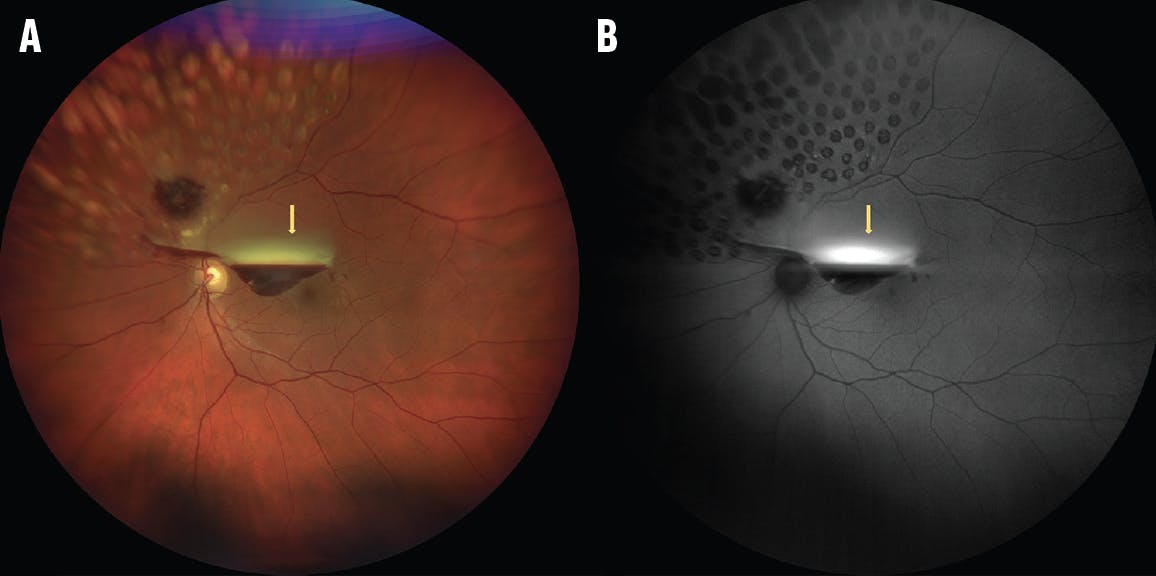
Figure 1. Fundus imaging of the left eye revealed a boat-shaped subhyaloid hemorrhage in the macula. Dehemoglobinized blood (yellow arrow) can be seen superior to fresh blood with clear separation between layers (A). FAF of the left eye demonstrated hyperautofluorescence of the dehemoglobinized subacute subhyaloid blood (yellow arrow) and hypoautofluorescence of the fresh blood (B).
FAF showed dramatic marked hyperautofluorescence of the chronic dehemoglobinized yellow blood and marked hypoautofluorescence of the fresh red blood (Figure 1B). OCT confirmed preretinal, optically dense debris in a dome-shaped configuration representing fresh red hemorrhage (Figure 2A) and similar, but less dense preretinal debris representing chronic yellow hemorrhage (Figure 2B). Fluorescein angiography of the retinal NVE showed leakage along the superotemporal vascular arcade. The patient was treated with an intravitreal injection of bevacizumab and returned 1 month later for additional PRP.
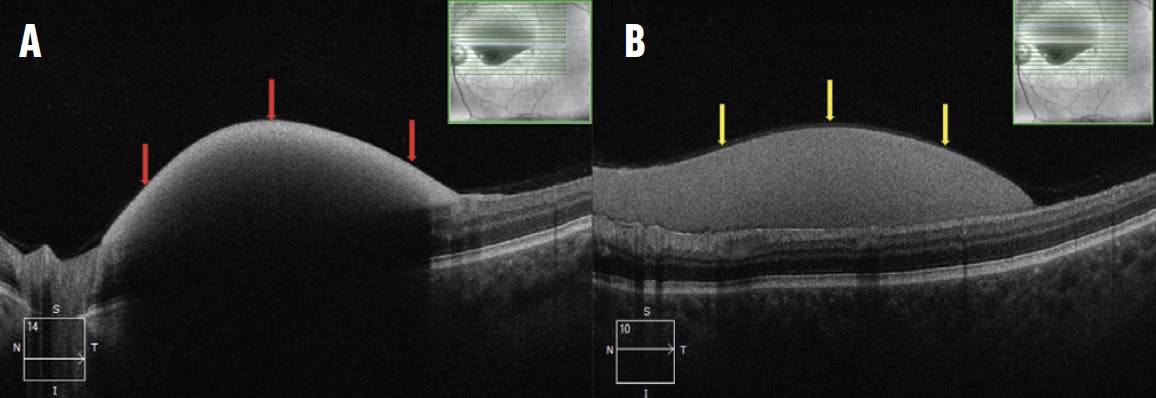
Figure 2. OCT of the left eye demonstrated subhyaloid hemorrhage. Cross-sectional capture of fresh hemorrhage (A, red arrows) versus old hemorrhage (B, yellow arrows), both with relatively homogeneous optical density (B), was obtained.
DISCUSSION
In this case, the yellow dehemoglobinized blood was displaced superiorly above fresh red blood with clear delineation between the two layers—an interaction that is often seen between two fluids that do not homogenize. The loss of hemoglobin in chronic hemorrhagic blood results in a lower mean corpuscular hemoglobin concentration and lower density,5 so it is possible for a slow, insidious leak of blood to show separation, such that degraded blood floats above continuously deposited fresh blood.
The characteristics of subhyaloid hemorrhage on FAF have rarely been documented in the literature, although the temporary hyperautofluorescence in dehemoglobinized blood has been related to the degree of fluorescence in the breakdown products of heme.4 Heme is structurally considered a porphyrin ring, which is composed of multiple methyl groups and double bonds, with an iron molecule at its core.6 As blood is broken down, the iron molecule separates, and the conjugated double bonds exhibit the highest level of hyperautofluorescence, with degradation of these double bonds leading to lower and lower levels of autofluorescence.4,7 Bilirubin, a yellowish pigment that is a breakdown product of heme, also exhibits hyperautofluorescence when bound to albumin and likely contributes to the weak hyperautofluorescence seen in chronic hemorrhage.4,8 This phenomenon would explain the findings of hyperautofluorescence in subacute subhyaloid hemorrhage and its slow conversion to hypoautofluorescence in chronic cases.
CLINICAL TAKEAWAY
A pathophysiologic explanation for findings of retinal hemorrhage on FAF has rarely been discussed. Subhyaloid hemorrhage is a sequela of various retinal pathologies, including PRR, that warrants quick and appropriate management. An understanding of FAF patterns in cases of hemorrhage can assist in the characterization and management. While fresh hemorrhage will appear hypoautofluorescent, newly dehemoglobinized hemorrhage will initially appear brightly hyperautofluorescent followed by diminishing autofluorescence over time. A timeline of the hemorrhage can be drafted, and the delivery of treatment can be given accordingly.
Support provided in part by the Eye Tumor Research Foundation, Philadelphia, PA (CLS). The funders had no role in the design and conduct of the study, in the collection, analysis and interpretation of the data, and in the preparation, review or approval of the manuscript. Carol L. Shields, MD, has had full access to all the data in the study and takes responsibility for the integrity of the data.
1. Rose K, Krema H, Durairaj P, et al. Retinal perfusion changes in radiation retinopathy. Acta Ophthalmol. 2018;96(6):e727-e731.
2. Bianciotto C, Shields CL, Pirondini C, Mashayekhi A, Furuta M, Shields JA. Proliferative radiation retinopathy after plaque radiotherapy for uveal melanoma. Ophthalmology. 2010;117(5):1005-1012.
3. Murtaza F, Rizvi SF, Bokhari SA, Kamil Z. Management of macular pre-retinal subhyaloid hemorrhage by Nd:Yag laser hyaloidotomy. Pak J Med Sci. 2014;30(2):339-342.
4. Bloom SM, Spaide RF. Autofluorescence and yellowing subhyaloid blood with proliferative diabetic retinopathy.[Preprint published online August 7, 2020] Retin Cases Brief Rep.
5. Chang M, Dalvin LA, Mazloumi M, et al. Prophylactic intravitreal bevacizumab after plaque radiotherapy for uveal melanoma: analysis of visual acuity, tumor response, and radiation complications in 1131 eyes based on patient age. Asia Pac J Ophthalmol (Phila). 2020;9(1):29-38.
6. Haines DD, Tosaki A. Heme degradation in pathophysiology of and countermeasures to inflammation-associated disease. Int J Mol Sci. 2020;21(24):9698.
7. Bonkovsky HL, Guo JT, Hou W, Ting L, Narang T, Thapar M. Porphyrin and heme metabolism and the porphyrias. Compr Physiol. 2013;3(1):365-401.
8. Glushko V, Thaler M, Ros M. The fluorescence of bilirubin upon interaction with human erythrocyte ghosts. Biochim Biophys Acta. 1982;719(1):65-73.


