



It comes as no surprise that the top financial goals of most physicians, retina specialists included, are tax reduction and long-term retirement wealth accumulation.
What is surprising is how many of those same physicians attempt to reach these goals without considering the fundamental long-term strategy of tax diversification. In this article, we explain this concept and how retina specialists can implement it for their benefit.
THE DEFINITION
Tax diversification means building up wealth in three “buckets” (Figure):
- Assets subject to ordinary income tax rates upon distribution in retirement—qualified retirement plans (such as 401(k)s and profit-sharing plans) and roll-over individual retirement accounts (IRAs)
- Assets subject to capital gains tax rates—investment assets, like securities or business interests, if held for more than a year
- Assets not subject to any tax upon distribution—Roth IRAs, cash value life insurance (if managed properly)
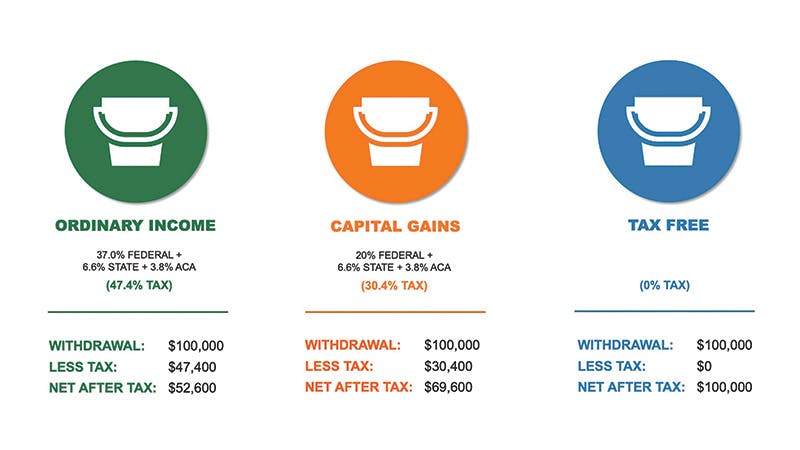
Figure. The three retirement tax buckets. Bucket 1 (green): assets subject to ordinary income tax rates upon distribution in retirement. Bucket 2 (orange): assets subject to capital gains tax rates. Bucket 3 (blue): assets not subject to any tax upon distribution. In this example, we assume a marginal top tax bracket because many physicians will be in the top two or three tax brackets in retirement, and the current rate of 37% isn’t even close to an all-time high. We also assume a 6.6% state income tax, although many states, such as California and New York, have rates that far exceed this.
While many physicians have heard of asset class diversification in the context of investing, it is important to direct additional attention to diversifying your wealth according to tax rate exposure.
Your retirement portfolio will benefit significantly by having differently taxed buckets to draw from when it comes time to start withdrawing those funds. As the retirement/wealth distribution phase hopefully lasts many years, or even decades, being diversified across the three tax buckets puts you in a position of strength and provides options for withdrawing income depending on the tax rates in effect.
One of the benefits of being well-diversified from a tax perspective is that, once in retirement, you can examine tax rates each year and pull from the appropriate bucket to maximize after-tax income. If, at the beginning of your retirement, income tax rates are high and capital gains taxes are relatively low, then it may be best to draw from bucket 2, or assets subject to capital gains tax rates. If the opposite is true, bucket 1 (assets subject to ordinary income tax rates) may be targeted for larger distributions. As an example, if you were in retirement and a new administration and Congress cut income tax rates drastically (as President Reagan did in the early 1980s), it might make sense to take outsized distribution assets from bucket 1, like a roll-over IRA, while such rates are low, leaving assets in bucket 2 and 3 to grow.
Bucket 3, assets not subject to any tax upon distribution, provides the highest level of flexibility, as it can be accessed in any tax environment. An ideal retirement plan calls for physicians to have a significant percentage of their wealth in each bucket; yet, in our experience, most physicians have too little wealth in bucket 3.
CASE STUDY
Let’s look at an example. Rachel (a retina surgeon), Gary (a gastroenterologist), and their spouses are all 45 years old and plan on retiring at age 65. At this point, both couples have a joint life expectancy of 91 years, meaning that, according to the actuaries, at least one spouse in each couple should live until age 91. With a planned retirement age of 65, these couples will need to rely on their assets and other sources of income (eg, social security) to provide them with an income for 26 years.
While numerous financial, investment, and planning factors are essential for Rachel and Gary, let’s concentrate on just the tax issue here. Both couples will begin drawing down assets in 20 years and stop doing so approximately 46 years from now. During that period, tax rates will likely be very different than they are at present day and may change several times.
Let’s assume that Rachel and Gary have the same overall net worth, but their asset mix is different. Rachel has her net worth in all three buckets—some in a qualified retirement plan (QRP), some in after-tax brokerage accounts and real estate, and some in a Roth IRA and a permanent life insurance policy. Gary has nearly all his net worth in his home and 401(k) QRP. Rachel and Gary both qualify for social security.
Rachel is much better positioned than Gary to maximize her post-tax retirement income. Most of Gary’s retirement income will come from his QRP and social security, both of which are subject to ordinary federal and state income tax. If income tax rates are high, Gary has little flexibility to take income from other sources unless he is willing to sell his home, which he may be reluctant to do. In addition, he can’t sell only part of his home, like Rachel can with her brokerage accounts, and it may be difficult for him to get favorable loans against his home equity in retirement when he will have no income.
Rachel, on the other hand, is well positioned if income tax rates are high. She can draw down her brokerage account if capital gains taxes have remained lower than income taxes. Moreover, she can take income from her Roth IRA or access life insurance cash values, both of which are completely tax free.
Despite their equal net worth, Rachel may net out significantly more after-tax retirement income than Gary. Because of tax diversification in her long-term planning, Rachel is in a more secure position in her retirement.
LONG-TERM PLANNING REQUIRES FLEXIBILITY
Regardless of the planning tools a physician employs to save for retirement, one of the fundamental pillars of any retirement plan should be flexibility to withstand changes in tax rates, income, market performance, and personal health. In this article, we focused only on flexibility regarding taxes and the importance of tax diversification. While always an important concept, tax diversification is especially relevant today, as many physicians are seeking ways to minimize the negative impact of potential tax increases in 2022 and beyond.
SPECIAL OFFERS: To receive free print copies or ebook downloads of Wealth Planning for the Modern Physician or Wealth Management Made Simple, text RETINA to 844-418-1212, or visit www.ojmbookstore.com and enter promotional code RETINA at checkout.
OJM Group, LLC, (“OJM”) is an SEC registered investment adviser with its principal place of practice in the State of Ohio. SEC registration does not constitute an endorsement of OJM by the SEC nor does it indicate that OJM has attained a particular level of skill or ability. OJM and its representatives are in compliance with the current notice filing and registration requirements imposed upon registered investment advisers by those states in which OJM maintains clients. OJM may only transact practice in those states in which it is registered or qualifies for an exemption or exclusion from registration requirements. For information pertaining to the registration status of OJM, please contact OJM or refer to the Investment Adviser Public Disclosure web site www.adviserinfo.sec.gov.
For additional information about OJM, including fees and services, send for our disclosure brochure as set forth on Form ADV using the contact information herein. Please read the disclosure statement carefully before you invest or send money.
This article contains general information that is not suitable for everyone. The information contained herein should not be construed as personalized legal or tax advice, or as a recommendation of any particular security or strategy. There is no guarantee that the views and opinions expressed in this article will be appropriate for your particular circumstances. Tax law changes frequently, accordingly information presented herein is subject to change without notice. You should seek professional tax and legal advice before implementing any strategy discussed herein.


