


Some digital ultra-widefield imaging systems are now powered by broad line fundus imaging (BLFI) technology, which is a hybrid of confocal scanning laser ophthalmoscopy and traditional fundus photography. The technology uses line-scanning illumination with light-emitting diodes and an aperture confocal to the illumination, which could help improve image analysis.1
RGB CHANNELS
BLFI enables the combination of an ultra-widefield view and a full range of retinal imaging modes to generate images with high dynamic range, contrast, resolution, and natural colors—capturing images that resemble the coloration of the fundus as seen during clinical examination, also known as true color imaging. The tool also allows a single image to be deconstructed into channels to show the individual wavelength views by adjusting the blend function of the software. The blue channel (BC; 435-500 nm) increases the visibility of anterior retinal layers, the green channel (GC; 500-585 nm) permits a view from the sensory retina to the retinal pigment epithelium (RPE), and the red channel (RC; 585-640 nm) and infrared laser diode (785 nm) scans the deeper structures from the RPE to the choroid.2
CLINICAL IMPLICATIONS
This imaging tool has the potential to allow clinicians to better distinguish retinal changes specific to certain retinal layers. Retinal alterations that are located in the anterior layers, such as a lamellar hole or a nerve fiber layer defect, are better distinguished in the BC and GC compared with the RC or true color. For example, a lamellar hole would not be distinguishable using the RC and true color imaging, while it would be visible with the BC and GC, with the lamellar hole being more evident in the BC (Figure 1). A nerve fiber layer defect, such as within the retinal vasculature, is highlighted in the GC due to its deeper penetration, compared with the BC (Figure 2). Although still visible in the RC and true color, the defect is less noticeable, limiting the clinician’s ability to characterize the changes.
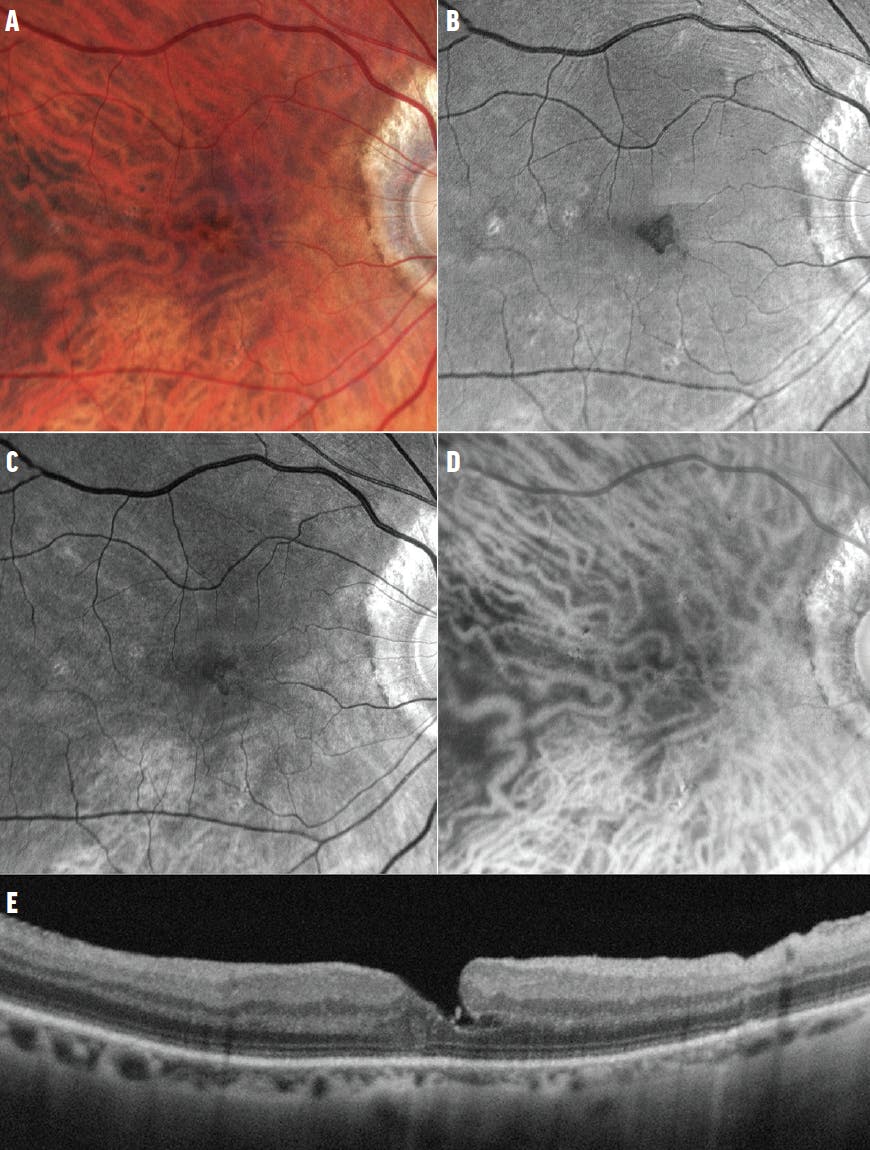
Figure 1. True color imaging shows the macular region without evident signs of alterations (A). The blue channel reveals a trapezoid hypopigmented change in the foveal area (B). The green channel reveals a less evident hypopigmented change in the foveal area, with the retinal vasculature well distinguished (C). The red channel highlights the choroidal vessels, but no changes are seen in the foveal area (D). B-scan spectral-domain OCT imaging (vertically oriented, centered in the fovea) shows details of the lamellar hole (E).
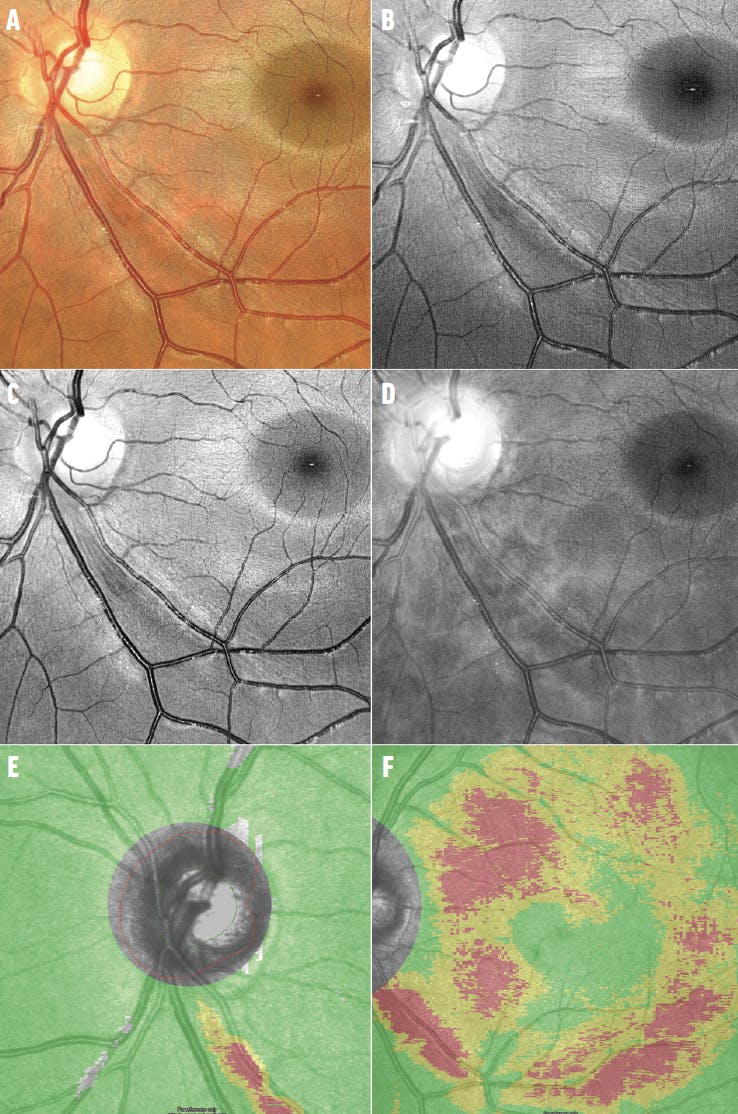
Figure 2. True color imaging shows a nerve fiber layer defect in the inferotemporal arcade (A). The blue channel (B) and green channel (C) show the nerve fiber layer defect; the retinal vasculature is better visualized in the green channel. The defect is still visible in the red channel despite being less noticeable (D). The changes are evident on the spectral-domain OCT quantitative analysis of the retinal nerve fiber layer and ganglion cell layer (E and F).
On the other hand, choroidal nevus are undetectable in the BC and GC (Figure 3). The only visible change is related to drusen, which appear in the BC as light focal dots, correlating with the yellowish foci in the true color image. This pattern is maintained in GC and RC, but contrast is more evident in the GC compared with the other channels.
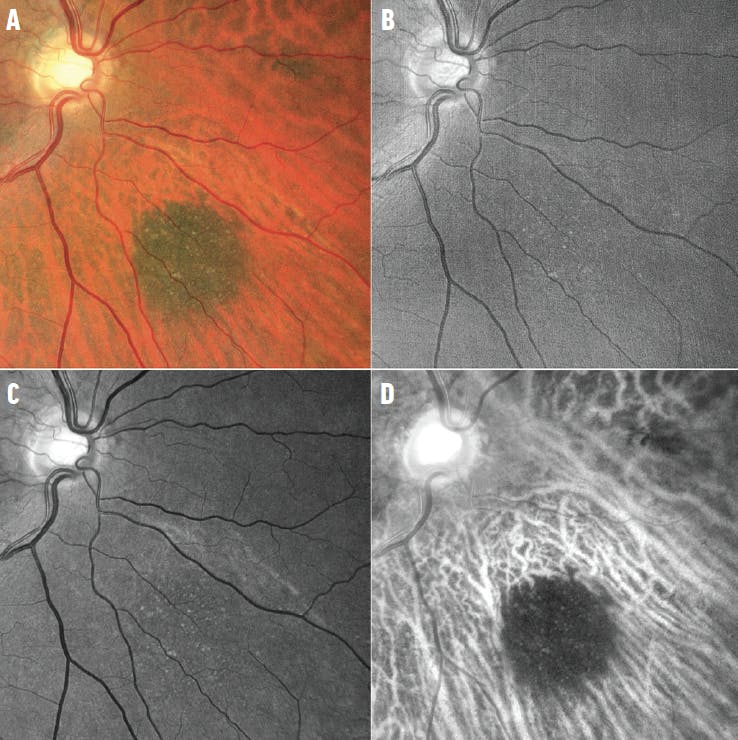
Figure 3. True color imaging shows a dark, flat, and well-defined lesion with drusen in the nasal-inferior quadrant, consistent with a choroidal nevus (A). The choroidal nevus is undetectable in the blue channel, while drusen appear as low-contrast light focal dots (B). The choroidal nevus is also undetectable in the green channel while drusen appear as medium-contrast light focal dots (C). The choroidal nevus appears as a dark, flat, and well-defined lesion in the red channel while drusen appear as low-contrast light focal dots (D).
A choroidal nevus imaged with the RC, reveals a consistent pattern, presenting as a well-defined dark spot, with higher levels of contrast; this allows better identification, measurement, and characterization of the nevus compared with the other color channels, including the true color imaging.
CONCLUSION
Many other retinal peculiarities can be assessed and characterized using different color channels. Even at relatively close wavelengths, the images exhibit significant distinctions between the color channels. In addition to facilitating the identification of the depth at which a lesion resides, deconstructing the image into color channels allows for a better characterization of the disorders. This improved characterization may provide pieces of information that might be useful during screening by increasing the diagnostic reliability and at follow-up by allowing a more accurate assessment of the lesion.
1. Bublitz D, Everett MJ, Farkas C, Kempe M, Qiu Y, Schmitt-Manderbach T. Systems and methods for broad line fundus imaging. February 2017. World Intellectual Property Organization. www.patentimages.storage.googleapis.com/49/65/95/2bc0891f6f8910/US20170049323A1.pdf
2. Zeiss Clarus 500 introduces Broad Line fundus imaging for fundus autofluorescence. White Paper. Zeiss. Accessed January 15, 2022. www.zeiss.ca/content/dam/med/ref_international/products/retinal-cameras/clarus500/pdf/clarus_white_paper_final.pdf


