


The 10th annual Vit-Buckle Society (VBS) meeting was the bee’s knees. The 2022 Great Gatsby-themed event, which had many of us seeing each other in person for the first time in 2 years, roared like the 20s. The sessions and exhibit hall exploded with VBS energy. New surgical techniques, management of rare cases, wild clinical videos, and truly addressing diversity in ophthalmology and retina were at the forefront of this year’s meeting.
The scientific poster session followed this trend, with projects shedding light on a variety of topics, from diversity and inclusion to rare dystrophies. Here’s a look at what this year’s scientific poster winners brought to the party (Figure).
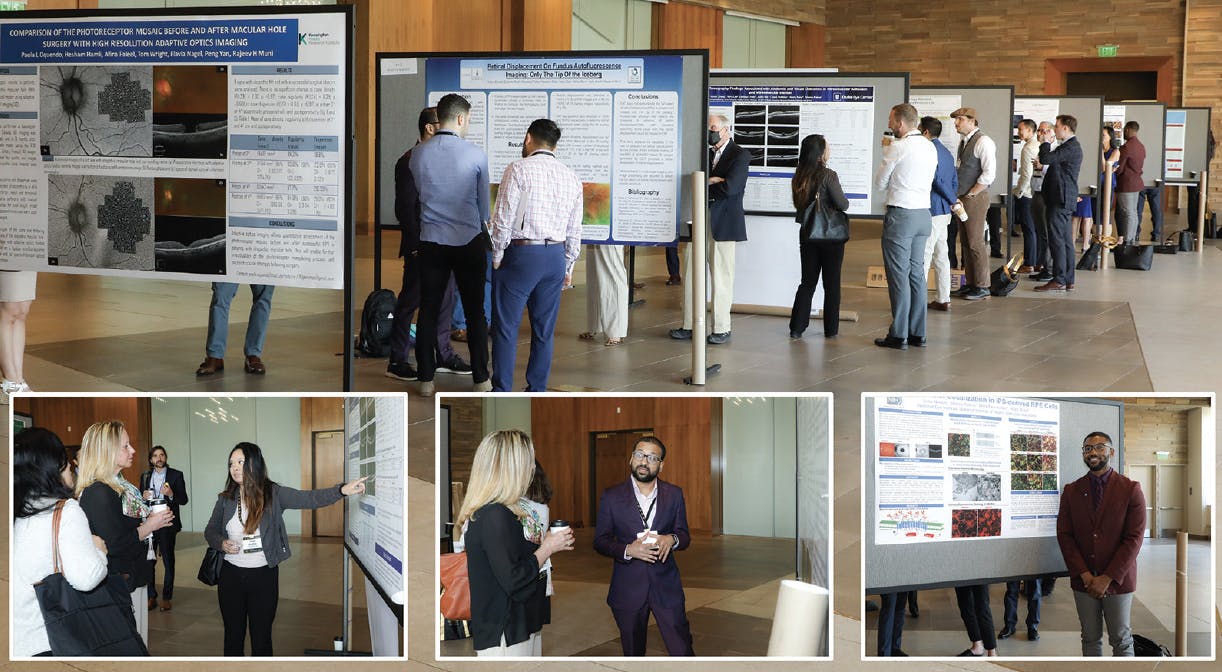
Figure. The 2022 VBS scientific poster presenters were available throughout the meeting and had enriching discussions with the conference attendees. The winners were (insets left to right) Yuxi Zheng, MD; Aditya Bansal, DNB; and Luke Nelson, BS.
RESIDENT WINNER: YUXI ZHENG, MD
The pathologic vitreomacular interface remains a mystery and raises a host of unanswered questions. How long do we monitor patients with vitreomacular adhesion (VMA) and vitreomacular traction (VMT)? Which patients will have release? Can we predict visual outcomes? Why won’t the posterior hyaloid just let go? Zheng et al used OCT to analyze 328 eyes with VMA and 263 eyes with VMT and found that, in cases of VMA, increased time to release was significantly associated with the presence of posterior hyaloid membrane hyperreflectivity (PHMH) and vitreofoveal interface hyperreflectivity (VIH). A decreased rate of VMT release was associated with PHMH, increased central subfield thickness (CST), and cystoid retinal changes. Factors associated with worse visual acuity included inner retinal surface disturbances, ellipsoid zone disruption, and cystoid changes; however, no difference in visual acuity was found after 3 months. They concluded that OCT characteristics indicating stronger tractional forces (PHMH and VIH) or ongoing traction (CST and cystoid changes) were associated with a decreased rate of vitreomacular separation, longer time to VMA/VMT release, and short-term poorer visual acuity in VMT.
FELLOW WINNER: ADITYA BANSAL, DNB
In a world where single-surgery success in rhegmatogenous retinal detachment (RRD) repair is all-important, the idea of retinal displacement, or low-integrity retinal attachment (LIRA), pushes us to think beyond anatomic indicators of success and more deeply consider quality of vision post-reattachment surgery in our surgical planning. Multimodal imaging, especially fundus autofluorescence (FAF), is an important tool to integrate this metric into clinical practice.
Bansal et al assessed the sensitivity and specificity of FAF imaging when used for LIRA detection following RRD repair. This retrospective review of eight patients included infrared (IR) images before and after RRD occurrence and FAF images post-RRD repair. Using OCT software, they marked at least four corresponding retinal pigment epithelium (RPE) and choroidal landmarks on all IR images and created pre- and post-RRD repair image overlays using a python code to align the images and compute a homography. They used the patients’ contralateral normal eyes to validate the technique, and all contralateral images had perfect alignment. Using IR overlay images as the standard, FAF showed 78.6% sensitivity and 100% specificity when detecting LIRA. However, the IR overlays detected a far greater extent of retinal displacement compared with FAF. They found IR overlay imaging to be a better qualitative and quantitative measure of retinal displacement and suggested that lower sensitivity may be the reason for variability across LIRA studies that use FAF.
MEDICAL STUDENT WINNER: LUKE NELSON, BS
This project sheds light on the potential pathophysiology of Stargardt disease. The mutated ABCA4 protein, an adenosine 5’-triphosphate (ATP)-binding cassette transporter implicated in Stargardt disease, has long been thought to be localized to the photoreceptor outer segments (POS). The defective ABCA4 protein in these photoreceptors leads to a downstream accumulation of degenerative byproducts in the RPE, causing RPE dysfunction and photoreceptor loss. Although researchers know that ABCA4 is present in the RPE, its function in the visual cascade is not well-defined.
Nelson et al aimed to understand the colocalization of ABCA4 in the RPE cells and characterize its movement following exposure to the lab-created POS regimen. The team used healthy donor fibroblasts reprogrammed to induced pluripotent stem cells (iPSCs) that were differentiated into RPE cells. After they cultured the iPSC-RPE cells, the researchers studied the ABCA4 localization within these cells in unfed (30 minutes) and fed (4 hours) POS conditions. They found that ABCA4 transitions from the apical membrane to the subcellular after exposure to POS. On the apical side, ABCA4 colocalizes with the sodium-potassium pump (Na-K ATPase) via immunostaining. They also found that ABCA4 colocalizes with RAB5, RAB7, and caveolin-1 at different timepoints. These findings provide a more detailed understanding of the functional role of ABCA4 in the RPE cells and its contribution to visual processing.
POSTER SNAPSHOTS
Brinson et al studied disparities in eye care usage across vision impairment and diabetes status in the United States from 2010 to 2018. They found that older patients with diabetes, females, and patients of Asian and White races were more likely to use eye care. They also found eye care usage was overall steadily increasing among patients with diabetes.
Diaz et al presented a nontraumatic hyperoxic retinopathy model in mice to study the formation of tractional retinopathy and preretinal membranes in retinal detachments (RD). They found that oxygen fluctuations can lead to an upregulation of myofibroblast progenitor cells, contributing to the development of preretinal membranes and RDs.
Hucko et al used self-reported data to study the trends in racial and ethnic diversity of US allopathic residency programs from 2011 to 2019. They found that the increase in the number of underrepresented minority residents has not kept pace with the demographic changes in the United States. More efforts are needed to address the persistent lack of representation for racial and ethnic minorities.
Watane et al presented results of a retrospective review of surgical techniques and complications of IOL exchanges, a case series of scleral-sutured enVista MX60 (Bausch + Lomb) dislocations, and a structural integrity study of lens eyelets and haptic-optic junctions. They found a simple-pass suture allowed for greater force on MX60 eyelets before fracture compared with the cow-hitch suture. Yamane scleral-fixated IOLs were associated with the greatest tilt, while iris-sutured IOLs had the highest subsequent dislocation. The haptics of the CT Lucia three-piece IOL (Carl Zeiss Meditec) required 2.8x greater force to break than the MX60 haptics.
Venincasa et al presented a survey study exploring the impact of COVID-19 on resident perceptions of their training and personal lives. After surveying 193 applicants to the Bascom Palmer residency program between 2016 and 2019, the authors noted a significant impact on surgical and clinical ophthalmic training during the pandemic. Residents also reported personal stressors such as worsened friendships with fellow residents and increased time away from family.
Rahman et al presented a retrospective review of six patients treated with low-dose oral methotrexate (MTX) as a preventative measure against proliferative vitreoretinopathy (PVR). Patients with RD with high-risk characteristics for PVR, such as multiple breaks during surgery and redetachments, were included. All patients received oral MTX on the first postoperative day. The study eyes had flat and attached retinas throughout the 6+ month course of MTX.
Al-Khersan et al presented a cost-utility analysis of MTX versus mycophenolate mofetil (MMF) for the treatment of noninfectious uveitis. Costs included medications, lab testing, imaging, clinical visits, and adverse events. Outcome measures included cost and utility of treatment, lifetime quality-adjusted life year gain and cost/quality-adjusted life year ratio. They concluded that MMF had a higher modeled cost due to medication cost. Both MMF and MTX had similar predicted utility gains, and both were cost-effective.
Tabbaa et al presented a multimodal imaging case series of five patients from the same family with autosomal dominant neovascular inflammatory vitreoretinopathy. Genetic testing revealed the pathognomonic CAPN5 mutation in all five patients, along with a number of variants of unknown significance. Imaging from two patients aged 15 and 40 years highlighted the stages of the disease.
Lin et al evaluated the efficacy of online learning to teach trainees key pathology noted on fundus examination and OCT imaging. They found that most participants repeatedly engaged with the imaging-based multiple-choice quiz modules with measurable performance improvements. They encouraged continued efforts to leverage virtual tools.
Robles-Holmes et al presented the results of a retrospective review of 14 eyes with asymptomatic RDs. More than half (64%) of RDs were found inferotemporally, 86% were posterior to the equator, and 21% presented with a demarcation line. Of asymptomatic RRDs, 31% had prior laser barricade with no progressed RDs during the mean follow-up of 2.76 years. Only two RDs progressed and one required surgery. The authors concluded that close observation, especially for inferior peripheral RDs anterior to the equator and those without large breaks, could be a viable option.
De Carlo et al presented a retrospective chart review of seven eyes that underwent I-125 plaque brachytherapy that developed ocular tumor lysis syndrome (OTLS). The authors concluded that common OTLS associations included large plaque diameter, presence of subretinal fluid, collar-button shape, and high total energy delivered to the eye. They stated that enucleation can be avoided in eyes with OTLS despite poor vision with surgical intervention for hemorrhage, pigment removal, and RD repair.


