


AT A GLANCE
- Phase 3 trials of faricimab (Vabysmo, Genentech/Roche) and tarcocimab (KSI-301, Kodiak Sciences) for the treatment of macular edema in patients with RVO met their primary endpoints.
- The phase 3 SCORE2 trial evaluated bevacizumab (Avastin, Genentech/Roche) for the treatment of macular edema due to RVO.
Retinal vein occlusion (RVO) is a common cause of vision loss worldwide. Its complications, including macular edema, retinal neovascularization, and ischemia, cause anatomic and functional compromise of the retina (Figure). While ischemia and outer retinal damage is difficult to reverse, edema and neovascularization respond remarkably well to current anti-VEGF treatments. However, the treatment burden can be high, and some may experience an incomplete response. Novel agents that are under investigation aim to further improve efficacy and durability to minimize treatment burden while maximizing visual outcomes. In this article, we provide an update on ongoing and recent phase 3 studies.
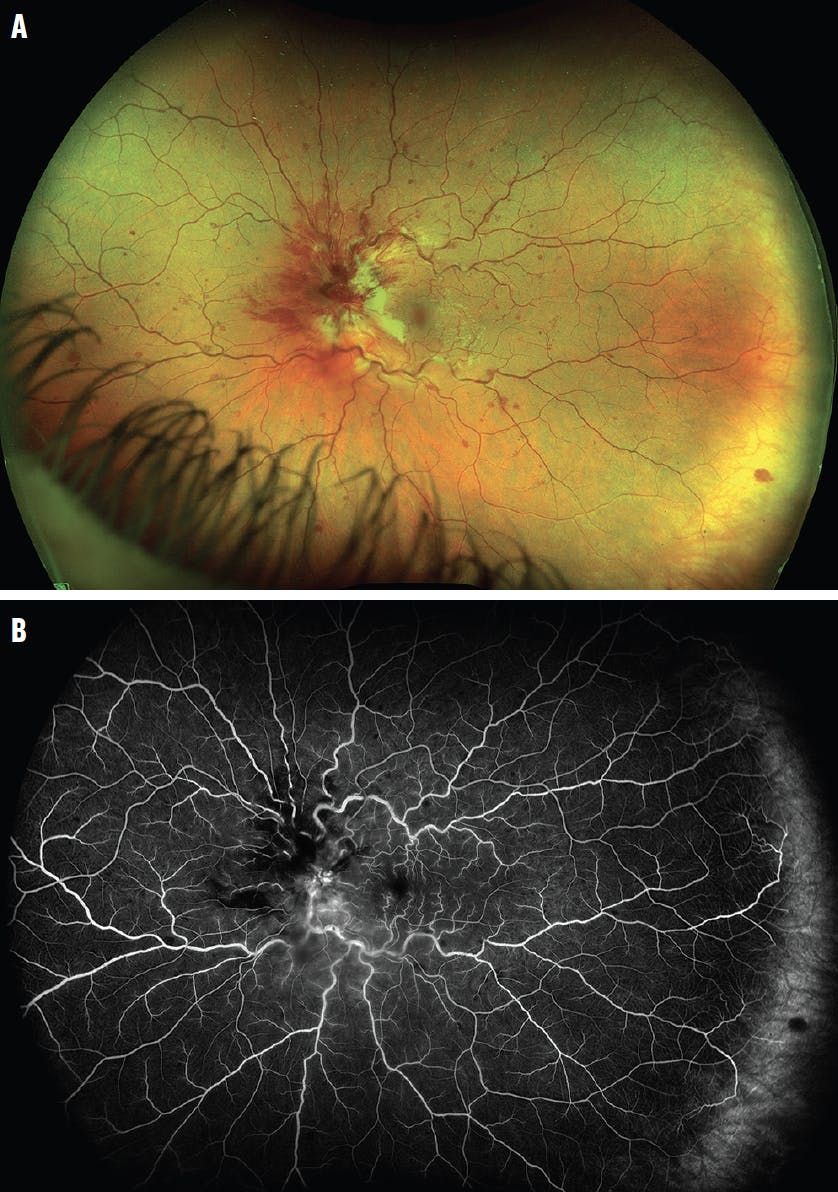
Figure. This 63-year-old man with decreased vision in his left eye presented with diffuse intraretinal and optic disc hemorrhages, cotton-wool spots, and venous dilation and tortuosity, consistent with CRVO (A). Widefield fluorescein angiography shows hypofluorescence due to the blockage caused by the intraretinal and optic disc hemorrhages (B). The angiogram highlights the vascular tortuosity and capillary leakage.
SEEKING A NEW INDICATION
Faricimab (Vabysmo, Genentech/Roche) is an antibody designed to target both VEGF and angiopoietin-2 (Ang-2), while sparing angiopoietin-1 (Ang-1).1 Ang-2 is upregulated in disease states and competitively inhibits Ang-1, which results in pericyte death and sensitization to VEGF.1 Two phase 3 clinical trials are evaluating faricimab for the treatment of macular edema secondary to central RVO (CRVO) or hemiretinal vein occlusion (COMINO) and branch RVO (BRVO; BALATON).2,3 Patients were assigned to either 6 mg faricimab or 2 mg aflibercept (Eylea, Regeneron) every 4 weeks for a total of 20 weeks followed by faricimab dosed with a personalized treatment interval (PTI) regimen from weeks 24 to 72.2,3 Both studies met the 24-week primary endpoint of noninferior BCVA gains compared with aflibercept, and the treatment arms experienced a rapid reduction in central subfield thickness.4
NOVEL APPROACHES
Tarcocimab (KSI-301, Kodiak Sciences) uses an antibody biopolymer conjugate platform that combines a monoclonal anti-VEGF antibody with a high molecular weight phosphorylcholine-based polymer.5 The phase 3 BEACON trial is evaluating tarcocimab for the treatment of macular edema secondary to RVO.6 Patients were assigned to one of two treatment arms: 5 mg tarcocimab at day 1, week 4, and every 8 weeks through week 20 followed by a PTI regimen from weeks 24 to 44 or 2 mg aflibercept every 4 weeks for 20 weeks followed by a PTI regimen from weeks 24 to 44.6
Tarcocimab met its 24-week primary endpoint of noninferior visual acuity gains with fewer doses than the average number used in clinical practice.7 Tarcocimab showed improvement in visual and anatomic outcomes as early as week 1. After 2 monthly loading doses, tarcocimab is dosed every other month and had an average of 3.9 injections through week 24 compared with aflibercept dosed monthly (an average of 5.8 injections).7 The secondary outcome of avoiding BCVA loss of more than 15 ETDRS letters was also achieved in both groups, and 46% of patients treated with tarcocimab achieved a BCVA gain of 15 or more letters, which was noninferior to patients in the aflibercept group (50%). Tarcocimab had a favorable safety profile with no cases of endophthalmitis, vasculitis, or vascular occlusions.7
Aflibercept (Regeneron) is a soluble decoy receptor molecule, which binds to VEGF-A, VEGF-B, and placental growth factor. The efficacy and safety of 2 mg aflibercept were demonstrated for CRVO in the COPERNICUS and GALILEO trials, and for BRVO in the VIBRANT study.8,9 In an attempt to further improve outcomes and potentially increase durability, a high-dose 8 mg agent is currently being evaluated, with promising initial results presented for wet AMD (PULSAR) and diabetic macular edema (PHOTON).10 An RVO study is also under consideration.
STALLED RESEARCH
Brolucizumab (Beovu, Novartis) has variable domains of its monoclonal antibody that are joined by a short flexible linker stabilization peptide. Its lack of an Fc region allows it to have a small molecular size.11 RAPTOR and RAVEN were terminated phase 3 clinical trials evaluating brolucizumab for the treatment of macular edema in patients with BRVO and CRVO, respectively.12,13 Participants were randomized into one of two treatment arms: 6 mg brolucizumab or 2 mg aflibercept every 4 weeks for six injections, followed by 48 weeks of individualized flexible treatment. The studies were terminated early due to increased adverse events, including retinal vasculitis and retinal vascular occlusions, in patients who had more than three doses of the study drug.12
COMPARING CURRENT THERAPIES
Bevacizumab (Avastin, Genentech/Roche), is a humanized monoclonal antibody that directly inhibits all active isoforms of VEGF. It was originally engineered to prevent angiogenesis in solid tumor cancers, and although it is a pillar of treatment for patients with retinovascular disease, bevacizumab remains an off-label option in the ophthalmic space.1 SCORE2 was a phase 3 National Eye Institute-sponsored clinical trial that included 362 patients with macular edema due to central retinal vein occlusion (CRVO) or hemiretinal vein occlusion.2 Patients were randomized to 1.25 mg bevacizumab every 4 weeks or 2 mg aflibercept (Eylea, Regeneron) every 4 weeks for 6 months.
The primary outcome was visual acuity letter score (VALS) at the 6-month follow-up.2 Scores ranged from 0 to 100 with higher scores indicating better visual acuity.3 The primary analysis findings from SCORE2 showed that the mean VALS were the same for both groups (69.30, P = .001), meeting the criteria for noninferiority.3 Secondary outcomes included the change in central subfield thickness (CST) from baseline to 6 months, and both treatment groups showed similar decreases in CST.3
There have been several secondary analyses from the SCORE2 clinical trial. One study followed VALS and CST outcomes of patients who responded well to the SCORE2 treatment arms. These patients received monthly injections or treat-and-extend regimens from months 6 to 12.4 At 12 months, the mean CST in both groups improved, and there was no significant change in VALS from baseline between the treatment groups, although the sample sizes were limited.4
In another study examining 24-month outcomes, VALS and CST worsened at 24 months compared with 12 months in both groups.5 At 60 months, VALS significantly improved from baseline, but were less than the improvement observed at 12 months.6
A follow-up study was conducted to evaluate VALS and CST at 12 months for patients who responded poorly to anti-VEGF treatments at 6 months in SCORE2.7 Of the 49 poor responders, 35 patients did not respond to bevacizumab and were switched to aflibercept. The mean changes from 6 to 12 months in VALS and CST were 10.27 (P < .001) and -125.4 μm (P < .001), respectively. Fourteen patients did not respond to aflibercept and were switched to dexamethasone, and their mean changes in VALS and CST from 6 to 12 months were 2.65 (P = .37) and 46.00 μm (P = .46), respectively.7
Another secondary study from SCORE2 examined patient-reported visual function at 6 months between the two treatment arms using the 25-item National Eye Institute Visual Function Questionnaire (NEI VFQ-25) composite and subscale scores.8 Among the 346 participants, both the bevacizumab (P < .001) and aflibercept groups (P < .001) significantly improved in NEI VFQ-25 composite score from baseline.8
Because CRVO can be associated with glaucoma, one secondary study examined IOP-related events at 60 months in SCORE2 to evaluate the risks and benefits of therapy in both good responders and poor responders to anti-VEGF who were switched to an alternative treatment.9 There were 312 patients who met inclusion criteria: 25 (8%) had IOP elevation greater than 10 mm Hg over baseline, and five (1.6%) had IOP higher than 35 mm Hg. The results supported continued monitoring of IOP in eyes with CRVO treated with anti-VEGF therapy.9
1. Gunther JB, Altaweel MM. Bevacizumab (Avastin) for the treatment of ocular disease. Surv Ophthalmol. 2009;54(3):372-400.
2. Study of comparative treatments for retinal vein occlusion 2 (SCORE2). Accessed October 24, 2022. clinicaltrials.gov/ct2/show/results/NCT01969708
3. Scott IU, VanVeldhuisen PC, Ip MS, et al. Effect of bevacizumab vs aflibercept on visual acuity among patients with macular edema due to central retinal vein occlusion: the SCORE2 randomized clinical trial. JAMA. 2017;317(20):2072-2087.
4. Scott IU, VanVeldhuisen PC, Ip MS, et al. Comparison of monthly vs treat-and-extend regimens for individuals with macular edema who respond well to anti-vascular endothelial growth factor medications: secondary outcomes from the SCORE2 randomized clinical trial. JAMA Ophthalmol. 2018;136(4):337-345.
5. Scott IU, Oden NL, VanVeldhuisen PC, et al. Month 24 outcomes after treatment initiation with anti-vascular endothelial growth factor therapy for macular edema due to central retinal or hemiretinal vein occlusion: SCORE2 report 10: a secondary analysis of the SCORE2 randomized clinical trial. JAMA Ophthalmol. 2019;137(12):1389-1398.
6. Scott IU, VanVeldhuisen PC, Oden NL, Ip MS, Blodi BA; SCORE2 Investigator Group. Month 60 outcomes after treatment initiation with anti-vascular endothelial growth factor therapy for macular edema due to central retinal or hemiretinal vein occlusion. Am J Ophthalmol. 2022;240:330-341.
7. Ip MS, Oden NL, Scott IU, et al. Month 12 outcomes after treatment change at month 6 among poor responders to aflibercept or bevacizumab in eyes with macular edema secondary to central or hemiretinal vein occlusion: a secondary analysis of the SCORE2 study. JAMA Ophthalmol. 2019;137(3):281-287.
8. Scott IU, VanVeldhuisen PC, Barton F, et al. Patient-reported visual function outcomes after anti-vascular endothelial growth factor therapy for macular edema due to central retinal or hemiretinal vein occlusion: preplanned secondary analysis of a randomized clinical trial. JAMA Ophthalmol. 2019;137(8):932-938.
9. Aref AA, Scott IU, VanVeldhuisen PC, et al. Intraocular pressure-related events after anti-vascular endothelial growth factor therapy for macular edema due to central retinal vein occlusion or hemiretinal vein occlusion: SCORE2 report 16 on a secondary analysis of a randomized clinical trial. JAMA Ophthalmol. 2021;139(12):1285-1291.
HOPE FOR THE FUTURE
We are hopeful that these anti-VEGF agents under investigation will improve upon the efficacy and durability of current treatments. The future remains promising in our quest to improve outcomes for patients with vision loss from RVO.
1. Sharma A, Kumar N, Kuppermann BD, Bandello F, Loewenstein A. Faricimab: expanding horizon beyond VEGF. Eye (Lond). 2020;34(5):802-804.
2. A study to evaluate the efficacy and safety of faricimab in participants with macular edema secondary to central retinal or hemiretinal vein occlusion (COMINO). Accessed October 24, 2022. clinicaltrials.gov/ct2/show/NCT04740931
3. A study to evaluate the efficacy and safety of faricimab in participants with macular edema secondary to branch retinal vein occlusion (BALATON). Accessed October 24, 2022. clinicaltrials.gov/ct2/show/NCT04740905
4. Genentech: topline phase 3 results show Vabysmo improved vision in people with RVO [press release]. Eyewire+. October 27, 2022. Accessed October 27, 2022. eyewire.news/news/genentech-topline-phase-3-results-show-vabysmo-improved-vision-in-people-with-rvo
5. A study to evaluate the efficacy, durability, and safety of KSI-301 compared to aflibercept in patients with macular edema due to retinal vein occlusion (RVO) (BEACON). Accessed October 24, 2022. clinicaltrials.gov/ct2/show/NCT04592419
6. Iglicki M, González DP, Loewenstein A, Zur D. Next-generation anti-VEGF agents for diabetic macular oedema. Eye (Lond). 2022;36(2):273-277.
7. Khanani, AM. KSI-301 anti-vegf antibody biopolymer conjugate for retinal vein occlusion: primary 24-week efficacy and safety outcomes of the BEACON phase 3 pivotal study. Presented at Euretina 2022. September 2, 2022; Hamburg, Germany.
8. Boyer D, Heier J, Brown DM, et al. Vascular endothelial growth factor trap-eye for macular edema secondary to central retinal vein occlusion: six-month results of the phase 3 COPERNICUS study. Ophthalmology. 2012;119(5):1024-1032.
9. Campochiaro PA, Clark WL, Boyer DS, et al. Intravitreal aflibercept for macular edema following branch retinal vein occlusion: the 24-week results of the VIBRANT study. Ophthalmology. 2015;122(3):538-544.
10. Aflibercept 8 mg meets primary endpoints in two global pivotal trials for DME and WAMD, with a vast majority of patients maintained on 12- and 16-week dosing intervals [press release]. Regeneron. September 8, 2022. Accessed October 24, 2022. investor.regeneron.com/news-releases/news-release-details/aflibercept-8-mg-meets-primary-endpoints-two-global-pivotal
11. Tadayoni R, Sararols L, Weissgerber G, Verma R, Clemens A, Holz FG. Brolucizumab: a newly developed anti-VEGF molecule for the treatment of neovascular age-related macular degeneration. Ophthalmologica. 2021;244(2):93-101.
12. Assessing the efficacy and safety of brolucizumab versus aflibercept in patients with visual impairment due to macular edema secondary to central retinal vein occlusion (RAVEN). Accessed October 24, 2022. clinicaltrials.gov/ct2/show/results/NCT03810313
13. Assessing the efficacy and safety of brolucizumab versus aflibercept in patients with visual impairment due to macular edema secondary to branch retinal vein occlusion (RAPTOR). Accessed October 24, 2022. clinicaltrials.gov/ct2/show/NCT03802630


_1773249222.png?auto=compress,format&w=75)


