


Retinoblastoma is the most common intraocular malignancy in children, with an incidence of one in every 15,000 to 18,000 live births.1 Eye and vision preservation are among the main goals of therapy, along with life salvage. Traditional therapies include intravenous chemotherapy, plaque radiotherapy, and consolidation therapies, such as transpupillary thermotherapy, cryotherapy, and laser photocoagulation.2
Intraarterial chemotherapy (IAC) is one of the most powerful therapies for retinoblastoma, as it delivers targeted chemotherapy directly into the eye.3,4 This approach has led to a paradigm shift in the management of retinoblastoma.5
IAC is performed by passing a catheter through the femoral artery, aorta, and internal carotid artery into the ostium of the ophthalmic artery, without entering the artery itself. Once the catheter is in position, melphalan, topotecan, or carboplatin is infused into the artery in a pulsatile fashion for 30 minutes each to minimize toxicity to the arterial endothelium and allow flow into the eye. Melphalan is the most common single agent used in IAC.5
Herein, we report a child with bilateral advanced retinoblastoma who required enucleation of one eye and demonstrated recurrent tumor in the remaining eye, facing blindness. Her disease was successfully managed with IAC, resulting in life, globe, and vision preservation.
CASE REPORT
A 10-month-old Black female with advanced bilateral retinoblastoma, classified as group D in the right eye and group E in the left eye, was initially treated elsewhere with intravenous chemotherapy (vincristine, etoposide, and carboplatin for three cycles). She was referred to our Ocular Oncology Service for further management.
On examination, the right eye demonstrated two active tumors measuring 5.5 x 5 x 2.1 mm and 1 x 1 x 1 mm, with an intact macula (Figure 1A). The left eye revealed phthisis bulbi with hypotony, and the vitreous cavity was filled with partially regressed tumor and blood. Management included continuation of the intravenous chemotherapy for six cycles, consolidation therapy for the right eye with transpupillary thermotherapy and cutting cryotherapy, and enucleation of the left eye. Control was achieved for both tumors in her right eye at completion of intravenous chemotherapy (Figure 1B). Three months later, however, the right eye experienced recurrence of the nasal juxtapapillary tumor with localized vitreous seeds (Figure 2A).
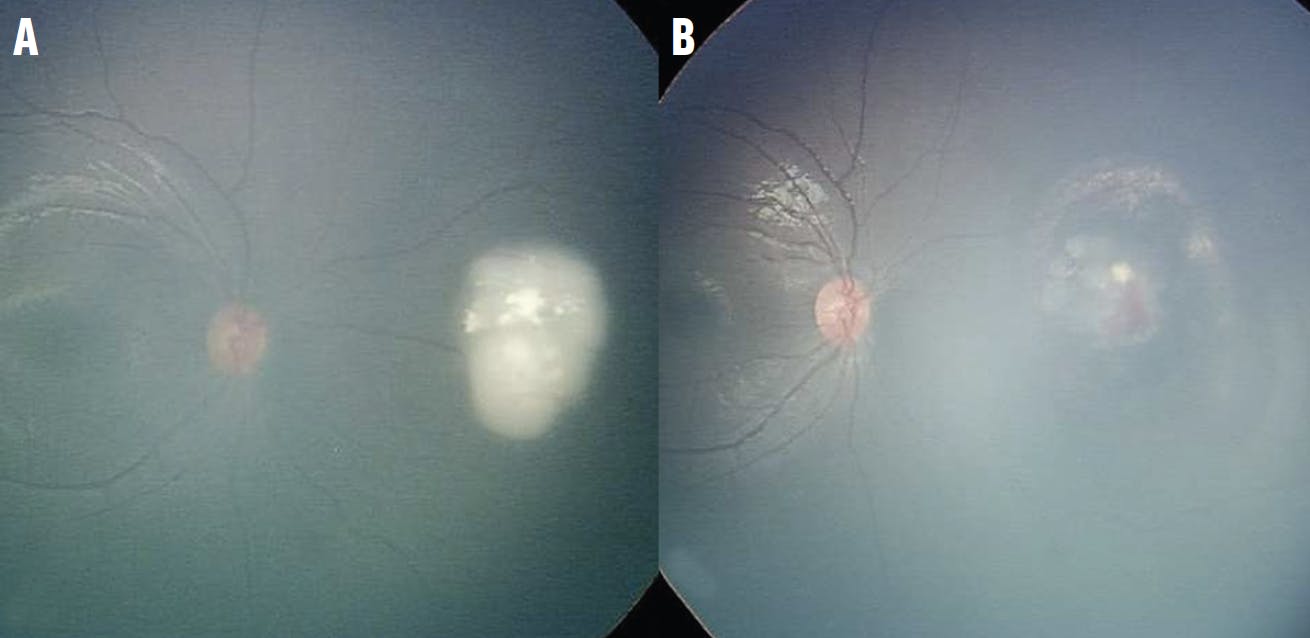
Figure 1. Retinoblastoma in the nasal juxtapapillary region measuring 5.5 x 5 x 2.1 mm (A). Following six cycles of intravenous chemotherapy, the tumor regressed (B).
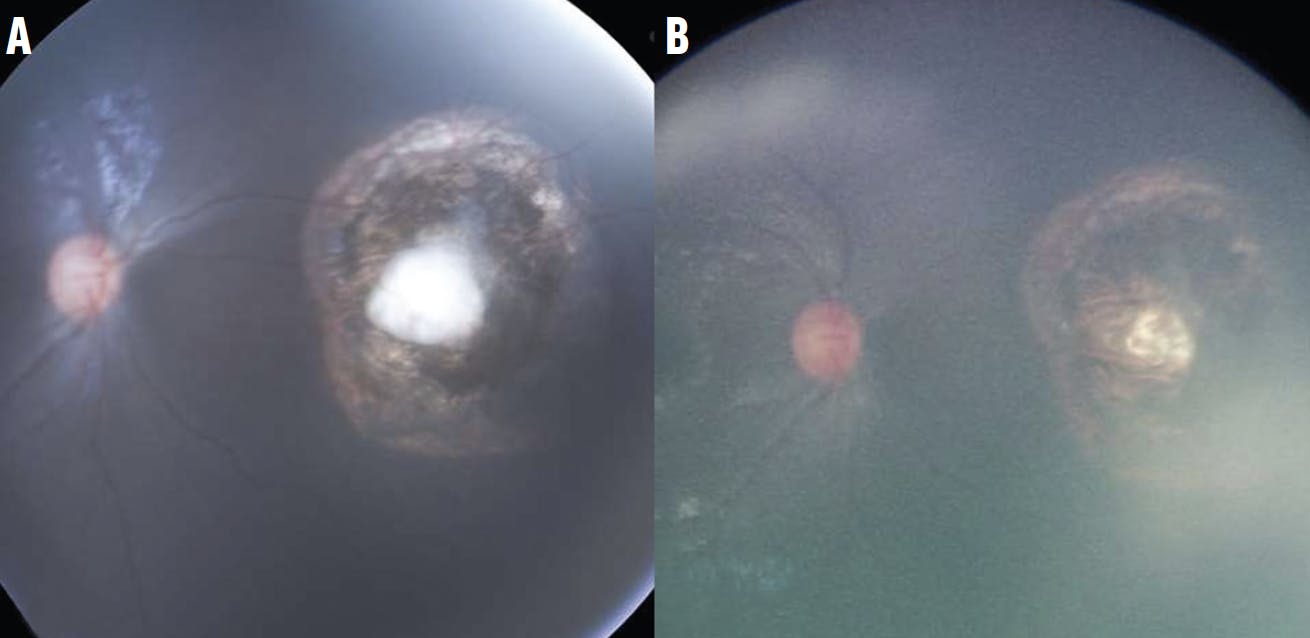
Figure 2. The tumor recurred 3 months later (A) but demonstrated complete regression following three cycles of IAC (B).
Options for management of this recurrence included further cryotherapy plus intravenous chemotherapy with risks of retinal and foveal dragging and retinal toxicity; plaque radiotherapy with the risk of radiation papillopathy and maculopathy; and IAC with the risk of vascular obstruction. IAC was the chosen therapy, and 5 mg melphalan and 1 mg topotecan were delivered for three planned sessions, which led to complete tumor regression (Figure 2B).
DISCUSSION
IAC can be employed as primary therapy for unilateral retinoblastoma in groups B, C, or D eyes, some group E eyes, and in some cases of bilateral retinoblastoma.5 IAC can also be employed as secondary therapy for recurrent or persistent solid tumor, subretinal seeds, or both.5 IAC is routinely given via the transfemoral artery, but transradial IAC can be considered in older children and adolescents with retinoblastoma who have a relatively large radial arterial caliber, with lower risk of access site hematoma and complications, earlier ambulation, and reduced time in the hospital.6
Our team reported on the 5-year globe salvage rate for 341 consecutive eyes with retinoblastoma managed with a total of 1,292 infusions of IAC. For primary IAC, we found a globe salvage rate of 100% for groups B and C, 86% for group D, and 55% for group E.3 For secondary IAC, we found an overall 5-year globe salvage rate of 71% following, in most cases, primary treatment with intravenous chemotherapy.3 In this study, comparative analysis of patient age, race, and sex at the time of therapy revealed no differences in outcomes for race and sex, but it was noted that younger patients experienced a higher rate of globe salvage.3 Younger patients were also more likely to be White, with bilateral retinoblastoma, and positive germline retinoblastoma testing. Older patients were more likely to need secondary IAC for recurrent vitreous seeds.3
We also compared eye salvage rates with primary intravenous chemotherapy versus primary IAC for unilateral retinoblastoma, which revealed similar results in group B (85% vs 100%, respectively) and group C (100% vs 100%), but significantly better results with IAC in group D (48% vs 91%, P = .004).7 Furthermore, there was significantly better tumor control for solid tumor (62% vs 92%, P = .002), subretinal seeds (31% vs 86%, P = .006), and vitreous seeds (25% vs 74%, P = .006) with IAC.7 The combination of IAC with intravenous chemotherapy versus IAC alone for advanced group E retinoblastoma showed a significant reduction of the need for enucleation (27% vs 75%, respectively, P = .039).8
Vascular events, periocular edema and hyperemia, ptosis, focal madarosis, and forehead erythema are some of the complications of IAC, but the risk of vascular events have been reduced from 59% in the early era (2009–2011) to 9% in more recent years (2012–2017; P = < .01).9 These vascular events included peripheral retinal nonperfusion, vitreous and subretinal hemorrhage, branch retinal vein occlusion, choroidal ischemia, and ophthalmic artery spasm.9
SAVING LIVES AND VISION
IAC was instrumental in saving the life, eye, and vision of this young girl with bilateral retinoblastoma, recurrent in her only remaining eye. IAC is an excellent primary and secondary therapy for retinoblastoma and is quite effective for recurrent disease, as shown in this case.
Support provided in part by the Eye Tumor Research Foundation, Philadelphia, PA (CLS). The funders had no role in the design and conduct of the study, in the collection, analysis and interpretation of the data, and in the preparation, review or approval of the manuscript. Carol L. Shields, MD, has had full access to all the data in the study and takes responsibility for the integrity of the data.
1. Rao R, Honavar SG. Retinoblastoma. Indian J Pediatr. 2017;84(12):937-944.
2. Ancona-Lezama D, Dalvin LA, Shields CL. Modern treatment of retinoblastoma: a 2020 review. Indian J Ophthalmol. 2020;68(11):2356-2365.
3. Shields CL, Dockery PW, Yaghy A, et al. Intra-arterial chemotherapy for retinoblastoma in 341 consecutive eyes (1292 infusions): comparative analysis of outcomes based on patient age, race, and sex. J AAPOS. 2021;25(3):150.e1-150.e9.
4. Gobin YP, Dunkel IJ, Marr BP, Brodie SE, Abramson DH. Intra-arterial chemotherapy for the management of retinoblastoma: four-year experience. Arch Ophthalmol. 2011;129(6):732-737.
5. Manjandavida FP, Stathopoulos C, Zhang J, Honavar SG, Shields CL. Intra-arterial chemotherapy in retinoblastoma - a paradigm change. Indian J Ophthalmol. 2019;67(6):740-754.
6. Al Saiegh F, Chalouhi N, Sweid A, et al. Intra-arterial chemotherapy for retinoblastoma via the transradial route: technique, feasibility, and case series. Clin Neurol Neurosurg. 2020;194:105824.
7. Shields CL, Jorge R, Say EA, et al. Unilateral retinoblastoma managed with intravenous chemotherapy versus intra-Arterial chemotherapy. Outcomes based on the international classification of retinoblastoma. Asia Pac J Ophthalmol (Phila). 2016;5(2):97-103.
8. Shields CL, Alset AE, Say EA, Caywood E, Jabbour P, Shields JA. Retinoblastoma control with primary intra-arterial chemotherapy: outcomes before and during the intravitreal chemotherapy era. J Pediatr Ophthalmol Strabismus. 2016;53(5):275-284.
9. Dalvin LA, Ancona-Lezama D, Lucio-Alvarez JA, Lucio-Alvarez JA, Masoomian B, Jabbour P, Shields CL. Ophthalmic vascular events after primary unilateral intra-arterial chemotherapy for retinoblastoma in early and recent eras. Ophthalmology. 2018;125(11):1803-1811.


