




This year has been one for the record books for all of us practicing in the retina space. Our meetings were back in full force after the COVID-19 pandemic, and clinical trial data—and products—have been pouring out of the research pipeline.
We barely finished toasting to the approval of the port delivery system (PDS) with ranibizumab (Susvimo, Genentech/Roche) when faricimab (Vabysmo, Genentech/Roche) gained approval in January—two extended-duration options approved within months of each other.
The first biosimilar in ophthalmology launched, a second biosimilar gained interchangeable status with ranibizumab (Lucentis, Genentech/Roche), and brolucizumab (Beovu, Novartis) recieved a new indication. Completed phase 3 data for ONS-5010 (Outlook Therapeutics), pegcetacoplan (Apellis), and avacincaptad pegol (Iveric Bio) are in the FDA’s hands, and positive phase 3 data is available for high-dose aflibercept (Regeneron) and faricimab for retinal vein occlusion. Data is rolling out for rare conditions too, with Neurotech Pharmaceuticals’ positive phase 3 data for its encapsulated cell therapy for the treatment of macular telangiectasia type 2.1
(If rare and inherited diseases are your jam, check out the July/August issue with the latest data on gene therapies in the pipeline, the role of genetic counselors in your practice, and more.)
With all these advances, you would think this pipeline issue would be a bit light. Instead, the pages are full of therapies and tools that hold promise for patients who don’t have good treatment options—or any treatment option at all.
But, if 2022 has taught us anything, it’s patience because innovation always comes with setbacks and learning opportunities. We were happy to have the PDS for certain patients until the company voluntarily recalled the product due to manufacturing issues—a year, almost to the day, after its approval. In addition, we were expecting the FDA’s ruling on pegcetacoplan, but that remains in the pipeline after the company submitted positive 24-month data to the FDA to bolster its submission.
Most clinicians admit that they aren’t in any hurry to implement the latest therapies, and it’s easy to see why. Positive trial data is worth celebrating, but long-term real-world outcomes are what separate true game-changers from one-hit wonders. And that’s not even considering the reimbursement landscape, particularly for biosimilars.
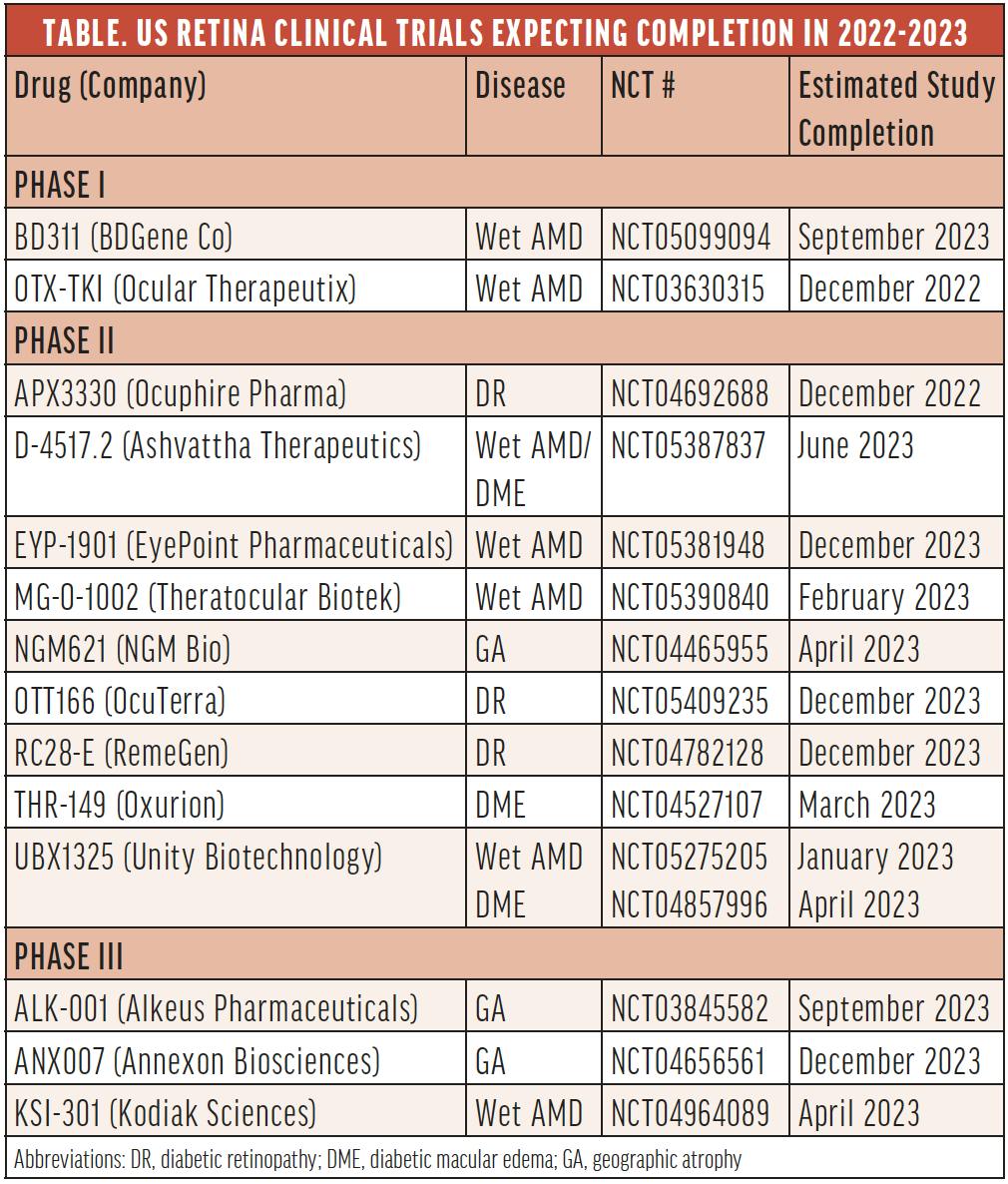
So we wait. 2023 is shaping up to be even more eventful with several potential FDA approvals and at least 15 AMD, geographic atrophy, and diabetic eye disease trials in the United States expecting study completion between now and the end of 2023 (Table). That’s a lot to digest. Rest assured, Retina Today will be reporting on the latest findings as they becomes available.
Before we leave you to the data, we want to thank all the clinician researchers who have dedicated themselves to saving patients’ vision. It’s not easy, particularly when a trial doesn’t go according to plan, but clinical research is a noble cause that continues to move our field forward, sometimes at break-neck speed. Hats off to all of you.
1. Neurotech Pharmaceuticals announces positive phase 3 topline results for NT-501 implant in macular telangiectasia type 2 [press release]. Eyewire+. November 2, 2022. Accessed November 14, 2022. eyewire.news/news/neurotech-pharmaceuticals-announces-positive-phase-3-topline-results-for-nt-501-implant-in-macular-telangiectasia-type-2


