



AT A GLANCE
- Significant morbidity, combined with an incidence that is rising with our aging population, has led to an explosion of experimental therapies designed to address geographic atrophy (GA).
- Novel targets include C3, C5, and C1Q inhibition and oral and gene therapies.
- Drug candidates in phase 3 trials include pegcetacoplan (Syfovre, Apellis), avacincaptad pegol (Zimura, Iveric Bio), and ALK-001 (Alkeus Pharmaceuticals).
- Several retinal implants show promise for restoring some functional vision for patients with GA.
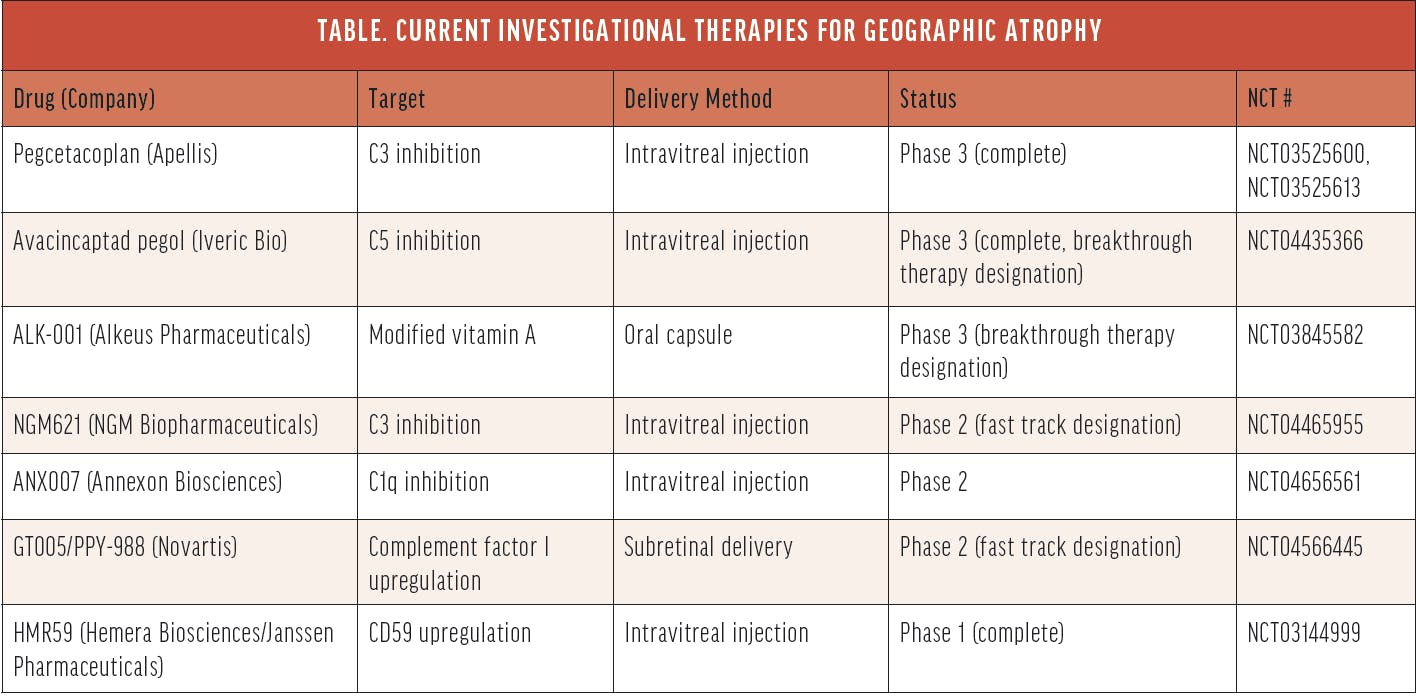
Geographic atrophy (GA) has long been a major cause of visual impairment worldwide, with a global prevalence of more than 5 million and nearly 1 million cases in the United States alone (Figure).1 Significant morbidity, combined with an incidence that is rising with our aging population, has led to an explosion of experimental therapies designed to address this growing need. Here, we share the ongoing investigations for therapies targeting GA (Table).
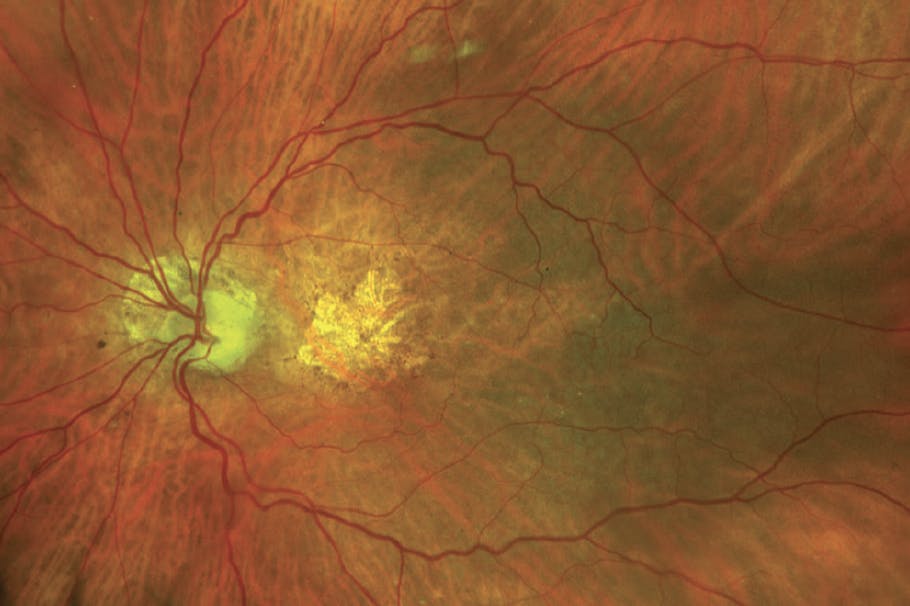
Figure. More than 5 million patients worldwide have geographic atrophy, as seen here in this fundus photograph.
C3 INHIBITION
Pegcetacoplan (Syfovre, Apellis) is a pegylated complement C3 inhibitor that blocks the initial convergence of the three complement pathways, resulting in significant downregulation of downstream complement cascade activity.2-4
The 18-month results of the phase 3 OAKS and DERBY trials, along with evidence of the drug’s consistent safety profile, were included in the new drug application (NDA)submitted in June 2022 and granted priority review designation by the FDA in July 2022.5,6
Subsequently, the 24-month results showed that the extrafoveal GA lesion growth rate was reduced by 22% with monthly injections (P < .0001) and 18% with every-other-month injections (P = .0002) in the OAKS study, and 19% (P = .0004) and 16% (P = .0030) in the DERBY study, respectively.3,4,7 The FDA accepted the company’s major NDA amendment to include this data, pushing the Prescription Drug User Fee Act target action date to February 2023.8
The GALE extended phase 3 study, initiated to assess long-term safety and efficacy, plans to enroll 1,200 participants with projected completion in 2025.9
NGM621 (NGM Biopharmaceuticals) is a humanized IgG1 monoclonal antibody with a high affinity for C3. NGM621’s inhibition of C3 creates blockage at the intersection of all three pathways. The phase 2 CATALINA trial enrolled 320 participants who were randomized into monthly injections, every-other-month injections, or sham groups.10,11 The primary endpoints include the rate of change of GA lesion areas and the incidence and severity of ocular and systemic adverse events. The estimate for primary completion is December 2022, with final completion estimated for April 2023.
In February 2022, the FDA granted fast track designation to NGM621, which provides opportunities for close and frequent communication with the FDA throughout the development process as well as the potential for accelerated approval.12
C5 INHIBITION
Avacincaptad pegol (Zimura, Iveric Bio) is a pegylated aptamer that inhibits cleavage of C5 into terminal fragments C5a and C5b-9, which block the complement cascade and the formation of the membrane attack complex.
The phase 3 GATHER1 study included 286 participants and, at 12 months, demonstrated a mean reduced GA growth rate of 27.4% in the 2 mg dose group (P = .0072) and 27.8% in the 4 mg dose group (P = .0051) compared with sham controls.13 At 18 months, the rate was reduced by 28% and 30% in the 2 mg and 4 mg groups, respectively. Of note, the study found that the treatment groups developed choroidal neovascularization at a rate of 9.0% in the 2 mg dose group and 9.6% in the 4 mg dose group at 12 months, compared with 2.7% in the sham group. At 18 months, these rates increased to 11.9% and 15.7%, respectively, while the sham rate remained unchanged.13
The phase 3 GATHER2 trial also met its primary endpoint with a favorable safety profile.14 Patients in the investigative arm experienced a mean rate of GA growth of 1.745 mm compared with 2.121 mm in the sham group (P = .0039).14
Based on this data, the company submitted the first part of its NDA to the FDA for rolling review in November and is already collaborating with DelSiTech to develop an injectable silica-based sustained-release formulation of avacincaptad pegol.15,16 The FDA granted breakthrough therapy designation for avacincaptad pegol in November.17
ORAL THERAPY
ALK-001 (Alkeus Pharmaceuticals) is a chemically modified form of vitamin A in which hydrogen is replaced by deuterium, resulting in the reduced formation of dimers.18 Replacing natural vitamin A with this modified version inhibits the formation of toxic vitamin A aggregates in the eye. ALK-001 is administered as an oral capsule once per day.
Initially investigated for the treatment of Stargardt disease, ALK-001 was studied in a phase 2 trial that found that the treatment was able to safely slow disease progression without interrupting the normal visual cycle.19
The ongoing phase 3 SAGA trial is investigating the safety, tolerability, and efficacy of ALK-001 in the treatment of GA.20 The trial randomized approximately 300 participants into two groups, daily ALK-001 or placebo, for 24 months. Initial results are expected in August 2023.20
The drug was granted breakthrough therapy designation from the FDA in July 2021.21
Restoring Vision IN Geographic Atrophy
Several device companies are offering potential therapies to restore some functional vision for patients with geographic atrophy (GA). One of the first to market was the Argus II retinal implant (Second Sight Medical Products). The company abandoned the technology amid financial struggles and has since merged with Nano Precision Medical, changing its name to Vivani Medical.1 Another early-stage technology is the NR600 retina implant (Nano Retina), which is designed to provide electrical stimulation to activate remaining healthy retina cells.2
Two more retinal implants are on track to help improve functional vision for patients with GA.
The Prima System (Pixium Vision) is an ocular implant designed to provide a photovoltaic substitute for photoreceptors, allowing for simultaneous use of the central prosthetic and peripheral natural vision.3 A study conducted by a research team in France, published in the Journal of Neural Engineering, used spectral-domain OCT to evaluate the implant’s efficacy in three patients. Metrics included retinal thickness, distance between the array and the inner nuclear layer (INL), and potential macular changes related to trauma from the surgical implantation. The results showed no significant changes in retinal thickness in 36 months of follow-up, after an initial 3-month settling period, during which retinal thickness decreased by a mean of 39 µm.3 In addition, no significant changes were observed in the distance between the implant and the INL. A readout of data from the ongoing European PRIMAvera study to verify the safety and efficacy of the Prima System is expected in 2023.3
In July, the CONCERTO study of the Smaller-Incision New-Generation Implantable Miniature Telescope (SING IMT, Samsara Vision) completed the first of its US surgeries to evaluate the implant’s safety and efficacy in increasing the visual acuity of patients with late-stage AMD.4 The trial will enroll a total of 100 patients with stable bilateral central scotomas due to late-stage AMD and fovea-involving GA or disciform scar who have not had previous cataract surgery. In addition, patients must agree to undergo visual rehabilitation and training after the implantation.
“The SING IMT is a viable option in the treatment of advanced GA when present in both eyes,” said Marc H. Levy, MD, of the Sarasota Retina Institute in Florida, one of surgeons who performed the first SING IMT surgeries, in an email to Retina Today. “Unlike traditional cataract surgery in these patients, the intraocular Galilean telescope magnifies 2.7x, which can improve the patient’s vision beyond what is expected with a traditional IOL.”
With the implant, images are projected onto healthy portions of the retina to reduce the blinding effects of the scotomas. The company reported that the surgeries performed so far have gone smoothly,4 and it plans to continue working with the FDA toward gaining approval to market SING IMT in the United States.
1. Second Sight Medical Products announces successful completion of its merger with Nano Precision Medical and its name change to Vivani Medical, Inc [press release]. Businesswire. August 30, 2022. Accessed October 31, 2022. www.businesswire.com/news/home/20220830005423/en/second-sight-medical-products-announces-successful-completion-of-its-merger-with-nano-precision-medical-and-its-name-change-to-vivani-medical-inc
2. Technology. Nano Retina. Accessed October 31, 2022. www.nano-retina.com/technology
3. Pixium Vision announces the publication of peer-reviewed clinical data of the prima system in dry AMD [press release]. Eyewire+. October 11, 2022. Accessed October 31, 2022. eyewire.news/news/pixium-vision-announces-the-publication-of-peer-reviewed-clinical-data-of-the-prima-system-in-dry-amd-i
4. Samsara Vision announces first US surgeries of the SING IMT (smaller-incision new-generation implantable miniature telescope), for age-related macular eegeneration as part of the CONCERTO study [press release]. July 11, 2022. Accessed October 31, 2022. www.samsaravision.com/press-releases/detail/70/samsara-vision-announces-first-u-s-surgeries-of-the-sing
C1Q INHIBITION
ANX007 (Annexon Biosciences) is a monoclonal antibody antigen-binding fragment that binds to C1q, disrupting the entire classical complement pathway. Phase 1 trials with participants with primary open-angle glaucoma completed in 2020 showed that ANX007 was well-tolerated at all dose levels and achieved target C1q suppression.22-24
In the phase 2 ARCHER study, 270 participants are randomized to receive intravitreal ANX007 injections monthly or every-other-month or receive monthly sham injections for one year.25 The primary endpoint is GA lesion growth rate over 12 months as measured by fundus autofluorescence, with secondary endpoints including safety, BCVA, low-luminance BCVA, and low-luminance visual acuity deficit. Topline data is expected in the first half of 2023, with full data expected at the end of the year after a 6-month off-treatment period.26
GENE THERAPY
HMR59 (Hemera Biosciences/Janssen Pharmaceuticals) is an ocular gene therapy, delivered via a single intravitreal injection, that is designed to cause retinal cells to increase the expression of a soluble form of CD59. The phase 1 dose-escalating safety and tolerability study, which enrolled 17 patients, is complete with data pending.27
GT005 (Gyroscope Therapeutics/Novartis) is an AAV2 vector gene therapy but acts on complement factor I (CFI), a key regulator of the complement system that inactivates proteins implicated in complement overactivation. The therapy received FDA fast track designation in September 2020.28 Novartis acquired GT005 in December 2021, changing the name of the therapy to PPY-988.29,30
Preliminary results of the phase 1/2 FocuS study showed that subretinal delivery of GT005 was well-tolerated with no serious adverse events.31,32 The initial data also showed that the therapy provided sustained increases in vitreous CFI and downstream modulation of complement biomarkers, consistent with reduced complement activity. The trial is active but not recruiting, and the final two cohorts will receive GT005 through the Orbit Subretinal Delivery System (Gyroscope Therapeutics).33
Additional phase 2 trials EXPLORE and HORIZON are recruiting.34,35 Both trials administer GT005 at two doses and assess the progression of GA as measured by fundus autofluoresence for 48 weeks.34,35
1. Genentech. Understanding geographic atrophy: A closer look at advanced AMD. November 13, 2015. Accessed August 12, 2022. www.gene.com/stories/understanding-geographic-atrophy
2. Liao DS, Grossi FV, El Mehdi D, et al. Complement C3 inhibitor pegcetacoplan for geographic atrophy secondary to age-related macular degeneration: A randomized phase 2 trial. Ophthalmology. 2020;127(2):186-195.
3. Study to compare the efficacy and safety of Intravitreal APL-2 therapy with sham injections in patients with geographic atrophy (GA) secondary to age-related macular degeneration. Accessed October 14, 2022. clinicaltrials.gov/ct2/show/NCT03525600
4. A study to compare the efficacy and safety of intravitreal APL-2 therapy with sham injections in patients with geographic atrophy (GA) secondary to age-related macular degeneration. Accessed October 14, 2022. clinicaltrials.gov/ct2/show/NCT03525613
5. Apellis announces 24-month results in phase 3 studies examining pegcetacoplan in geographic atrophy (GA) [press release]. EyeWire+. August 24, 2022. Accessed October 7, 2022. eyewire.news/news/apellis-announces-24-month-results-showing-increased-effects-over-time-with-pegcetacoplan-in-phase-3-derby-and-oaks-studies-in-geographic-atrophy-ga
6. Apellis announces submission of New Drug Application to the FDA for pegcetacoplan for geographic atrophy [press release]. Apellis Pharmaceuticals. June 1, 2022. Accessed October 14, 2022. investors.apellis.com/news-releases/news-release-details/apellis-announces-submission-new-drug-application-fda
7. Apellis announces FDA acceptance and priority review of the new drug application for pegcetacoplan for the treatment of geographic atrophy (GA) [press release]. Apellis Pharmaceuticals. July 19, 2022. Accessed October 17, 2022. investors.apellis.com/news-releases/news-release-details/apellis-announces-fda-acceptance-and-priority-review-new-drug-0
8. Apellis announces FDA acceptance of NDA amendment and new PDUFA date for pegcetacoplan for G A[press release]. Apellis. November 18, 2022. Accessed November 29, 2022.
9. An extension study to evaluate the long-term safety and efficacy of pegcetacoplan (APL-2) in subjects with geographic atrophy secondary to AMD (GALE). Accessed October 17, 2022. clinicaltrials.gov/ct2/show/NCT04770545
10. NGM Bio Explorer Series 4: NGM621. NGM Bio. June 29, 2022. Accessed August 12, 2022. ir.ngmbio.com/static-files/2d55c27b-6567-45b4-b416-5b29d0f49ab5
11. A study of NGM621 in participants with geographic atrophy (CATALINA). Accessed October 17, 2022. clinicaltrials.gov/ct2/show/NCT04465955
12. NGM Bio’s NGM621 receives fast track designation from the FDA for the treatment of patients with geographic atrophy secondary to age-related macular degeneration [press release]. NGM Biopharmaceuticals. February 7, 2022. Accessed October 17, 2022. ir.ngmbio.com/news-releases/news-release-details/ngm-bios-ngm621-receives-fast-track-designation-fda-treatment
13. Zimura in subjects with geographic atrophy secondary to dry age-related macular degeneration. Accessed October 17, 2022. clinicaltrials.gov/ct2/show/NCT02686658
14. Iveric Bio announces positive topline data from Zimura GATHER2 phase 3 clinical trial in geographic atrophy [press release]. Eyewire+. September 6, 2022. Accessed October 17, 2022. eyewire.news/news/iveric-bio-announces-positive-topline-data-from-zimura-gather2-phase-3-clinical-trial-in-geographic-atrophy
15. Iveric bio and DelSiTech enter exclusive agreement for development of sustained release Zimura [press release]. Iveric Bio. July 5, 2022. Accessed October 17, 2022.
16. Iveric Bio submits first part of NDA for rolling review of avacincaptad pegol for the treatment of geographic atrophy [press release]. Eyewire+. November 4, 2022. Accessed November 4, 2022. eyewire.news/news/iveric-bio-submits-first-part-of-nda-for-rolling-review-of-avacincaptad-pegol-for-the-treatment-of-geographic-atrophy
17. Iveric Bio announces FDA has granted breakthrough therapy designation for avacincaptad pegol for geographic atrophy [press release]. Iveric Bio. November 17, 2022. Accessed November 17, 2022. investors.ivericbio.com/news-releases/news-release-details/iveric-bio-announces-fda-has-granted-breakthrough-therapy
18. Alkeus Pharmaceuticals. Science: Pipeline. Accessed October 17, 2022. www.alkeuspharma.com/pipeline.html
19. Phase 2 tolerability and effects of ALK-001 on Stargardt disease. Accessed October 17, 2022. clinicaltrials.gov/ct2/show/NCT02402660
20. Phase 3 study of alk-001 in geographic atrophy. Accessed October 17, 2022. clinicaltrials.gov/ct2/show/NCT03845582
21. FDA grants Alkeus Pharmaceuticals breakthrough therapy designation for ALK-001 for the treatment of Stargardt disease [press release]. Alkeus Pharmaceuticals. July 14, 2021. Accessed October 17, 2022. www.alkeuspharma.com/2021-07-14-press-release.html#:~:text=The%20FDA%20granted%20ALK%2D001,reported%20later%20in%20the%20year
22. Single-dose study of ANX007 in participants with primary open-angle glaucoma. Accessed October 17, 2022. clinicaltrials.gov/ct2/show/NCT03488550
23. Study of ANX007 in participants with primary open-angle glaucoma. Accessed October 17, 2022. clinicaltrials.gov/ct2/show/NCT04188015
24. Annexon Biosciences reports top-line phase 1B results for novel C1Q inhibitor ANX007 in glaucoma [press release]. Annexon. October 9, 2019. Accessed October 17, 2022. ir.annexonbio.com/news-releases/news-release-details/annexon-biosciences-reports-top-line-phase-1b-results-novel-c1q
25. A study investigating the efficacy and safety of intravitreal injections of ANX007 in patients with geographic atrophy. Accessed October 17, 2022. clinicaltrials.gov/ct2/show/NCT04656561
26. Annexon biosciences completes enrollment in ARCHER phase 2 trial of novel C1q inhibitor, ANX007, in patients with geographic atrophy [press release]. Annexon. April 7, 2022. Accessed August 12, 2022. ir.annexonbio.com/news-releases/news-release-details/annexon-biosciences-completes-enrollment-archer-phase-2-trial
27. Treatment of advanced dry age related macular degeneration with AAVCAGsCD59. Accessed October 17, 2022. clinicaltrials.gov/ct2/show/NCT03144999
28. Gyroscope Therapeutics granted FDA fast track designation for GT005, an investigational gene therapy for dry age-related macular degeneration [press release]. Gyroscope. September 22,2020. www.gyroscopetx.com/gyroscope-therapeutics-granted-fda-fast-track-designation-for-gt005-an-investigational-gene-therapy-for-dry-age-related-macular-degeneration
29. Novartis to acquire Gyroscope Therapeutics, adding a one-time gene therapy that could transform care for geographic atrophy, a leading cause of blindness [press release]. Novartis. December 22, 2021. Accessed October 17, 2022. www.novartis.com/news/media-releases/novartis-acquire-gyroscope-therapeutics-adding-one-time-gene-therapy-could-transform-care-geographic-atrophy-leading-cause-blindness
30. Novartis. PPY 988. Accessed October 17, 2022. www.novartis.com/node/137286
31. FocuS: First in human study to evaluate the safety and efficacy of GT005 administered in subjects with dry AMD. Accessed October 17, 2022. clinicaltrials.gov/ct2/show/NCT03846193
32. Kiss S. Preliminary results from a first-in-human phase I/II gene therapy study (FOCUS). Gyroscope Therapeutics. Presented at ASRS 2022; New York, New York; July 13-16, 2022.
33. Ho AC. Delivering investigational gene therapy, GT005, via the orbit subretinal delivery system in the phase I/II FOCUS clinical trial. Presented at AAO 2021; New Orleans, LA; November 12-15, 2022.
34. EXPLORE: a phase II study to evaluate the safety and efficacy of two doses of GT005. Accessed October 17, 2022. clinicaltrials.gov/ct2/show/NCT04437368
35. HORIZON: a phase II study to evaluate the safety and efficacy of two doses of GT005. Accessed October 17, 2022. clinicaltrials.gov/ct2/show/NCT04566445


_1784132761.jpg?auto=compress,format&w=75)


