


Retinopathy of prematurity (ROP) is one of the most common causes of preventable vision loss in children.1,2 Despite the availability of various treatment approaches—and favorable results with timely intervention—many infants present for treatment only once they have reached the advanced stages of the disease.2 This is due, in part, to the lack of access to pediatric ophthalmologists and retina specialists, particularly in developing countries (eg, South-East Asia).3
Although ROP screening protocols have improved, many infants still develop severe vision loss due to retinal folds and tractional retinal detachment (TRD), the most serious ROP complications leading to blindness.4 With the advent of anti-VEGF therapy, the number of patients who develop TRDs has decreased.3 Still, some patients will require surgical intervention for ROP. When they do, these clinical factors can help you understand when less is more in the OR.
STAGE 4
Surgery is indicated when ROP progresses to stage 4, whether stage 4A (macula-sparing TRD) or stage 4B (macula-involving TRD). The goal is to reattach as much of the retina as possible without introducing a retinal break. Although scleral buckling and/or vitrectomy are routine procedures in the hands of an experienced vitreoretinal surgeon, surgical intervention for these stages can quickly become complex if intraoperative complications arise. Each ROP-related TRD is unique with varying presentations, and even a tiny retinal tear can devastate the prognosis. Sen et al found that intraoperative breaks occurred in 19% of patients in their case series of 202 premature eyes.4 Other complications included postoperative vitreous hemorrhage (28%), increased IOP (12.7%), and cataract progression (2.4%).4
More risk is involved with stage 4B ROP surgery because surgeons must peel the fibrovascular membranes to relieve traction and dissect all the preretinal fibrovascular membranes over the macula or around the equator. Thus, “less is more” for stage 4B surgery, more so than with stage 4A.
The least risky surgical procedure to treat stage 4A ROP is scleral buckling, which I reserve for cases that present with a retinal tear or simple traction (ie, no fibrovascular membrane). To ensure success, surgeons must be careful to time the release of the silicone band properly, observe the IOP closely, and be mindful of the patient’s refractive error. Scleral buckling should reduce the vascular activity and help to reattach the retina.
Thanks to today’s advanced surgical tools, vitrectomy is another surgical approach that may help to release traction due to fibrovascular membranes with reasonable safety. In fact, some researchers have reported better surgical results with vitrectomy for ROP compared with scleral buckling.5,6
When performing surgery for stage 4 ROP, surgeons should follow two rules:
Rule no. 1: There is no need to induce a posterior vitreous detachment.
Rule no. 2: Try to relieve the traction in all directions (ie, ridge to ora serrata, ridge to ridge, and ridge to lens) while removing as few preretinal membranes and as little proliferative tissue as possible (Figure 1).7,8
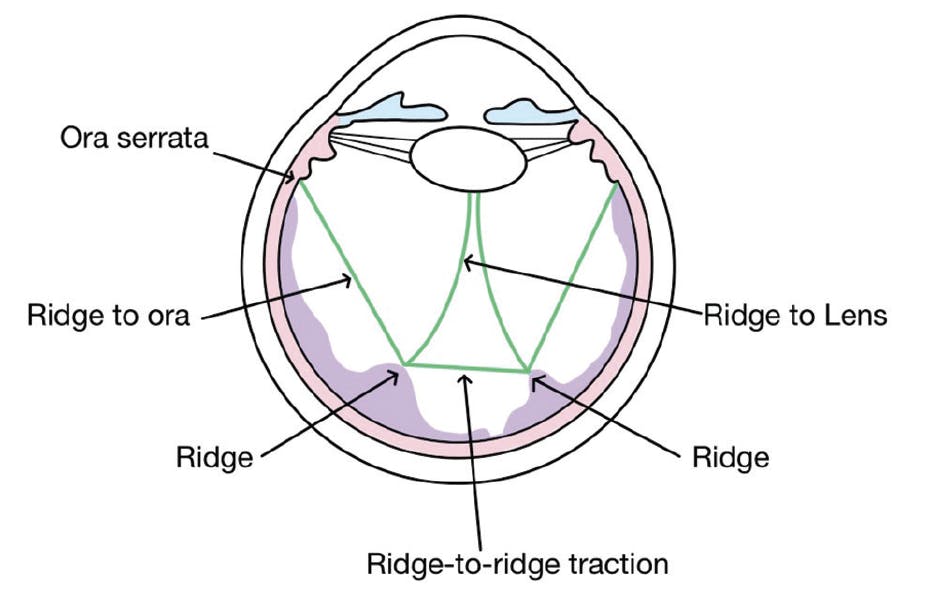
Figure 1. This diagram represents the beginning of a TRD due to various tractional forces in ROP. The traction must be released as much as possible with no complications. Some traction could be due to the vitreous and/or gross fibrovascular membranes.
Image courtesy of Wararee sriyuttagrai, MD
Even if some traction remains, some areas of the retina will gradually reattach postoperatively, which is a better outcome than attempting to eradicate all traction and create a complication in the process, such as a retinal tear.
When to Be Aggressive
When the ridge-to-ridge traction is extensive and the surgeon does not feel that the retina will reattach, usually in stage 4B, a more aggressive approach is necessary to remove the fibrovascular membrane and trim the adhesive vitreous closely to the retina (Figure 2). I prefer to use smaller-gauge instruments, 25- or 23-gauge, without cannulas to allow easy access, better manipulation, and safer removal of fibrovascular tissue.6 In the case of thick membranes that are difficult to cut (often stage 5 ROP), surgeons can use intraocular scissors, although these instruments require precision to avoid inducing a retinal break. Surgeons should watch for intraoperative bleeding, the telltale sign of a retina tear.
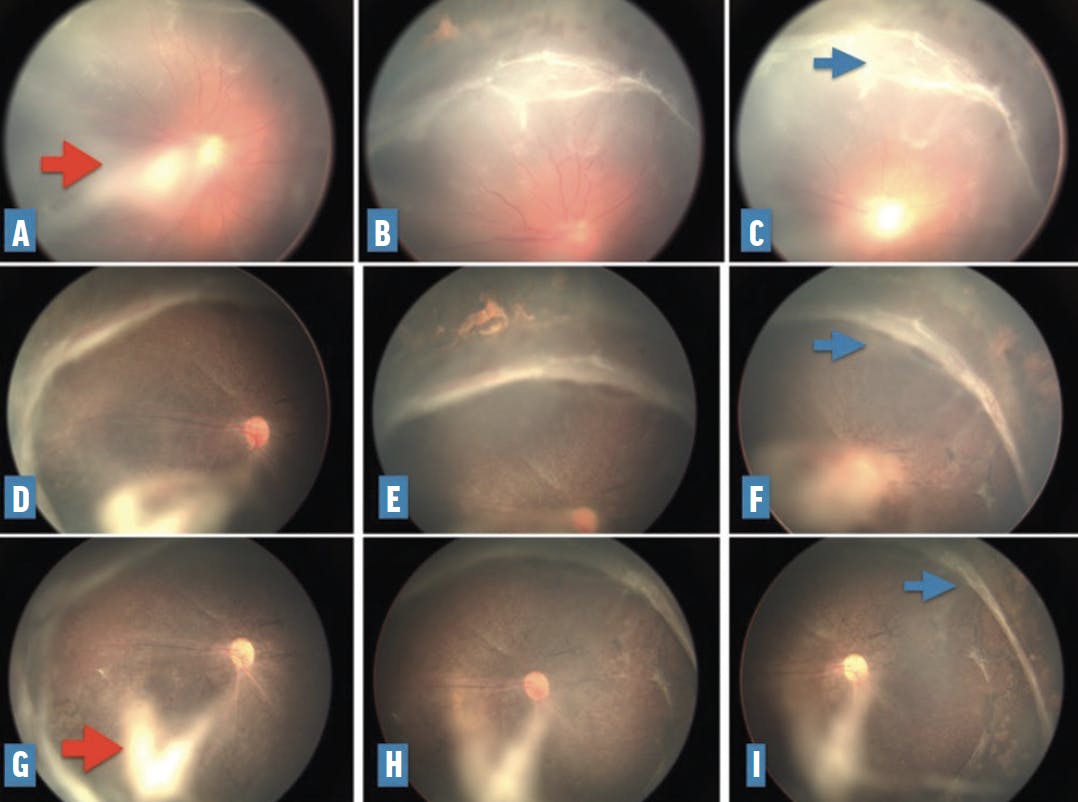
Figure 2. This patient, born at 28 weeks gestational age with a birth weight of 589 g, developed stage 3 ROP with plus in each eye. After treatment with laser indirect ophthalmoscope in each eye, the ROP progressed to stage 5C in the left eye and stage 5A the right eye. At 56 weeks postmenstrual age (PMA), the right eye demonstrated a total RD with a visible optic disc and a 360° ring of active TRD with no significant complex fibrovascular membranes or funnel (A-C). At 80 weeks PMA, the right eye presented with a spontaneously partially reattached retina without the need for surgery (D-F). At 3.6 years of age, fundus photography showed a reattached retina with spontaneously regressed ROP (G-I). Note the mature fibrovascular tissue regression in the vitreous from ridge traction (red arrows) and the regression of peripheral fibrovascular tissues (blue arrows).
STAGE 5
There is no consensus on the proper timing and type of surgery for stage 5 ROP, particularly given the poor anatomical and visual prognosis.4 Stage 5 total RD is categorized into three configurations: stage 5A, in which the optic disc is visible by ophthalmoscopy (open-funnel detachment); stage 5B, in which the optic disc is not visible secondary to retrolental fibrovascular tissue (closed-funnel detachment); and stage 5C, in which stage 5B is accompanied by anterior segment abnormalities (eg, anterior lens displacement, marked anterior chamber shallowing, and iridocapsular adhesions).9
Surgeons must choose their stage 5 surgical cases carefully and impress upon parents the benefits of even light perception vision such interventions can provide. Research shows that surgical intervention for stage 5 ROP can lead to successful anatomical results in only 20% to 50% of cases.2 Here are my typical approaches for each category of stage 5 ROP:
- Stage 5A: I often choose a conservative approach and may wait up to 6 months to see if the retina reattaches from spontaneous regression. If surgery is indicated, the goal of surgical intervention is to achieve at least partial reattachment because complete release of traction is extremely difficult.
- Stage 5B: I adhere to the “less is more” mantra during surgery and minimize my dissection of the fibrovascular membranes to open the funnels. The less vitreous that can be released during surgery, the more likely at least some of the retina will reattach. The less the surgeon manipulates the retina and globe, the better the chances of useful anatomical and functional outcomes.2
- Stage 5C: Selecting these cases is challenging. I do not recommend surgery for patients with severe corneal complications due to the poor surgical view for membrane dissection and subsequent risk of surgical failure, which can lead to phthisis bulbi. Stage 5C ROP with retrolental fibroplasia, more common than cases without retrolental fibroplasia, requires a lensectomy and deep dissection—a more technically challenging surgical approach.2
Preoperative ultrasonography can help surgeons verify the morphology of the stage 5 TRD and plan the best approach to improve the chances of a positive prognosis.
RDs that are closer to the lens with a narrower funnel provide the surgeons with poor visualization through cornea, which can limit the surgeon’s precision when dissecting thin membranes; thus, these fibrovascular membranes should be manipulated as little as possible to avoid unintentional retinal tears.
Another challenge with these stage 5 cases is determining where to begin removing the sheath of vitreous that formed in a radial pattern and closed the funnel anteriorly. Often, the safest starting point is in the center, where surgeons can find the space and then dissect along the top of the retinal fold. Surgeons can be sure they have found the correct plane if they are able to safely dissect to the equator and further into the periphery.
ROP SURGERY QUICK TIPS
- Less is more.
- Surgeons should start ROP surgery with the goal of manipulating the tissues of the eye as little as possible to achieve the goal of an attached retina—even if only a partial reattachment.
- Vitrectomy in the setting of ROP aims to relieve the traction, eliminate the scaffold for further TRD progression, and remove excessive levels of VEGF. All are often enough to stop disease progression, accelerate disease regression, and decrease complications.
Failure to find the correct plane or distinguish between the thin fibrovascular membrane and the avascular retina may lead to unintentional retinal tears and surgical failure. Finally, how much of the fibrovascular membrane to remove depends on the circumstances of each case and requires careful preoperative and intraoperative consideration as the surgeon dissects.
FINAL GOAL
Vitrectomy for ROP-associated TRD is a complex procedure due to the risk of complications. Surgeons must judge carefully to determine how much of the fibrovascular membrane to remove to reduce the vitreous traction without inducing a retinal tear. More often than not, a successful surgery doesn’t involve completely removing the traction; instead, partial reattachment of the retina may be the best possible outcome to avoid introducing complications that may further limit the patient’s visual potential. When in doubt, I recommend surgeons remember that, when it comes to ROP surgery, less is more in complex TRD repair.
1. Shah PK, Prabhu V, Karandikar SS, Ranjan R, Narendran V, Kalpana N. Retinopathy of prematurity: past, present and future. World J Clin Pediatr. 2016;5(1):35-46.
2. Sen P, Jain S, Bhende P. Stage 5 retinopathy of prematurity: an update. Taiwan J Ophthalmol. 2018;8(4):205-215.
3. Sen P, Wu WC, Chandra P, Vinekar A, Manchegowda PT, Bhende P. Retinopathy of prematurity treatment: Asian perspectives. Eye (Lond). 2020;34(4):632-642.
4. Sen P, Bhende P, Sharma T, et al. Surgical outcomes of microincision vitrectomy surgery in eyes with retinal detachment secondary to retinopathy of prematurity in Indian population. Indian J Ophthalmol. 2019;67(6):889-895.
5. Hartnett ME. Features associated with surgical outcome in patients with stages 4 and 5 retinopathy of prematurity. Retina. 2003;23(3):322-329.
6. Wu W-C, Lai C-C Rey-In Lin, et al. Modified 23-gauge vitrectomy system for stage 4 retinopathy of prematurity. Arch Ophthalmol. 2011;129(10):1326-1331.
7. De Juan E, Gritz DC, Machemer R. Ultrastructural characteristics of proliferative tissue in retinopathy of prematurity. Am J Ophthalmol. 1987;104(2):149-156.
8. Foos RY. Retinopathy of prematurity. Pathologic correlation of clinical stages. Retina. 1987;7(4):260-276.
9. Chiang MF, Quinn GE, Fielder AR, et al. International classification of retinopathy of prematurity, third edition. Ophthalmology. 2021;128(10):e51-e68.


