


The oropharynx comprises the middle part of the throat, located between the nasopharynx and hypopharynx, and includes the soft palate, walls of the throat, tonsils, and posterior one-third of the tongue. Risk factors for oropharyngeal carcinoma (OPC) include human papilloma virus (HPV) infection and excessive alcohol and tobacco use.
Orbital involvement in OPC is extremely rare. Of all uveal metastases associated with OPC, 90% are to the choroid, while 8% are to the iris and 2% are to the ciliary body.1 The choroid is particularly vulnerable because of its robust blood supply; choroidal metastasis is the most common type of intraocular malignancy.1,2 There are published reports of OPC from the gingiva, tongue, buccal mucosa, and tonsil metastasizing to the choroid.3-7
Shields et al described many of the clinical features of uveal metastases in a retrospective analysis of 1,111 patients.1 Breast and lung were the most common primary sites, responsible for 37% and 27% of cases, respectively. The primary cancer was diagnosed prior to discovery of uveal metastasis in 67% of patients. The primary site was never determined in 16% of cases.
This report describes a case of presumed choroidal metastasis secondary to OPC and details the patient’s examination findings, multimodal imaging, and response to therapy.
CASE REPORT
A 44-year-old man was referred for evaluation by his ophthalmologist due to blurry vision and presence of multiple deep retinal or choroidal lesions within the posterior pole in each eye.
His past medical history included hypertension, hypothyroidism, and OPC of the left tonsil. Biopsy of the affected tonsil previously demonstrated HPV-positive squamous cell carcinoma (SCC), for which he had previously undergone radiotherapy and three cycles of cisplatin chemotherapy. After completion of treatment, his tumor was reported to have been in remission for 18 months prior to onset of symptoms. Shortly before the onset of his visual symptoms, positron emission tomography (PET) and CT scans suggested metastases to the hilar and mediastinal lymph nodes. Bronchoscopy and biopsy confirmed metastatic carcinoma. Soon after, repeat PET and MRI of the brain suggested additional metastases in the bones, muscles, and brain. Around the same time, he began to note blurring of his vision in each eye, which was subjectively worse in his left eye.
His past ocular history was significant for mild myopia, for which he wore glasses while driving at night. At presentation, his BCVA was 20/50 OU with no relative afferent pupillary defect in either eye. IOPs were 12 mm Hg OD and 11 mm Hg OS. The anterior segment examination was unremarkable. There were no vitreous opacities or cells noted. The optic nerve was normal in appearance with normal cup-to-disc ratios and sharp margins without edema. The retinal vasculature appeared to have normal course and caliber.
IMAGING
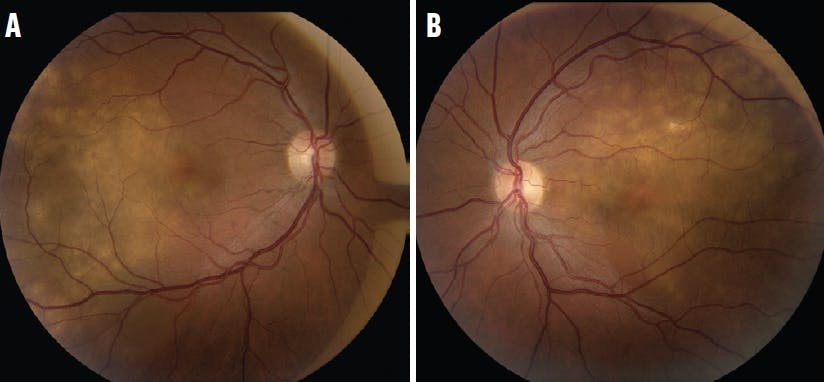
Dilated fundus examination showed numerous discrete yellow/white choroidal lesions with areas of confluence in the temporal macula in each eye that extended from the fovea to the temporal midperiphery (Figure 1).
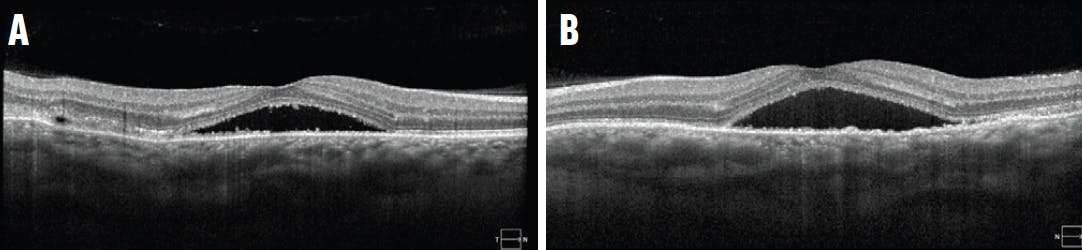
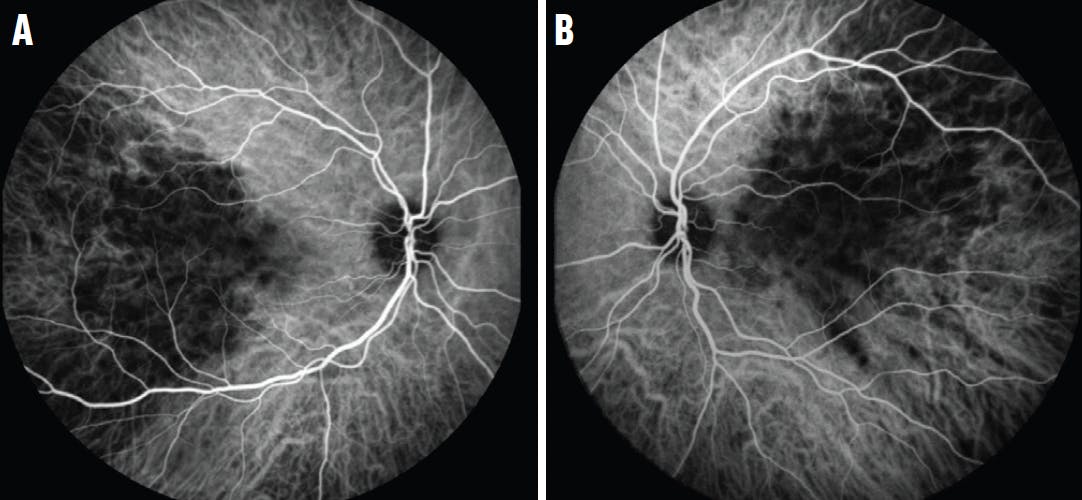
Spectral-domain OCT (SD-OCT) revealed retinal thickening, significant ellipsoid zone and interdigitation zone disruption, and irregularity of the choroid/retinal pigment epithelium in the temporal macula of each eye. Subretinal fluid extended under the fovea with “shaggy” photoreceptors and subretinal hyperreflective material. The choroid appeared thickened, with obscuration of the deep choroidal vasculature (Figure 2). ICG angiography showed large, wedge-shaped areas of hypocyanescence extending from the fovea to the temporal mid-periphery in the right eye and from the peripapillary area to the temporal mid-periphery in the left eye (Figure 3).
The presumed diagnosis at this time was bilateral choroidal metastases from OPC, given the absence of clinical or angiographic signs of intraocular inflammation. He was instructed to follow-up in 1 month. Shortly thereafter, he began eight cycles of carboplatin and 5-fluorouracil chemotherapy, combined with pembrolizumab immunotherapy.
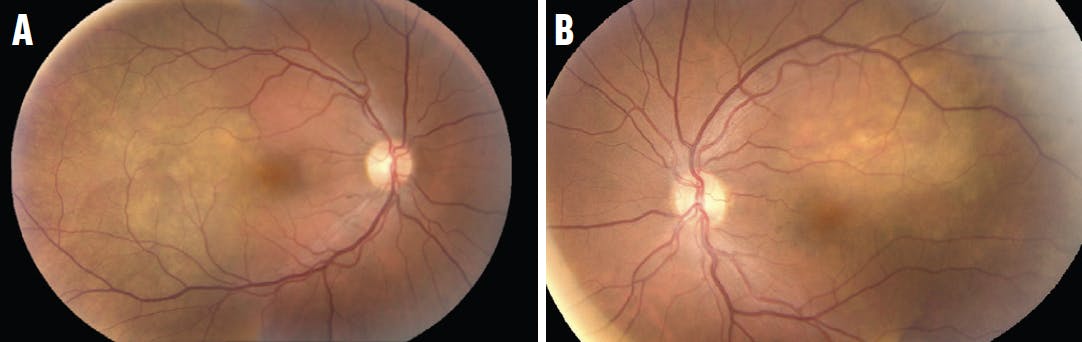
At follow-up, he reported significant improvement in his visual acuity but still noted a mild metamorphopsia, with mild blurring that was worse in his peripheral visual field. His BCVA had improved to 20/20 OU. The choroidal lesions appeared smaller and less prominent in each eye on fundus examination (Figure 4). On SD-OCT, the subretinal fluid had resolved in the right eye and had improved significantly in the left (Figure 5).

DISCUSSION
This patient demonstrated many of the typical characteristics of choroidal metastases. In a large review by Shields et al, 73% of patients with choroidal metastases were found to have subretinal fluid and 57% showed retinal pigment epithelium alterations.2 The epicenter of the lesions was located between the equator and the macula in 80% of patients; in the macula in 12%; and between the equator and ora serrata in 8%.2
Our patient had subretinal fluid and multiple, bilateral, yellow choroidal lesions. The epicenter was between the equator and the macula temporally. These features helped to distinguish the lesions from other entities that could be part of the differential diagnosis for choroidal metastases, such as choroidal melanoma, choroidal nevus, or other choroidal tumors. In addition, there was no anterior chamber or vitreous cell, as would typically accompany the serous retinal detachments seen in Vogt-Koyanagi-Harada syndrome or other inflammatory or infectious conditions.
In cases suspicious for choroidal metastasis where there is no known primary cancer, clinicians should refer patients for prompt systemic imaging and work-up with an oncologist. Chemotherapy for the primary malignancy is the first-line treatment for choroidal metastases. As was seen in our patient, choroidal lesions and secondary subretinal fluid often respond well to systemic treatment. In cases of visually significant subretinal fluid that persists despite systemic treatment, photodynamic therapy has been used with success.8
Clinicians may also consider plaque brachytherapy or external beam radiation therapy (EBRT) for unresponsive lesions. Brachytherapy is preferred for smaller choroidal malignancies.9 Brachytherapy and EBRT often cause significant ocular side effects, including retinopathy, papillopathy, and cataracts.9 However, these are usually outweighed by the benefit of maintaining vision in patients who often have limited life expectancy.9,10 The overall survival rate for patients with choroidal metastases is 57% at 1 year and 24% at 5 years, with a mean survival time of 17.2 months.1
FINAL PEARLS
Serous retinal detachment in the setting of multifocal choroidal lesions should be highly concerning for a metastatic process. In cases of bilateral and multifocal lesions, systemic chemotherapy is the preferred treatment strategy. Directed ocular therapies such as plaque radiotherapy, EBRT, or photodynamic therapy may be used in patients with unilateral metastasis, significant visual compromise, and/or inadequate response to chemotherapy.
Authors note: The Institution Review Board approval was waived for this retrospective case report study. The study was performed in compliance with the tenets of Declaration of Helsinki.
1. Shields CL, Welch RJ, Malik K, et al. Uveal metastasis: clinical features and survival outcome of 2214 tumors in 1111 patients based on primary tumor origin. Middle East Afr J Ophthalmol. 2018;25(2):81-90.
2. Shields CL, Shields JA, Gross NE, Schwartz GP, Lally SE. Survey of 520 eyes with uveal metastasis. Ophthalmology. 1997;104(8):1265-1276.
3. Biswas J, Krishnakumar S, Bhavsar K, Shanmugam MP. Choroidal metastasis of a gingival squamous cell carcinoma. Am J Ophthalmol. 2002;133(5):713-715.
4. Medina C, Biscotti C, Singh AD. Squamous cell carcinoma metastatic of the choroid. J Cytol Histol. 2014;5(3):1-2.
5. Samanta DB, Bhuyan R, Mishra S, Senapati S. Ophthalmic metastasis in squamous cell carcinoma of head and neck: a study on two patients. Int J Sci Study. 2015;3(2):230-233.
6. Bahl A, Dogra M, Rana S, Vyas S, Ghoshal S. Choroid metastasis from carcinoma of the tonsil. Jpn J Clin Oncol. 2020;50(11):1342-1343.
7. Binkley EM, Sampson AD, Syed NA, Boldt HC. Metastatic squamous cell carcinoma of the tonsil mimicking choroidal melanoma. Ocul Oncol Pathol. 2020;6(6):405-409.
8. Ghodasra DH, Demirci, H. Photodynamic therapy for choroidal metastasis. Am J Ophthalmol. 2016;161:104-109.
9. Abrams MJ, Gagne NL, Melhus CS, Mignano JE. Brachytherapy vs external beam radiotherapy for choroidal melanoma: survival and patterns-of-care analyses. Brachytherapy. 2016;15(2):216-223.
10. Arepalli S, Kaliki S, Shields CL. Choroidal metastases: origin, features, and therapy. Indian J Ophthalmol. 2015;63(2):122-127.


_1784132761.jpg?auto=compress,format&w=75)


