


AT A GLANCE
- Genetic testing can include phenotype-driven next-generation sequencing, exome sequencing, or comprehensive genome sequencing.
- Disease-specific panels are a good option for patients with clear clinical phenotypes or known family history of a specific inherited retinal disease.
- Genetic testing should be provided in conjunction with comprehensive genetic counseling before and after testing.
Inherited retinal diseases (IRDs) affect approximately 1 in 2,000 to 1 in 3,000 individuals with nearly 300 genes implicated.1,2 The AAO advocates for genetic testing for patients with a presumed IRD.3 Early genetic diagnosis can reduce the potential for extraocular morbidity, provide patients and families with accurate recurrence risks and prognostic information, and guide treatment decisions. Unfortunately, there is no one-size-fits-all genetic test. Testing options include a phenotype-driven next-generation sequencing (NGS) panel of preselected genes, exome sequencing (ES), and comprehensive genome sequencing (GS; Figure 1). Traditionally, a tiered strategy, starting with panel-based testing, is used to reduce cost and minimize the rates of false genotyping.4 These panels are designed to focus on smaller genomic regions and maximize the coverage of clinically relevant genes. Panel-based NGS techniques have a detection rate of 60% to 70%.5 If this is negative, many clinicians proceed with ES to cast a wider net, while reserving GS mostly for research purposes. Clinicians should be aware that both ES and GS cost more, entail time-consuming analysis, and can identify secondary or incidental medically actionable variants, such as an increased risk for hereditary cancer or cardiac arrhythmia, which can have implications for relatives beyond a suspected retinal disease.
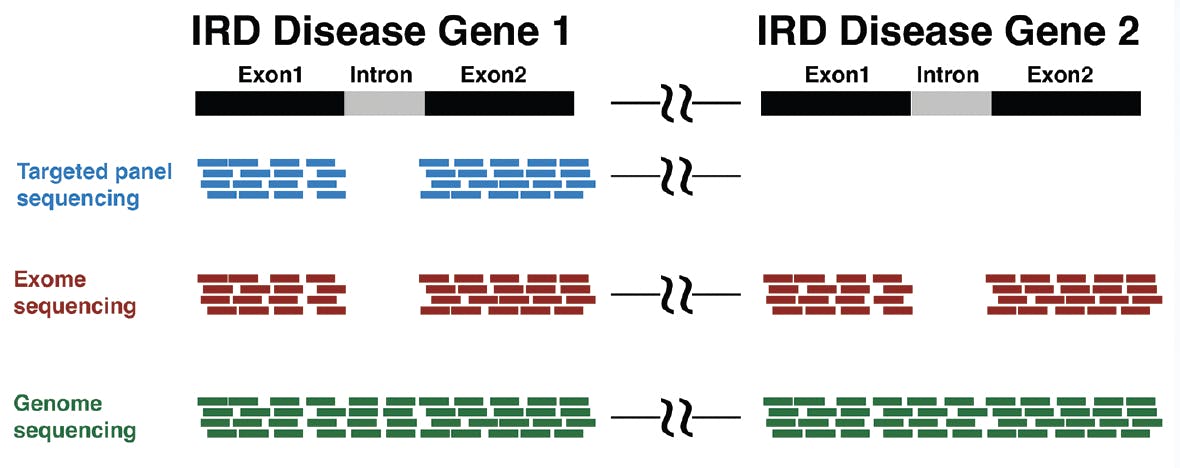
Figure 1. Schematic of the different genetic testing approaches to evaluate disease variants in IRD patients. In most targeted NGS, sequencing reads (blue) are mapped to exons, or coding regions, of targeted genes. Because the targets are preset, exonic variants in a distant (denoted by spacers) disease gene would not be captured with this test. In ES, sequencing reads (red) are mapped to exons of all genes. Both approaches are unable to capture most of the potential non-coding, or intronic disease, variants. GS, which has reads (green) encompassing all bases of an individual, can identify both intronic and exonic variants of IRD genes.
So, how can clinicians sift through the genetic testing landscape to select the most appropriate test for each patient? This article is designed to guide retinal specialists through this decision.
DEEP PHENOTYPING CAN GUIDE TESTING
Given the variability of IRDs in terms of pathogenesis, clinical presentation, visual symptoms, and inheritance, a thorough pretest evaluation is necessary. This can include advanced retinal imaging such as widefield fundus imaging, OCT, and electrophysiology.
There is also significant variability in the typical ages at onset of many IRDs with some associated with congenital or early-onset visual impairment while others more frequently lead to later-onset visual impairment.6,7 A thorough clinical evaluation can provide a presumptive diagnosis and help the clinician pursue more targeted genetic testing.
For example, a teenage male patient was referred to our pediatric retina clinic for macular edema and presumed uveitis that had not improved with topical steroid therapy. The initial examination did not reveal any signs of inflammation, but OCT imaging showed schisis cavities and fluorescein angiography showed no leakage (Figure 2). Further history revealed that the patient had experienced blurry vision for the past few years with no signs of disease in his female siblings. The patient was started on topical carbonic anhydrase inhibitor therapy with targeted genetic testing for the X-linked retinoschisis gene RS1. His genetic test came back positive for a pathogenic homozygous variant in RS1, and his schisis cavities and visual acuity improved with continued topical carbonic anhydrase inhibitor therapy.
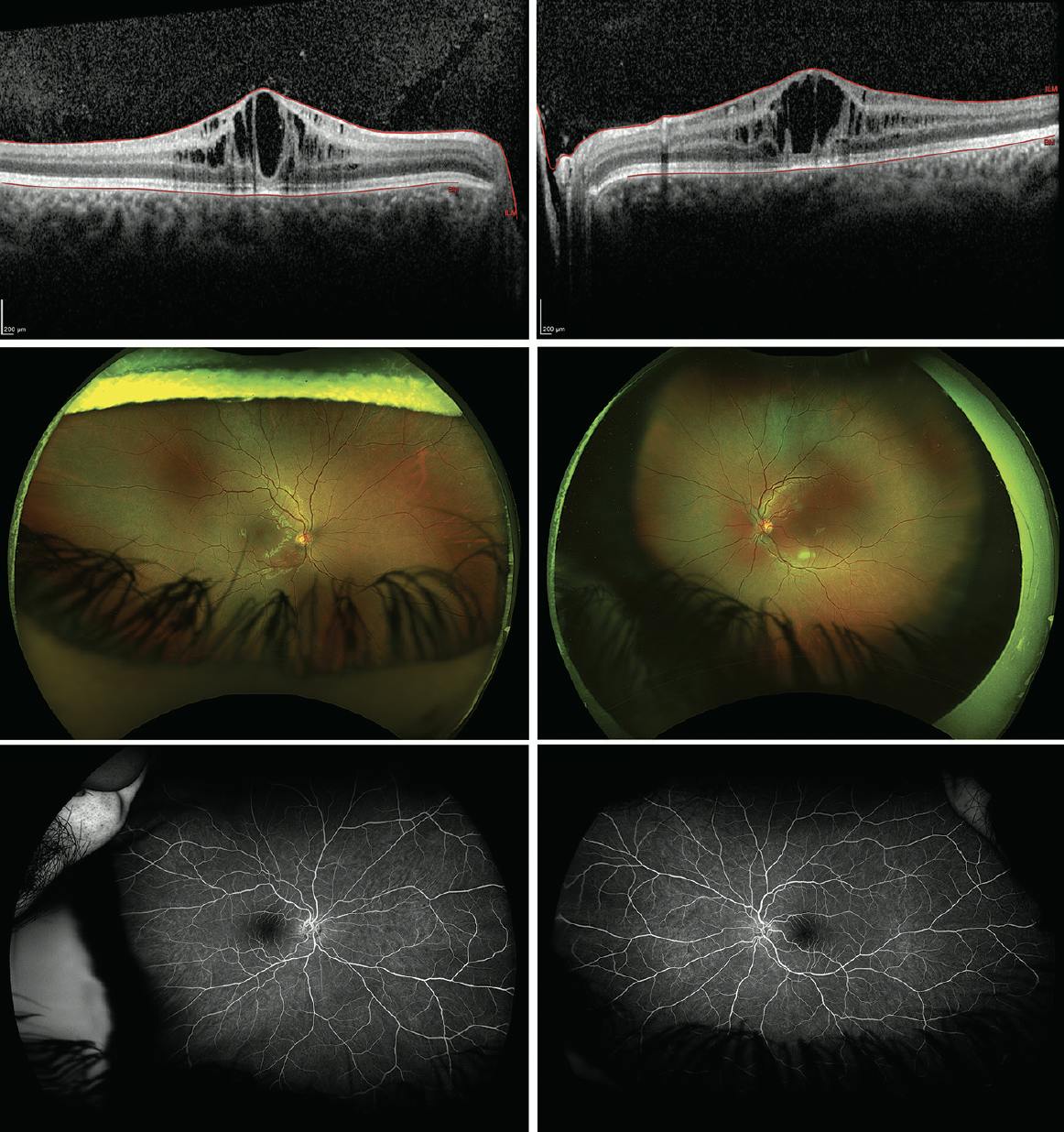
Figure 2. This teenage man presented with decreased visual acuity for presumed uveitis not controlled by topical steroid therapy. Examination revealed macular schisis cavities in each eye on OCT. Color fundus imaging revealed a blunted macular reflex but was otherwise normal. A fluorescein angiogram did not reveal leakage. This constellation of findings, along with familial history, was highly suggestive of X-linked retinoschisis, which was confirmed with genetic testing.
DISEASE-SPECIFIC, COMPREHENSIVE RETINAL, OR EXPANDED TESTING
The most common genetic test ordered for patients with a suspected IRD is panel-based NGS. Clinicians must decide between ordering a comprehensive IRD panel or a focused, disease-specific (eg, retinitis pigmentosa) panel. For patients with clear clinical phenotypes or known family history of a specific IRD, a subset of possible causative genes can be high on the clinician’s differential. In such cases, disease-specific panels are a good option.
Because each NGS panel is different, clinicians should select a panel that includes coverage of disease-specific genes and those of phenotypically similar diseases to increase the likelihood of a clear diagnosis. Given the phenotypic variability of many IRD genes and the continued discovery of novel genotype-phenotype correlations,8 many clinicians select a comprehensive IRD panel. Of note, some laboratories offer larger panels for general ocular disorders, but these do not necessarily increase the diagnostic rate, and they can increase the false discovery rate.4
THE GENES INCLUDED IN THE PANEL
The three commercial laboratories that offer comprehensive gene panels for IRDs (Blueprint Genetics, Invitae, and Prevention Genetics) have significant overlap with more than 250 genes shared among them. However, some genes are unique to each panel (see Online Resource for Inherited Retinal Disease Gene Testing Panels).10 For example, some panels include mitochondrial genes, which have been implicated in retinal degenerations.9 Some comprehensive retinal dystrophy panels also include genes related to ocular or oculocutaneous albinism and related retinal disorders. The addition of non-IRD-related genes in some panels changes the pretest counseling and informed consent discussion with the patient and their family.
NON-CODING VARIANTS IN IRDS
While most testing methodology focuses on the exons, or coding regions of our DNA, and the adjacent 10 to 20 base pairs that form the exon-intron boundary, we are becoming increasingly aware of the importance of deeper non-coding (intronic) variants in IRDs, most notably in ABCA4-related Stargardt disease.11 Identification and characterization of non-coding variants are particularly important for patients with an autosomal recessive IRD and whose testing revealed only one disease-causing coding variant. In such populations, non-coding intronic regions of the disease gene can harbor the other allelic variant.12 The ability to test for these non-coding variants differs greatly among the available panels, so when interpreting results, clinicians should consider if the panel included the non-coding variants in a gene of interest.
VARIANTS OF UNCERTAIN SIGNIFICANCE
Nearly any type of genetic testing will identify one or more variants of uncertain significance (VUS). A VUS is a genetic change that may or may not be associated with disease; essentially, there is not enough evidence for laboratories to predict the effect of a VUS on the gene function. These are non-diagnostic findings and should not be interpreted as causative of an IRD. Importantly, familial testing is not recommended when a VUS is identified on testing unless the laboratory states that it would be useful in reclassification of the VUS. Over time, most VUSs will be reclassified as benign/likely benign, but a few will be reclassified as likely pathogenic/pathogenic.13
ONLINE RESOURCE FOR GENE TESTING PANELS
Visit www.mustafilab.org/resources to explore a database of genes covered by various testing laboratories.1
1. Mustafi D, Hisama FM, Huey J, Chao JR. The current state of genetic testing platforms for inherited retinal diseases. Ophthalmol Retina. 2022;6(8):702-710.
GENETIC COUNSELING
Genetic testing should only be provided in conjunction with comprehensive genetic counseling, which should be done by clinicians with expertise in genetics and genetic counseling.14 Genetic counselors should meet with the patient and family before the test is ordered to discuss the possible results, obtain informed consent, and answer any questions. Counselors should also be available to review the test results, implications, and possible next steps.
We are fortunate to have a clinic that combines IRD care with genetics to facilitate genetic testing for our patients. For clinicians who may not have genetic counselors at their clinic or institution, several companies provide genetic counseling services through telemedicine appointments, and some laboratories contract with such companies to offer genetic counseling services after testing. Having a personal or family history of an IRD can place a significant burden on the individual and their family. Better access to testing and genetic counseling can help ease that burden throughout the diagnostic process.15,16
FINANCIAL BURDEN
Clinicians must also consider any out-of-pocket costs to patients when deciding on appropriate testing. While patients and families often want to pursue genetic testing, many insurance companies will not cover it. To address this challenge, many laboratories have assistance programs or offer decreased self-pay prices. Some sponsored panels offer no-cost genetic testing for eligible patients (eg, the My Retina Tracker program at Blueprint Genetics and the Inherited Retinal Disease program at Invitae), although these may be a part of a research protocol, which is important to review with patients and families.
HOW OFTEN TO ORDER A GENETIC TEST
In general, patients who underwent genetic testing more than 3 years ago with normal (or inconclusive) results should be considered for updated genetic testing due to advances in gene discovery, new gene-disease associations, and updates in massively parallel sequencing technology.
KNOWLEDGE IS POWER
Ordering genetic testing for IRDs is not straightforward, as evidenced by the multitude of panels available. As clinical trials for IRDs progress to potential treatments, genetic testing will be essential to properly identify patients who may benefit from intervention.
1. Berger W, Kloeckener-Gruissem B, Neidhardt J. The molecular basis of human retinal and vitreoretinal diseases. Prog Retin Eye Res. 2010;29(5):335-375.
2. Daiger S, Rossiter BJF, Greenberg J, Christoffels A, Hide W. Data services and software for identifying genes and mutations causing retinal degeneration. Invest Ophthalmol Vis Sci. 1998;39(S295).
3. Stone EM, Aldave AJ, Drack AV, et al. Recommendations for genetic testing of inherited eye diseases: report of the American Academy of Ophthalmology task force on genetic testing. Ophthalmology. 2012;119(11):2408-2410.
4. Stone EM, Andorf JL, Whitmore SS, et al. Clinically focused molecular investigation of 1000 consecutive families with inherited retinal disease. Ophthalmology. 2017;124(9):1314-1331.
5. Weisschuh N, Mayer AK, Strom TM, et al. Mutation detection in patients with retinal dystrophies using targeted next generation sequencing. PLoS One. 2016;11(1):e0145951.
6. Pontikos N, Arno G, Jurkute N, et al. Genetic basis of inherited retinal disease in a molecularly characterized cohort of more than 3000 families from the United Kingdom. Ophthalmology. 2020;127(10):1384-1394.
7. Goetz KE, Reeves MJ, Gagadam S, et al. Genetic testing for inherited eye conditions in over 6,000 individuals through the eyeGENE network. Am J Med Genet C Semin Med Genet. 2020;184(3):828-837.
8. Hull S, Arno G, Plagnol V, et al. The phenotypic variability of retinal dystrophies associated with mutations in CRX, with report of a novel macular dystrophy phenotype. Invest Ophthalmol Vis Sci. 2014;55(10):6934-6944.
9. Birtel J, von Landenberg C, Gliem M, et al. Mitochondrial retinopathy. Ophthalmol Retina. 2022;6(1):65-79.
10. Mustafi D, Hisama FM, Huey J, Chao JR. The current state of genetic testing platforms for inherited retinal diseases. Ophthalmol Retina. 2022;6(8):702-710.
11. Bauwens M, Garanto A, Sangermano R, et al. ABCA4-associated disease as a model for missing heritability in autosomal recessive disorders: novel noncoding splice, cis-regulatory, structural, and recurrent hypomorphic variants. Genet Med. 2019;21(8):1761-1771.
12. Di Scipio M, Tavares E, Deshmukh S, et al. Phenotype driven analysis of whole genome sequencing identifies deep intronic variants that cause retinal dystrophies by aberrant exonization. Invest Ophthalmol Vis Sci. 2020;61(10):36.
13. Fung JLF, Yu MHC, Huang S, et al. A three-year follow-up study evaluating clinical utility of exome sequencing and diagnostic potential of reanalysis. NPJ Genom Med. 2020;5(1):37.
14. Li AS, MacKay D, Chen H, Rajagopal R, Apte RS. Challenges to routine genetic testing for inherited retinal dystrophies. Ophthalmology. 2019;126(10):1466-1468.
15. Galvin O, Chi G, Brady L, et al. The impact of inherited retinal diseases in the Republic of Ireland (ROI) and the United Kingdom (UK) from a cost-of-illness perspective. Clin Ophthalmol. 2020;14:707-719.
16. Strait S, Loman R, Erickson L, DeBenedictis M. Inherited retinal degeneration current genetics practices – a needs assessment. Ophthal Genet. 2020;41(6):533-538.


