


Oculodermal melanocytosis is a congenital pigmentary disorder characterized by unilateral or bilateral periocular and temporal fossa cutaneous pigmentation with additional ipsilateral scleral, uveal, orbital, and meningeal pigmentation, often manifesting with heterochromia. This melanocytic pigmentary abnormality, also known as nevus of Ota, can manifest with sectoral or diffuse involvement. Often, the pigmentation is limited to the sclera and uvea, hiding behind the upper and lower eyelids.
This pigmentation is an important predisposing feature for the development of uveal melanoma. Affected patients should be made aware of the implications and the benefits of routine dilated ophthalmic examination.1 Herein, we describe the case of a middle-aged woman with choroidal melanoma in the setting of oculodermal melanocytosis.
CASE REPORT
A 56-year-old White woman of Ukrainian descent was referred to the Ocular Oncology Service at Wills Eye Hospital with blurred vision in her left eye for 2 weeks. She had no past ocular or medical history and claimed to have had several eye examinations over the past few years. Her BCVA was 20/20 OD and 20/30 OS, and her IOPs were 13 mm Hg OD and 14 mm Hg OS.
On examination, there was subtle hyperpigmentation of the periocular skin of the left eye, which the patient recalled was present since birth. Additionally, there was slight heterochromia with the iris (medium brown in the right eye and dark brown in the left eye) surrounded by extensive dark scleral melanocytosis in the left eye. The patient knew of these “freckles” but was never made aware of the potential risk for intraocular tumor. The right eye was unremarkable.
On fundus examination, the left eye had diffuse choroidal melanocytosis imparting a brown color to the choroid with loss of choroidal vascular detail. A 10 x 8 x 3.5 mm choroidal melanoma was noted in the macular region, with overlying hyperautofluorescence corresponding to lipofuscin orange pigment and a trough of dependent subretinal fluid on fundus autofluorescence and OCT.
Ocular ultrasonography confirmed an echolucent mass of 3.5 mm thickness with no extrascleral extension (Figure). Based on these features, a diagnosis of choroidal melanoma in an eye with oculodermal melanocytosis was made. Treatment with iodine-125 plaque radiotherapy and genetic testing for prognostication was performed.
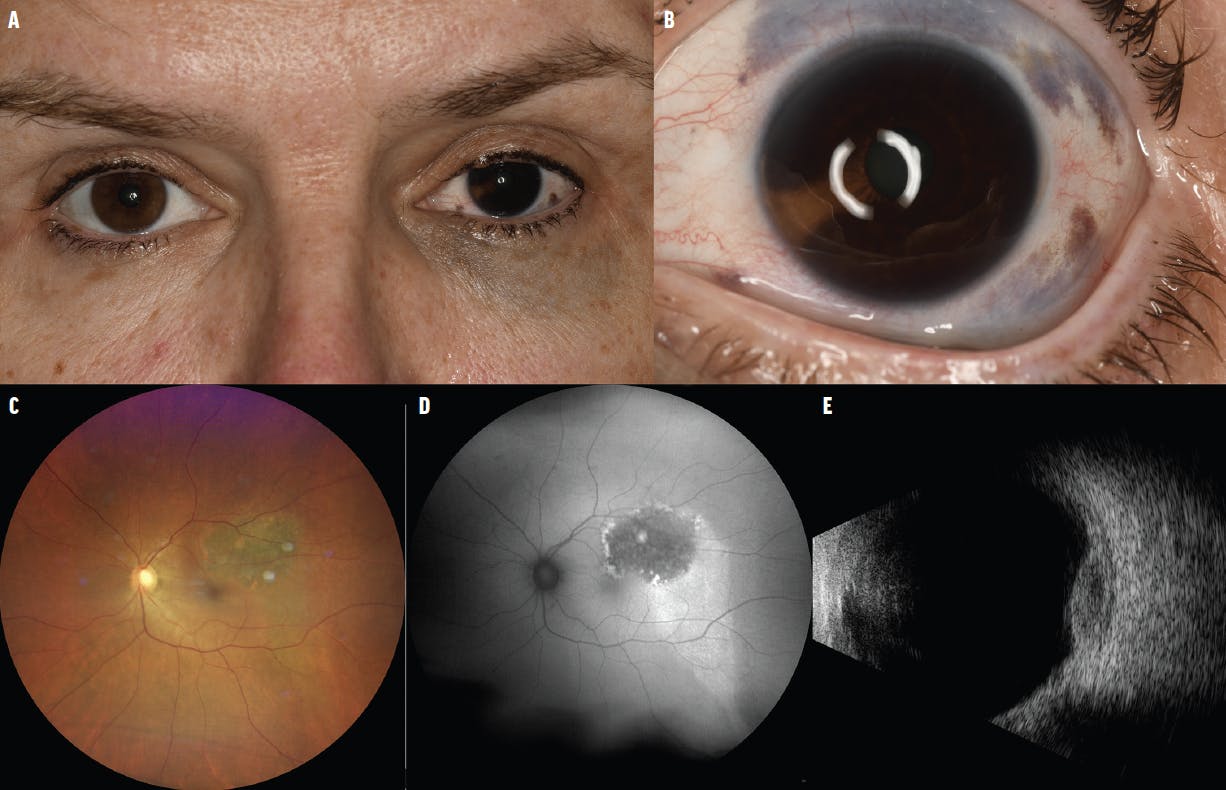
Figure. This 56-year-old woman presented with congenital oculodermal melanocytosis and a choroidal melanoma in the left eye. The external examination showed periocular cutaneous pigmentation of the left side and left iris heterochromia (A) and diffuse, slate-gray scleral melanocytosis (B). The fundus photograph (C) revealed the choroidal melanocytosis and a small choroidal melanoma, measuring 10 x 8 x 3.5 mm with overlying lipofuscin orange pigment, which is best depicted on fundus autoflourescence showing associated subretinal fluid (D). Ultrasonography showed a dome-shaped, echolucent choroidal melanoma (E).
DISCUSSION
Oculodermal melanocytosis most commonly involves the sclera (92%), followed by the iris (17%), which presents as iris heterochromia. The choroid (12%), eyelid (8%), and the temporal fossa (1%) are less frequently affected.1 Other less common sites of pigmentation include the palate, meninges, and tympanic membrane.1,2 This condition is often overlooked as a birthmark by patients and ophthalmologists alike. However, several studies have shown that oculodermal melanocytosis is a risk factor for the development of uveal melanoma, as was the case in our patient.3,4
Other pigmented birthmarks that have malignant potential but often escape attention without necessary follow-up include congenital nevocellular nevus, dysplastic melanocytic nevus, and cellular blue nevus, all of which can lead to cutaneous melanoma. Other potential malignancies include nevus sebaceous, which can lead to basal cell carcinoma, and phacomatosis pigmentokeratotica.5,6
Larsen et al reported the case of a 41-year-old man with an “undiagnosed” spot on his skin that was treated with laser and subsequently proved to be cutaneous melanoma with metastasis.7 Gündüz et al reported two children with bluish cutaneous discoloration of the eyelids who were later diagnosed at the ages of 29 years and 32 years with periorbital cellular blue nevus with transformation to cutaneous and orbital melanoma with metastasis.8
Quantifying the Risk for Uveal Melanoma
In eyes demonstrating ocular melanocytosis, the risk of developing uveal melanoma is estimated at 1 in 400, in contrast to the general White population (1 in 13,000).2 Conversely, Shields et al found that 3% of patients in a large cohort (n = 7,872) with uveal melanoma demonstrated underlying oculodermal melanocytosis, and many were unaware of the risk of congenital pigmentation.1 In addition, patients with oculodermal melanocytosis are also at a higher risk of developing multifocal uveal melanoma and bilateral melanoma.9
In 2013, our team of researchers published two reports on the rate of systemic metastasis in patients with uveal melanoma and found it to be nearly double in those with oculodermal melanocytosis compared with eyes without this condition.1,10 The first study revealed Kaplan-Meier estimates for systemic metastasis at significantly higher rates in patients with uveal melanoma associated with melanocytosis compared with those with uveal melanoma without melanocytosis (5 years and 15 years: 27% and 59% vs 15% and 33%, respectively; P = .013; hazard ratio = 1.99).10
The second study of 7,872 consecutive eyes with uveal melanoma revealed that the risk of metastasis varied depending on the tissues involved (iris = 2.8 times higher; choroid = 2.6 times higher; and sclera = 1.9 times higher).1 The Kaplan-Meier estimates for metastasis in patients with oculodermal melanocytosis versus no melanocytosis in this study were 2% versus 1.8% at 1 year, 27% versus 15% at 5 years, and 48% versus 24% at 10 years (P < .001).1
A genetic basis for this observation was revealed in another study by Shields et al, which determined that eyes with oculodermal melanocytosis showed a higher rate of chromosome 8q gain. This was associated with a 20 times higher risk for metastasis.11 In addition, GNAQ mutations have been found in 46% of uveal melanoma and GNA11 mutations in 32% of patients with uveal melanoma.12
CATCH IT EARLY
Early detection is the key to appropriate management and better prognosis. Patients with diffuse or sectoral oculodermal melanocytosis should be evaluated every 6 months with a high index of suspicion for uveal melanoma. Being cognizant of the importance of both the obvious periocular cutaneous and slate-gray scleral pigmentation is essential. Multimodal imaging with autofluorescence, ultrasonography, and OCT is helpful in identifying related small uveal melanoma.
Support provided in part by the Eye Tumor Research Foundation, Philadelphia, PA (CLS). The funders had no role in the design and conduct of the study, in the collection, analysis and interpretation of the data, and in the preparation, review, or approval of the manuscript. Carol L. Shields, MD, has had full access to all the data in the study and takes responsibility for the integrity of the data.
1. Shields CL, Kaliki S, Livesey M, et al. Association of ocular and oculodermal melanocytosis with the rate of uveal melanoma metastasis: analysis of 7872 consecutive eyes. JAMA Ophthalmol. 2013;131(8):993-1003.
2. Singh AD, DePotter P, Fijal BA, Shields CL, Shields JA, Elston RC. Lifetime prevalence of uveal melanoma in white patients with oculodermal melanocytosis. Ophthalmology. 1997;105(1):195-198.
3. Gonder JR, Shields JA, Albert DM, Augsburger JJ, Lavin PT. Uveal malignant melanoma associated with ocular and oculodermal melanocytosis. Ophthalmology. 1982;89(8):953-960.
4. Gonder JR, Ezell PC, Shields JA, Augsburger JJ. Ocular melanocytosis. A study to determine the prevalence rate of ocular melanocytosis. Ophthalmology. 1982;89(8):950-952.
5. Rhodes AR. Pigmented birthmarks and precursor melanocytic lesions of cutaneous melanoma identifiable in childhood. Pediatr Clin North Am. 1983;30(3):435-463.
6. Martínez-Menchón T, Mahiques Santos L, Vilata Corell JJ, Bosch IF, Baixauli JMF. Phacomatosis pigmentokeratotica: a 20-year follow-up with malignant degeneration of both nevus components. Pediatr Dermatol. 2005;22(1):44-47.
7. Larsen TH, Nielsen M, Lindskov R, Hegelund BL, Haedersdal M. Metastases from malignant melanoma after laser treatment of undiagnosed pigmented skin lesions. Lasers Med Sci. 2013;28(5):1403-1404.
8. Gündüz K, Shields JA, Shields CL, Eagle Jr RC. Periorbital cellular blue nevus leading to orbitopalpebral and intracranial melanoma. Ophthalmology. 1998;105(11):2046-2050.
9. Honavar SG, Shields CL, Singh AD, et al. Two discrete choroidal melanomas in an eye with ocular melanocytosis. Surv Ophthalmol. 2002;47(1):36-41.
10. Mashayekhi A, Kalkiki S, Walker B, et al. Metastasis from uveal melanoma associated with congenital melanocytosis. A matched study. Ophthalmology. 2013;120(7):1265-1268.
11. Shields CL, Say EAT, Hasanreisoglu M, et al. Cytogenetic abnormalities in uveal melanoma based on tumor features and size in 1059 patients: The 2016 W. Richard Green Lecture. Ophthalmology. 2017;124(5):609-618.
12. Van Raamsdonk CD, Griewank KG, Crosby MB, et al. Mutations in gna11 in uveal melanoma. N Engl J Med. 2010;363(23):2191-2199.

-1_1678291312.jpg?auto=compress,format&w=70)


