


Anyone who tuned into the Super Bowl this year—whether for the game, the commercials, or Rhianna’s first public performance in 7 years—hopefully noticed the effort put forth to boost diversity and inclusion during the event. Some were obvious choices; some were lucky coincidences for the National Football League (NFL). This was the first Super Bowl in which both quarterbacks were Black, the flight crew for the military flyover consisted of all women, performers used both American and North American Indian sign language to share the music with deaf listeners, and Rhianna blew up social media as the first artist to headline the event while pregnant.1
Put together, it looked like the NFL had done its best to check all the boxes, and the event was touted as “delivering wins for inclusion” by Forbes magazine (apparently the commercials fell short, though).1
Like many, we were watching with family and friends, and the reactions to these “firsts” were a mix of the all-too-familiar. Many applauded the overt attempts at inclusion, while a select few grumbled that it was “over the top.” The all-woman flight crew drew the adults’ attention, but the confused reactions from the young girls in the room made it painfully clear that not having an all-woman flight crew was just as unfathomable. The halftime show was rife with controversy: complaints that it was boring, praise for Rhianna’s vocals, and knowing nods from moms when Rhianna unapologetically took a seat mid-performance and then wrapped herself in what might as well have been a comforter—you go girl.
But now that the hubbub has died down, we must ask ourselves, why are we still having so many “firsts” in the first place? It’s 2023, and this year was the 57th Super Bowl—why is it the first one with two Black quarterbacks, considering nearly 60% of NFL players are Black?2 Why did it take commemorating 50 years of women flying in the US Navy to find five women to do the flyover?3 Why was there such a frenzy over a performer daring to be pregnant at the same time?
The answer is because diversity, equity, and inclusion (DEI) is still very much a work in progress. We have much to do, and for now, it must be a conscious decision. That’s why Retina Today, in addition to actively working to include diverse authors throughout the year, dedicates an entire issue to the topic. Within these pages, authors explore the gender gap in retina authorship, diversity in clinical trials, patient/physician concordance, retinal surgery in the developing world, mentoring underrepresented groups in retina, and one patient’s inspiring journey with retinitis pigmentosa.
One group that was conspicuously missing (in our humble opinion) from the Super Bowl inclusion fanfare was the LGBTQ+ community. Maybe the NFL isn’t ready to tackle this one. But we are. We convened what very well may be the first roundtable of superb retina specialists who are open about their status as part of the LGBTQ+ community. The article is an ode to the strength it takes to be your authentic self in a field once dominated by a very select group of practitioners. The panelists share poignant moments along their personal journeys in the hopes that it helps others better understand the struggles of those who are underrepresented in medicine—and where, exactly, they can work toward a more inclusive atmosphere for patients, staff, and colleagues.
Making DEI a priority takes effort and forethought. Right now, that intention may feel uncomfortable and forced for those who have yet to understand the need and embrace the benefits. But we must talk about it anyway so that, one day, it won’t be an obvious decision; instead, it will just be an integral part of who we are.
ON THE COVER
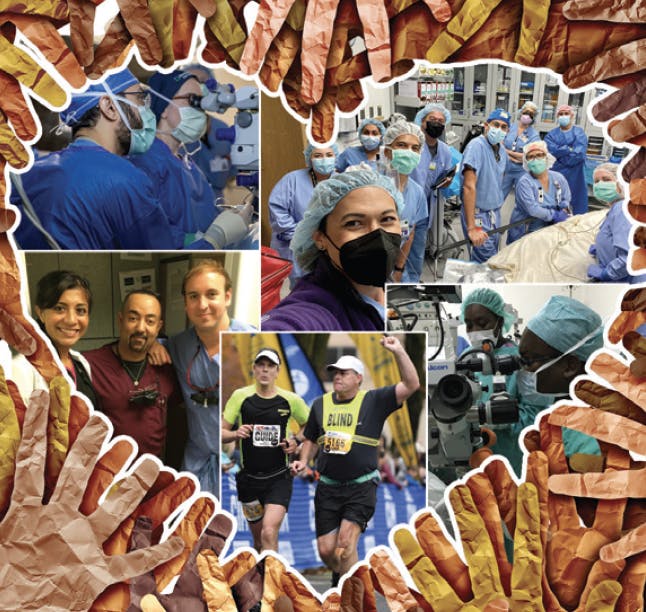
- Abdul-Hadi Kaakour, MD, MS, assists Aleksandra Rachitskaya, MD, in the OR.
- Vivienne S. Hau, MD, PhD, poses with her staff in the OR.
- Luc Dupuy Pierre, MD, performs his first vitrectomy in Cap-Haïtien, Haiti.
- Richard Hunter finishes a marathon with his guide, Scott Jurek.
- Roberto Diaz-Rohena, MD, enjoys a day in the office with his past fellows, Blanca Flores, MD, who is currently training in England, and Cooper Clark, MD, now a retina specialist in San Antonio.
1. Thompson S. SuperBowl LVII delivered wins for inclusion. Almost none came from the ads. Forbes. February 13, 2023. Accessed February 14, 2023. www.forbes.com/sites/soniathompson/2023/02/13/superbowl-lvii-delivered-wins-for-inclusion-almost-none-came-from-the-ads
2. Gough C. Share of African Americans in the National Football League in 2021, by role. Statista. July 20, 2022. Accessed February 14, 2023. www.statista.com/statistics/1154691/nfl-racial-diversity
3. US Navy Super Bowl LVII flyover team. Navy Outreach. Accessed February 14, 2023. www.navy.mil/Portals/1/features/superbowl/Navy-SuperBowl-Flyover-Bios-6Feb23.pdf

-1_1678291312.jpg?auto=compress,format&w=70)


