


With the oncoming myopia pandemic and the aging population, we will be facing an exponential increase in the number of pathologic myopia patients with myopic traction maculopathy.1,2 As retina specialists, we need to be prepared for it with a solid understanding of the underlying pathophysiology and the available treatment options, including different types of macular buckles and emerging surgical techniques.3-5
Currently, the FDA has not approved any macular buckles, but many have been used, with varying degrees of success, outside the United States for nearly 2 decades. Those include the Ando Plombe (Ondeko), T-shaped scleral buckle (FCI, Carl Zeiss Meditec), NPB macular buckle (AJL Ophthalmics), and adjustable MB (Micromed).6
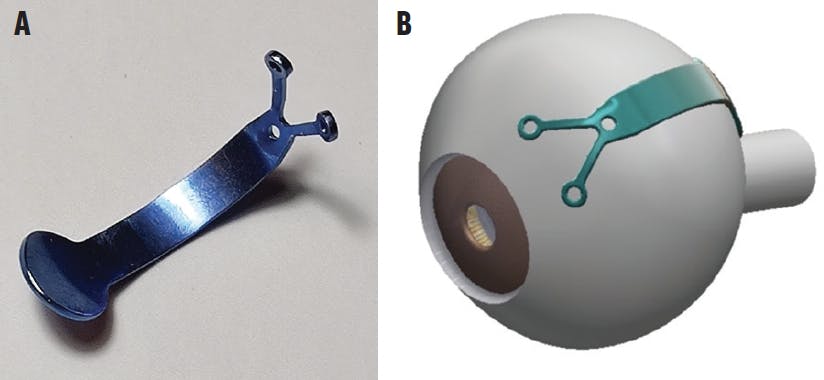
Figure 1. The Akduman MSD, a titanium macular buckle, supports the macula to potentially treat any number of myopia-related pathologies.
TRYING A NEW OPTION
We recently developed a titanium macular buckle, the Akduman Myopia Support Device (MSD) by LA Eye (Figure 1) and used it to repair a recurrent chronic macular hole in an eye with pathologic myopia.7 This buckle was awarded first place in the 2022 American Society of Retina Specialists’ (ASRS) Winning Pitch Challenge competition.
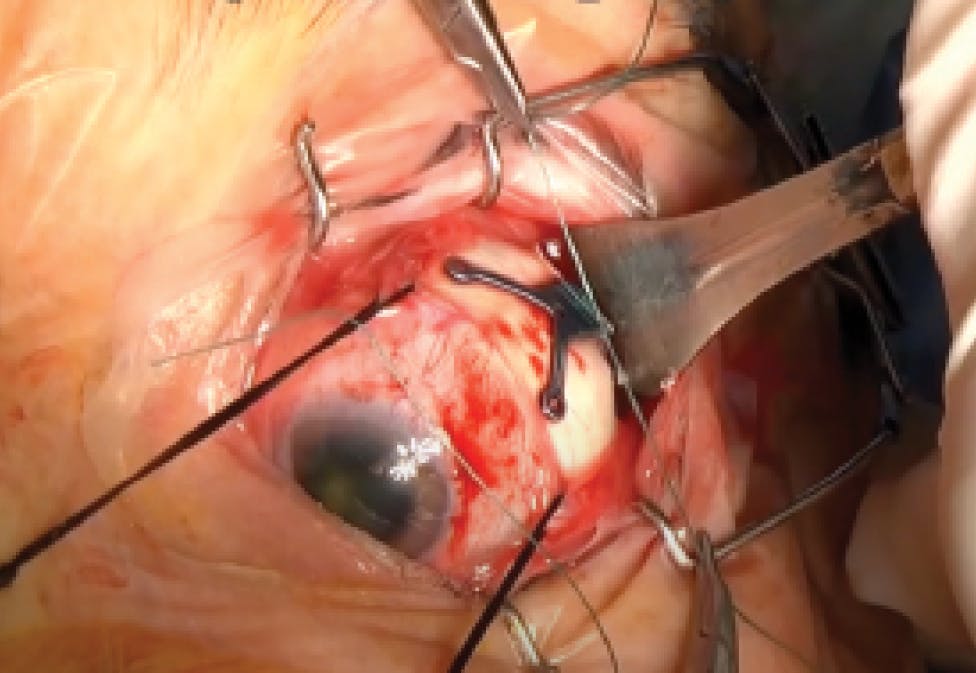
Video. Titanium Macular Buckle Placement
We placed this implant in a highly myopic eye that presented with a retinal detachment and maculoschisis (Video). At presentation, the patient was phakic with a moderate degree of cataract and a VA of hand motion in the right eye. The axial length of the eye was 28.77 mm, and the patient refracted to -11.25, -2.00 axis 72. Widefield imaging and OCT showed a staphyloma, a retinal detachment, and myopic maculoschisis (Figure 2).
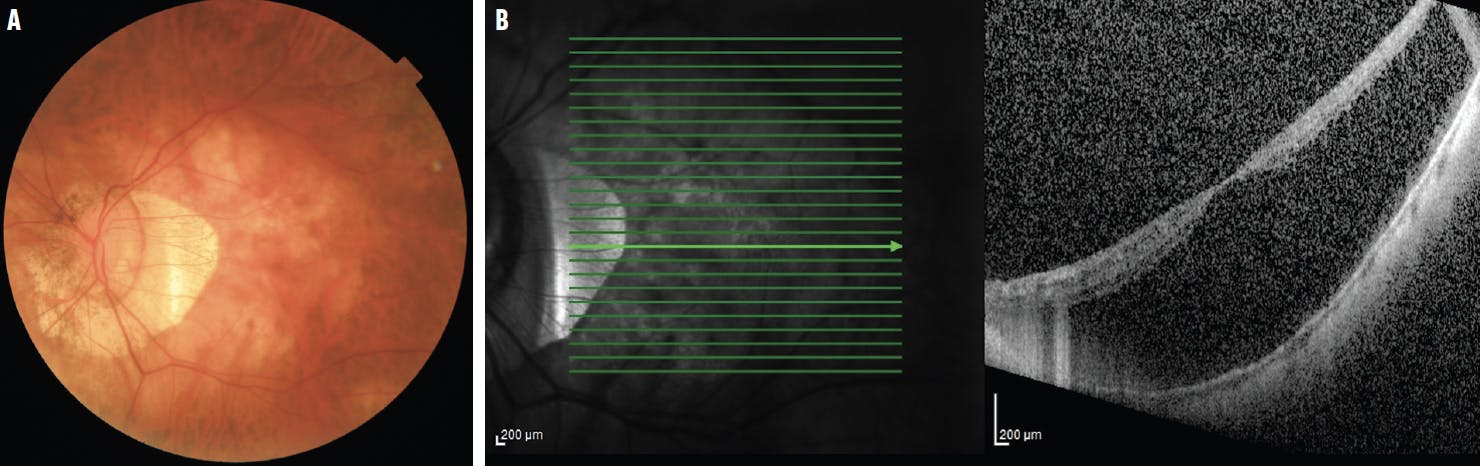
Figure 2. The preoperative color photo of the posterior pole (A) and OCT scan (B) showed a staphyloma and myopic maculoschisis. Note the retinal detachment in the fovea.
Six months after placing the macular buckle without vitrectomy, the retina was attached and the maculoschisis was nearly resolved. The external indentation of the buckle alone had addressed the pathophysiology defined in the myopic traction maculopathy classification by Parolini et al.1 Six months after surgery, the patient’s VA was 20/100, even with the cataract (Figure 3). The axial length of the eye was reduced to 26.31 mm at the 6-month follow up, and the refraction improved to -4.00, -1.75 axis 55. Thus, 7.25 D of myopia was corrected at the same time with no change in astigmatic error. Subjectively, the patient expressed extreme satisfaction with his BCVA and the reduction of the refractive error.
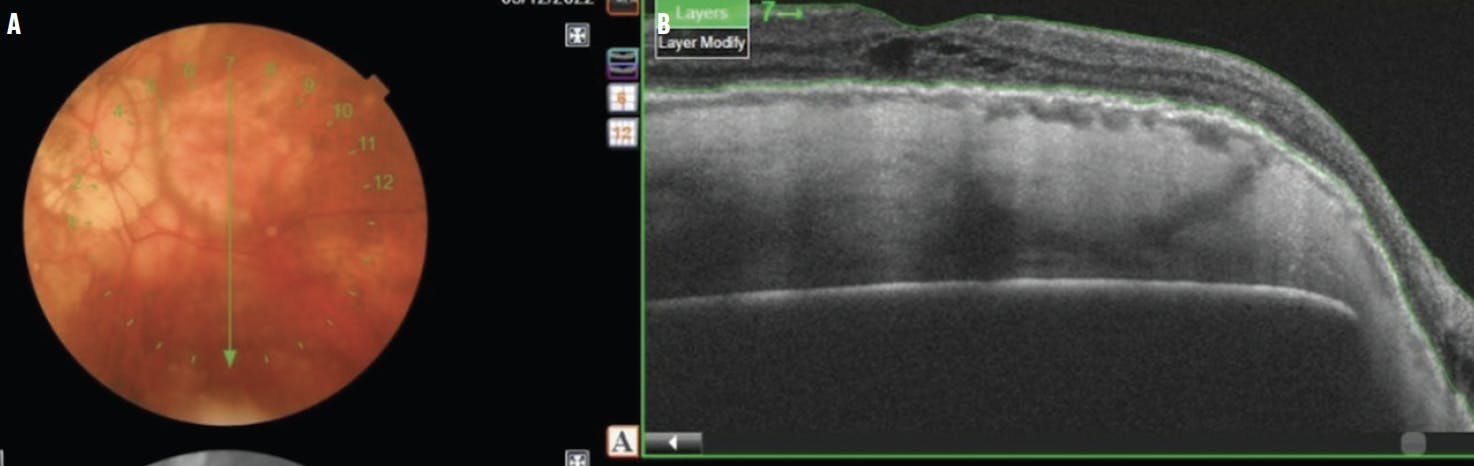
Figure 3. Fundus imaging 6 months after the surgery showed the indentation in the macular area caused by the exoplant (A). No macular scarring or other adverse effects were seen at the 6-month follow-up. The indentation stayed well centered and stable. OCT imaging at 6 months demonstrated resolved subretinal fluid and nearly resolved maculoschisis (B).
THE DESIGN
There are several features and surgical maneuvers unique to this titanium implant, including the following:
- The supportive plate facing and indenting the macular area is concave, which naturally hugs the globe and supports the macula without changing its contour.
- The stiffness and size of the buckle aim to provide a fixed final axial length after the surgery in all eyes, regardless of the initial axial length.
- The large surface area covers the fovea with almost no risk of clinically significant decentering while placing it.
- The material, size, and design allow for easy manipulation and surgical technique. Two-point fixation with 5/0 mersilene sutures, one at its body and one at the anterior inlet, fixate the titanium buckle with no chance of displacement. After placement, the anterior edge remains 8 mm to 10 mm from the limbus and is well covered with Tenon and conjunctiva.
- One size fits all eyes, right or left.
- Removal, if necessary, is easy given the buckle’s design and stiffness.
- Unlike other macular buckles, this one has an inner concave surface and does not compress on the fovea, possibly avoiding long-term foveal changes. The natural contour of the device is designed to avoid any significant effect on the choroidal or retinal circulation secondary to the indentation.
NEXT STEPS
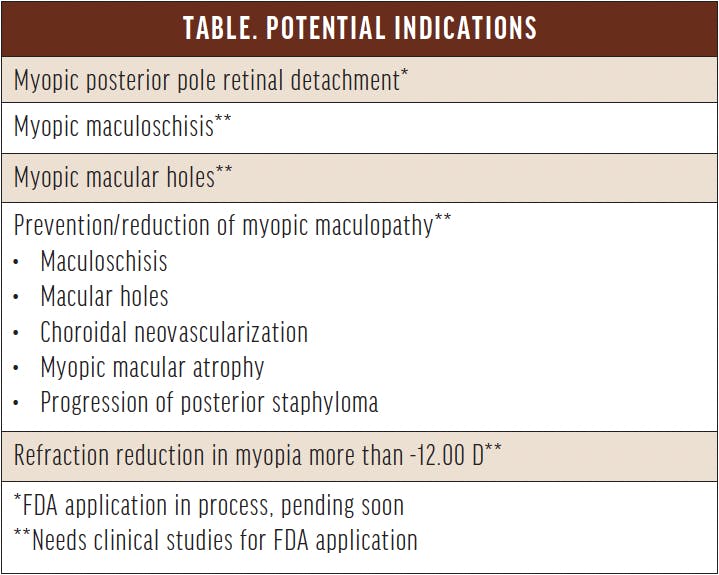
The Akduman MSD, with its unique design and simple surgical technique, may have a place in the retina specialist’s toolkit to manage several indications associated with pathologic myopia (Table). This device was voted as the best retinal innovation by a panel of four judges during the ASRS Winning Pitch Challenge competition in June 2022.
Disclaimers: The use of implants described in this article is not approved by the US FDA. The Akduman Myopia Support Device was developed and owned by Levent Akduman, MD, FASRS.
1. Parolini B, Palmieri M, Finzi A, Frisina R. Proposal for the management of myopic traction maculopathy based on the new MTM staging system. European J Ophthalmol. 2021;6:3265-3276.
2. Holden BA, Frickle TR, Wilson DA, et al. Global prevalence of myopia and high myopia and temporal trends from 2000 through 2050. Ophthalmology. 2016;123(5):1036-1042.
3. Tanaka T, Ando F, Usui M. Episcleral macular buckling by semirigid-rod exoplant for recurrent retinal detachment with macular hole in highly myopic eyes. Retina. 2005;25(2):147-151.
4. Ando F. Use of special macular exoplant in surgery for retinal detachment with macular hole. Jpn Clin Ophthalmol. 1980;35:29-34.
5. Parolini B, Frisina R, Pinackatt S, Mete M. A new L-shaped design of macular buckle to support a posterior staphyloma in high myopia. Retina. 2013;33(7):1466-1470.
6. Fukuyama H, Fawzi AA. Unconventional buckling techniques: controlling MTM. Retina Today. 2022;17(7):33-36.
7. Akduman L. A titanium macular buckle implant designed for an easy placement in myopic macular holes [published online ahead of print August 25, 2022]. Retin Cases Brief Rep.


-1_1678291312.jpg?auto=compress,format&w=70)


