


Thioridazine is an older-generation psychotropic medication used to treat schizophrenia and psychosis.1 Although efficient in treating mood disorders, the medication has a long list of side effects, including prolonged cardiac QTc interval, neuroleptic malignant syndrome, tardive dyskinesia, blood dyscrasias, hypotension, and retinal toxicity.1 Newer-generation psychotropic medications—with more favorable safety profiles—have largely replaced its use, and thioridazine retinal toxicity is exceedingly rare nowadays.
The risk of developing thioridazine retinal toxicity increases when ingesting a daily dose exceeding 800 mg/day, and toxicity usually manifests as blurred vision, nyctalopia, and dyschromatopsia 3 to 8 weeks after initiating therapy.2
Regardless of the shift away from thioridazine as a treatment option for schizophrenia and psychosis, clinicians should remain vigilant when reviewing a patient’s medical history because retinal toxicity can manifest years after stopping the medication.
Here, we present a rare case of assumed retinal toxicity due to thioridazine, which illustrates the classic clinical features to look out for.
THE CASE
A 69-year-old White man with a long-standing medical history of schizophrenia was referred for ocular evaluation due to a 25-year history of bilateral visual decline, nyctalopia, and blurred vision. His medical history was also remarkable for bipolar disorder, grand mal seizures, depression, and early Alzheimer disease. His current list of medications included memantine, lamotrigine, benztropine, mirtazapine, valproic acid, and paliperidone palmitate. The patient had been taking thioridazine 1 g/day for schizophrenia for 20 years prior to switching to paliperidone palmitate 10 years ago. The patient’s family history was negative for any inherited retinal dystrophies.
The ocular examination revealed BCVA of hand motion OD and 20/60 OS. Slit-lamp examination revealed lenticular changes in each eye. Dilated examination and retinal imaging revealed marked chorioretinal atrophy in the macula extending into the midperiphery, vascular attenuation, pigment plaques, retinal pigment epithelium (RPE) mottling, and optic nerve pallor (Figure 1).
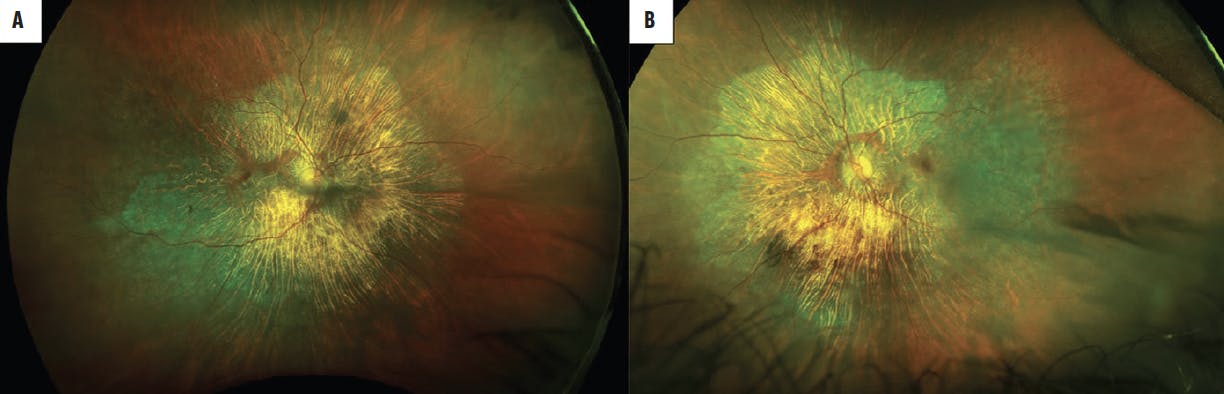
Figure 1. The fundus photographs of our patient’s right (A) and left (B) eyes showed marked macular atrophy, extensive chorioretinal atrophy, vessel attenuation, peripapillary changes, and pigmentary changes.
Fundus autofluorescence imaging showed marked hypoautofluorescence in the macula and midperiphery with a surrounding ring of hypoautofluorescent granularity (Figure 2). OCT imaging showed diffuse loss of the outer retina and RPE in the right eye and loss of the outer retina and RPE with sparing of the central ellipsoid zone in the left eye (Figure 3).
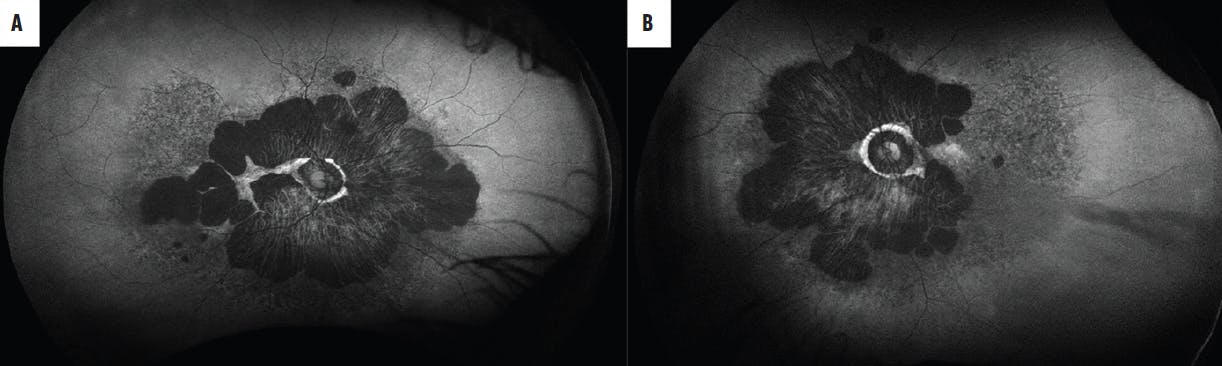
Figure 2. Fundus autofluorescence images of the right (A) and left (B) eyes showed marked hypoautofluorescence in the macula and midperiphery with a surrounding ring of hypoautofluorescent granularity.

Figure 3. OCT showed diffuse loss of the outer retina in the right eye (A) and loss of the outer retina with sparing of the central ellipsoid zone in the left eye (B).
Laboratory testing ruled out infectious and noninfectious diseases. The findings were suggestive of drug toxicity secondary to thioridazine. Due to the end stage of the retinal toxicity and the patient not being on the medication, the patient was followed by observation with no intervention.
DISCUSSION
Thioridazine retinal toxicity is an extremely rare diagnosis since the advent of newer-generation psychotropic medications for the treatment of schizophrenia. Thioridazine accumulates within melanin granules of the RPE, affecting enzyme kinetics.3 The accumulation of thioridazine leads to damage to the RPE, outer retina, and choriocapillaris.3 Clinically, early-stage patients develop granular pigmentary changes in the macula and sometimes in the midperiphery; as the toxicity increases, it progresses into extensive areas of patchy and nummular atrophy.4
Thioridazine retinal toxicity can present with characteristics similar to atypical AMD, making it important to perform multimodal imaging and an extensive review of the patient’s history to establish a diagnosis. Based on our patient’s clinical picture, our list of differentials included atypical AMD, infectious and noninfectious causes, inherited retinal dystrophies, and drug toxicity.
Due to our patient’s symptoms spanning more than 20 years and the extent of atrophy on examination, in addition to no visible drusen, we ruled out atypical AMD. The clinical picture and negative laboratory testing—which included syphilis, tuberculosis, and sarcoidosis—helped to rule out infectious and noninfectious causes. The patient had no family history of inherited retinal dystrophies. In addition, the patient ingested a daily dose of the medication that exceeded the recommended dose for a period of 20 years, with the visual symptoms beginning a few years after starting the medication. Because of this, we decided to forego genetic testing due to the high suspicion for drug toxicity.
That left us with drug toxicities, and toxicity from chlorpromazine, thioridazine, and pentosan polysulfate can cause similar retinal findings. Pentosan polysulfate has a similar mechanism of action to thioridazine in which its metabolite is directly toxic to the RPE, causing impaired retinal pigment processing of the ellipsoid zone.5
After reviewing the patient’s medications, we pinpointed his 20-year history of taking thioridazine as the cause, and he had a classic presentation of thioridazine retinal toxicity: loss of the outer retina, RPE, and choriocapillaris as seen on OCT.
Our patient developed presumed thioridazine retinal toxicity due to the long-term ingestion of greater than 800 mg/day of thioridazine. Dosages of thioridazine below 800 mg/day are generally considered safe, even in those who are on the medication long term.6 One study found that the severity of retinal toxicity correlates to the maximum daily dose more so than with the cumulative dose.7
Unfortunately, once the toxicity has progressed to the end stage, no treatment can reverse the damage. Thus, we followed our patient by observation.
For patients still taking thioridazine, it is important to immediately stop the medication at the first sign of retinal changes to preserve retinal functionality. One study showed that although atrophy may progress after a patient stops the medication, visual acuity may improve or remaine stable.8 It is also important to note that even if a patient who is on this medication does not have signs of retinal toxicity, consulting the patient’s primary care provider about switching to a newer generation psychotropic with fewer side effects may be beneficial for the patient.
CLINICAL PEARLS
When there is a concern for atypical AMD, it is important to perform further multimodal imaging and take a more detailed medical history to establish the correct diagnosis. Our patient’s medical history, clinical examination, and retinal imaging findings were sufficient evidence for us to establish a presumed diagnosis of thioridazine retinal toxicity. Although it is a rare diagnosis with the advent of newer medications, patients who have an underlying psychiatric history and atypical retinal findings on examination might have been taking or are currently taking a psychotropic medication that is the culprit.
1. Davidorf FH. Thioridazine pigmentary retinopathy. Arch Ophthalmol. 1973;90(3):251-255.
2. Shah GK, Auerbach DB, Augsburger JJ, Savino PJ. Acute thioridazine retinopathy. Arch Ophthalmol. 1998;116(6):826-827.
3. deMargerie J. Ocular changes produced by a phenothiazine drug: Thioridazine. Trans Canad Ophthalmol Soc. 1962;25:160-175.
4. Marmor MF. Is thioridazine retinopathy progressive? Relationship of pigmentary changes to visual function. Br J Ophthalmol. 1990;74(12):739-742.
5. Zinn K, Marmor MF. Clinical toxicology of the retinal pigment epithelium. In: Zinn K, Marmor MF, eds. The Retinal Pigment Epithelium. Cambridge: Harvard University; 1979.
6. Finn R. Pigmentary retinopathy associated with thioridazine: Report of a case with a maximum daily dose of 1,400 mg. Am J Psychiatry. 1964.
7. Kozy D, Doft BH, Lipkowitz J. Nummular thioridazine retinopathy. Retina. 1984;4:253-256.
8. Hanif AM, Shah R, Yan J, et al. Strength of association between pentosan polysulfate and a novel maculopathy. Ophthalmology. 2019;126(10):1464-1466.


-1_1678291312.jpg?auto=compress,format&w=70)


