


Uveitis encompasses a heterogeneous mix of diseases. The main culprits include noninfectious and infectious etiologies; rarely, masqueraders, such as neoplastic conditions, are responsible.1,2 The differentiation between these is important to determine the appropriate treatment and long-term management for patients.
In straightforward scenarios, the clinical examination coupled with laboratory testing yields a diagnosis and tenable treatment plan. However, with challenging cases (particularly those with infectious and neoplastic etiologies), a more invasive approach with vitrectomy remains a vital tool in the analytical armamentarium. With diagnostic vitrectomy, clinicians can examine ocular fluid and tissues with bacterial or fungal cultures, gram stain, polymerase chain reaction (PCR), and/or metagenomic deep sequencing. In addition, lymphoma testing includes an evaluation for the MYD88 mutation, IgH gene rearrangement, and the examination of ocular tissue with a pathologist.3,4
PERIOPERATIVE PLANNING AND TECHNIQUE
The perioperative management surrounding vitrectomy can impact diagnostic yield, visual outcomes, and potential complication rates. As a general rule, vitrectomy should be avoided in inflamed eyes; but in certain cases, such as suspected infection, it may be necessary. In these scenarios, clinicians must have a careful discussion with the patient regarding the potential complications, including iatrogenic breaks and proliferative vitreoretinopathy. Surgeons must also consider the potential for a masquerading disease in which vitrectomy would be contraindicated. For example, retinoblastoma with a pseudohypopyon can mimic uveitis, and entering the eye can seed cancer cells.
In cases of suspected ocular lymphoma, steroids should be tapered at least 2 weeks before surgery to increase cellular yield, and care should be coordinated with oncology for a brain MRI and possible lumbar puncture for disease staging.5 When an infection is suspected, ceasing steroids and the administration of intravitreal and/or systemic therapy can improve outcomes.4 If there is concern for a concurrent infection or inflamation with an intraocular foreign body, ocular and orbital imaging with OCT or gentle ultrasound can be helpful. After obtaining the samples, orchestrating the processing of samples between laboratories and an ocular pathologist is necessary to avoid delays and sample degeneration.
During a vitrectomy, the priority is to collect samples safely, identify pathology requiring immediate treatment, and if applicable, administer anti-infectious agents. A standard three-port vitrectomy with a wide-angle viewing system is preferable to obtain sufficient vitreous and maintain visualization. Any existing anterior chamber hypopyon or hyphema should be cleared and can also be sent for analysis. Additionally, a lensectomy may be necessary in phakic patients due to inflammatory debris, vitreous opacities, or to enable a peripheral vitrectomy. In difficult cases, the view can be poor and prevent evaluation of the peripheral retina; avoid extensive peripheral vitreous manipulation in these situations to minimize iatrogenic breaks. Additional techniques and considerations for specific conditions are discussed below.
DIAGNOSING LYMPHOMA
Lymphoma often presents with posterior involvement, and it can mimic panuveitis or posterior uveitis.4,6 Keep a high level of clinical suspicion in cases that initially respond to steroids but later flare and for patients older than 50 years who present with vitritis, especially those with neurological or personality changes (Figure 1).
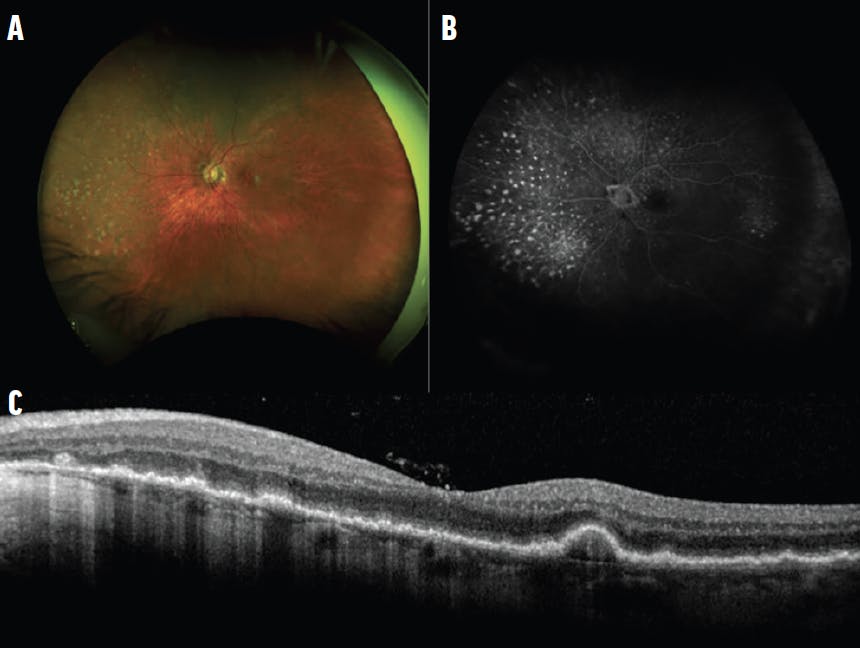
Figure 1. A 67-year-old woman presented with blurred vision in her left eye. Fundus examination showed vitritis and subretinal lesions in the macula and nasally (A). Fluorescein angiography showed staining of the lesions (B). OCT revealed a pigment epithelial detachment and subretinal deposits (C). Vitreous biopsy confirmed the diagnosis of vitreoretinal lymphoma.
Ideally, an undiluted specimen that provides a higher cellular yield is best for cytological analysis.7 When gathering an undiluted sample, the surgeon can leave the infusion off or turn it to air to maintain pressure without diluting the sample. Decreasing the cut rate also increases cellular yield, and although there are no strict criteria, studies show decreased cellularity at speeds above 600 cuts per minute.8 Despite optimizing surgical parameters, the yield of cytological analysis can be low, and ancillary tests—such as flow cytometry or MYD88 testing—can help with the diagnosis.3
In rare cases, a fine needle aspiration biopsy (FNAB) or tissue sample of subretinal deposits, the retina, and/or the choroid can also help identify lymphoma (Figure 2).9 An FNAB can be performed through either a transvitreal or transscleral approach with a 25-gauge needle attached to the tubing and a syringe, but the surgeon may have difficulty accessing or visualizing lesions that are anterior. When a subretinal biopsy makes the most sense, use diathermy to create a retinotomy overlying or adjacent to the infiltrate and aspirate the subretinal material with a soft tip.
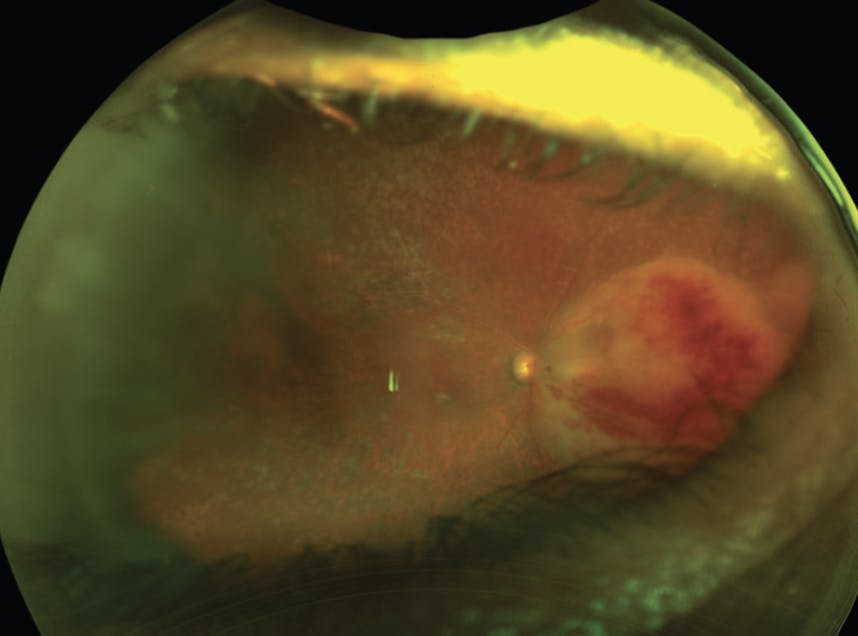
Figure 2. A 73-year-old woman with a history of diffuse large B-cell lymphoma was referred for worsening vision. Given her presentation of hemorrhage and retinal whitening, an infectious etiology was considered; however, the lesion continued to grow despite repeated injections of antiviral therapy. A retinal biopsy confirmed diffuse large B-cell lymphoma and the intraocular manifestations were managed with intravitreal methotrexate.
Image courtesy of Steven Yeh, MD, and Ghazala O’Keefe, MD
If obtaining a retinal biopsy, perform a vitrectomy first and be sure to remove all vitreous overlying the biopsy site. If there is cellular material, this vitreous can be sent for pathology examination as well. After the vitrectomy, use endolaser or diathermy to delineate the area of interest (usually about 2 mm by 2 mm). This area can be cut with intraocular scissors and forceps and removed through an enlarged sclerotomy. An increase in infusion pressure during these steps helps control hemorrhage. A gas or oil tamponade is often used afterward, along with reinforcement of the area with endolaser.6
Rarely, a chorioretinal biopsy is required. In these cases, endolaser is also preemptively applied to the biopsy site. To access the tissue, create a 90% to 95% full-thickness scleral flap overlying the area of interest, with one side left as a hinge. Next, apply diathermy to the choroid and retina underneath the scleral flap to make two incisions parallel to the limbus, spaced 1 mm to 2 mm apart. The surgeon grasps this section with forceps and then makes two more incisions, this time perpendicular to the limbus, to yield a slab of chorioretinal tissue. After obtaining the tissue, suture the scleral flap closed and instill an intraocular tamponade.9
BIOPSIES BEYOND LYMPHOMA
Outside of lymphoma, other oncological conditions can present with vitreous, retinal, or choroidal involvement and require biopsy for their diagnosis. Rarely, ocular metastases can mimic retinitis, and this presentation can delay a patient's diagnosis and portends a poor prognosis and life expectancy.10 Melanoma infrequently metastasizes to the vitreous and mimics uveitis unresponsive to steroids. Diagnostic vitrectomy and/or tissue biopsy coupled with cytological analysis can help elucidate the diagnosis in these cases (Figure 3).
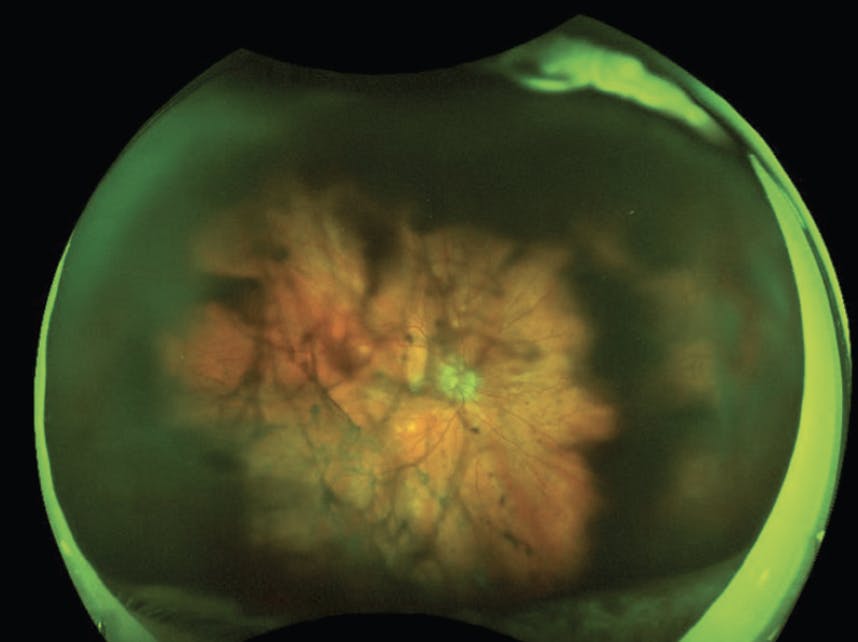
Figure 3. An 80-year-old man with metastatic melanoma on immunotherapy with Opdivo (nivolumab, Bristol-Myers Squibb) presented with decreasing vision. The fundus examination revealed dense vitritis that was initially assumed to be inflammation secondary to immunotherapy; however, the vitritis worsened with steroid therapy. Diagnostic vitrectomy with cytology revealed metastatic cells.
Image courtesy of Arthi Venkat, MD, MS
When infection is suspected, the first steps are to obtain a sample through a vitreous or aqueous tap and administer appropriate therapy. However, vitrectomy may be necessary for patients where clinical samples do not yield an answer, the clinical course is unexpected, or in cases where better visualization is required to make a diagnosis and/or treat the underlying pathology. For example, nocardia endogenous endophthalmitis has been reported to mimic lymphoma, among other possibilities, and can require a subretinal biopsy to confirm the diagnosis and determine treatment.11 Intraoperative samples are sent for gram stain and culture, as well as PCR for viral etiologies and toxoplasmosis. Additionally, more extensive testing can reveal a diagnosis often missed on routine cultures or PCR. These include panbacterial PCR and metagenomic deep sequencing, also known as metagenomics next-generation sequencing (mNGS).12,13
Panbacterial PCR may be particularly useful because of its ability to detect organisms even after the administation of intravitreal therapy. In one study, panbacterial PCR detected an infectious etiology more often than vitreous cultures in patients who had been previously treated with intravitreal antibiotics.14 mNGS also presents an exciting possibility to isolate causative pathogens. The utility of mNGS lies in its ability to analyze both DNA and RNA, thus allowing for all genomic material to be sequenced, even from very small clinical samples. This development has allowed for the identification of rare or even previously unidentified pathogens, as well as those that are culture resistant. This can further help to delineate which instances of uveitis may be inflammatory versus infectious and guide treatment.3,15
CONSEQUENCES OF INTRAOCULAR INFLAMMATION
Vitrectomy is also a helpful adjunct when managing the sequela of intraocular inflammation. Complications of inflammation include vitreous debris, retinal detachment, epiretinal membrane, and macular holes. A vitrectomy can remove visually significant vitreous debris, alleviate traction, and identify pathology often blocked by vitritis. When approaching retinal detachments, it is important to counsel patients on the higher rate of redetachment compared with traditional retinal detachment surgery. A few reports have evaluated retinal reattachment rates after infectious retinitis, with primary reattachment rates of about 60%.16 Additionally, patients may more often require silicone oil, which can have antimicrobial properties and provide an effective tamponade (Figure 4).
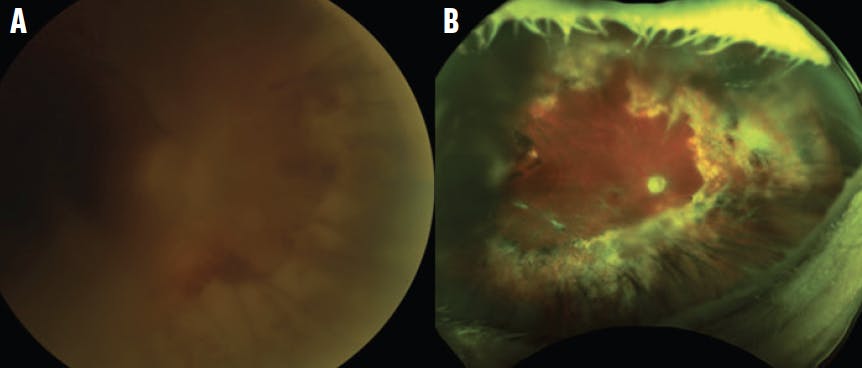
Figure 4. A 52-year-old man presented with retinal whitening and vitreous haze (A). Acute retinal necrosis was suspected and PCR testing was positive for herpes simplex virus. The patient initially received intravitreal antivirals and responded, but later developed a combined tractional and rhegmatogenous retinal detachment that required vitrectomy and silicone oil (B).
Image courtesy of Steven Yeh, MD
Patients can also develop epiretinal membranes or macular holes in the setting of intraocular inflammation. Like retinal detachments, the success rates of macular hole closure are lower than those with uveitis; one study showed a success rate of approximately 80%.17
In any patient with uveitis undergoing vitrectomy, perioperative control of inflammation is essential. This may require topical, local, oral, and/or intravenous steroids before, during, and after the surgery. In cases of mild and remote uveitis, heavy topical steroids with an extended taper may suffice. In cases of more extensive inflammation, oral or local steroids are required with an appropriate postoperative taper schedule. In patients with active inflammation who require emergent surgery, intravenous steroids can help quell inflammation in addition to pre- and postoperative medications. Additionally, in infectious cases requiring surgery, it is wise to pretreat or simultaneously administer anti-infectious agents. Careful examination is also required in the postoperative period to evaluate for the recurrence of inflammation and its potential complications, which can be visually devastating.
1. Thorne JE, Suhler E, Skup M, et al. Prevalence of noninfectious uveitis in the United States: a claims-based analysis. JAMA Ophthalmol. 2016;134(11):1237-1245.
2. Touhami S, Leclercq M, Stanescu-Segall D, Touitou V, Bodaghi B. Differential diagnosis of vitritis in adult patients. Ocul Immunol Inflamm. 2021;29(4):786-795.
3. Gonzales J, Doan T, Shantha JG, et al. Metagenomic deep sequencing of aqueous fluid detects intraocular lymphomas. Br J Ophthalmol. 2018;102(1):6-8.
4. Carbonell D, Mahajan S, Chee SP, et al. Consensus recommendations for the diagnosis of vitreoretinal lymphoma. Ocul Immunol Inflamm. 2021;29(3):507-520.
5. Chen T, Liu Y, Wang Y, et al. Evidence-based expert consensus on the management of primary central nervous system lymphoma in China. J Hematol Oncol. 2022;15(1):136.
6. Jeroudi A, Yeh S. Diagnostic vitrectomy for infectious uveitis. Int Ophthalmol Clin. 2014;54(2):173-197.
7. Reichstein D. Primary vitreoretinal lymphoma: an update on pathogenesis, diagnosis and treatment. Curr Opin Ophthalmol. 2016;27(3):177-184.
8. Jiang T, Zhao Z, Chang Q. Evaluation of cytologic specimens obtained during experimental vitreous biopsy using B-cell lymphoma line. Eur J Ophthalmol. 2014;24(6):911-917.
9. Gonzales JA, Chan CC. Biopsy techniques and yields in diagnosing primary intraocular lymphoma. Int Ophthalmol. 2007;27(4):241-250.
10. Shields CL, McMahon JF, Atalay HT, Hasanreisoglu M, Shields JA. Retinal metastasis from systemic cancer in 8 cases. JAMA Ophthalmol. 2014;132(11):1303-1308.
11. Scott M, Mehta S, Rahman HT, Grossniklaus HE, Yeh S. Nocardia veterana endogenous endophthalmitis in a cardiac transplant patient. J Ophthalmic Inflamm Infect. 2013;3(1):44.
12. Okhravi N, Adamson P, Carroll N, et al. PCR-based evidence of bacterial involvement in eyes with suspected intraocular infection. Invest Ophthalmol Vis Sci. 2000;41(11):3474-3479.
13. Doan T, Wilson MR, Crawford ED, et al. Illuminating uveitis: metagenomic deep sequencing identifies common and rare pathogens. Genome Med. 2016;8(1):90.
14. Kosacki J, Boisset S, Maurin M, et al. Specific PCR and quantitative real-time PCR in ocular samples from acute and delayed-onset postoperative endophthalmitis. Am J Ophthalmol. 2020;212:34-42.
15. Sabapathypillai SL, James HR, Lyerla RRL, Hassman L. The next generation of ocular pathogen detection. Asia Pac J Ophthalmol (Phila). 2021;10(1):109-113.
16. Wu CY, Fan J, Davis JL, Berrocal AM, et al. Surgical outcomes of acute retinal necrosis-related retinal detachment in polymerase chain reaction-positive patients: a single-center experience. Ophthalmol Retina. 2022;6(11):992-1000.
17. Callaway NF, Gonzalez MA, Yonekawa Y, Faia LJ, Mandelcorn ED, Khurana RN, Saleh MGA, Lin P, Sobrin L, Albini TA. Outcomes of pars plana vitrectomy for macular hole in patients with uveitis. Retina. 2018;38(Suppl 1):S41-S48.


-1_1678291312.jpg?auto=compress,format&w=70)


