


In today’s environment, retina practices have unique challenges related to operational efficiency and patient flow. These issues emerged when intravitreal injections became the standard of care for specific diagnoses, and it has only increased. Patients require frequent follow-up appointments and ongoing injections, and the newly approved therapy for geographic atrophy now adds a whole new patient population potentially seeking ongoing treatment in your office. As a result, you have probably experienced problems scheduling new patients, adding follow-up injections, and staying on time. To help address scheduling and patient flow, consider approaching your processes from a lean perspective.
Lean is a collection of principles, tools, and methodologies designed to improve process efficiency while minimizing waste and delays. The lean method removes the trial-and-error approach to problem-solving by using data. Applying lean principles can help you accomplish the following:
- find and eliminate causes of errors,
- reduce cycle time and cost of operations,
- improve productivity,
- better meet patient expectations,
- achieve higher asset use, and
- provide an improved return on investment.
AT A GLANCE
- Lean is a collection of principles, tools, and methodologies designed to improve process efficiency while minimizing waste and delays.
- If the patient doesn’t perceive a service or activity as valuable, and they aren’t willing to pay for it, it’s considered waste under the lean methodology.
- The DMAIC framework (define, measure, analyze, improve, and control) assists in an orderly, logical flow when improving a process.
In this article, we outline some lean process tips so you can implement continuous improvement in your busy practice.
IDENTIFY PROCESS WASTE
To begin, consider these two ways to measure patient value: 1) The patient perceives that the service or activity brings them value, and 2) the patient is willing to pay for it. All other clinic activities are considered waste under the lean methodology.
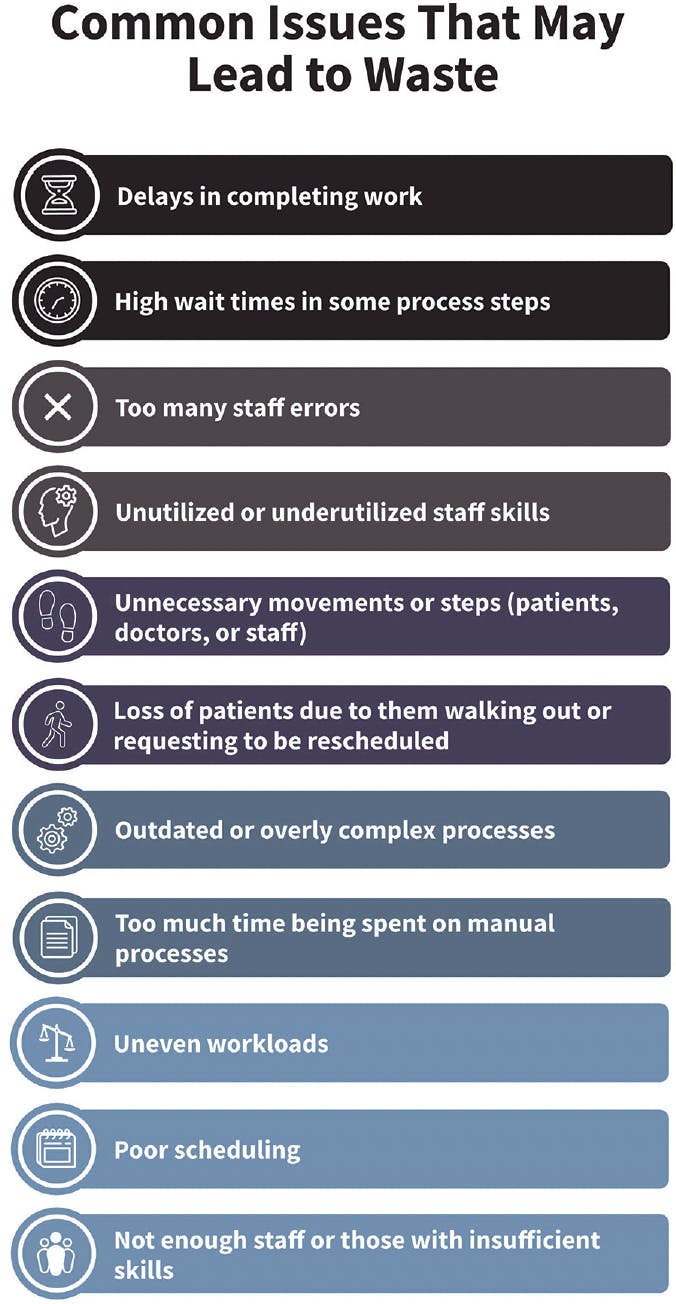
With that mindset, can you consider a few improvement areas to minimize waste and delays in your retina practice? For examples, see Common Issues That May Lead to Waste.
BUILD YOUR BUSINESS CASE
Once you identify an area in your practice that needs attention, build a business case to improve the issue. Ask yourself these questions: Why should we improve this process? How will this improve the patient experience? How will this benefit us financially (ie, lower costs, increase efficiency, improve quality, achieve consistency, or improve patient throughput and experience)? Again, you do not want to spend time on things that do not add value. As you build your business case for improvement, consider the following:
- the risks associated with the project,
- the human resources investment,
- the feasibility of success, and
- the schedule or timeline for completion.
BUILD YOUR TEAM
As you progress in your improvement process journey, ensure you listen to your team’s various viewpoints. Each person has a unique perspective and can help you update or change a process. Groups to involve in your review include:
- Patient: What is the patient’s attitude to this process?
- Practice executive team: How does a change affect the business?
- Management: Is the process realistic or feasible?
- Employee: Will staff be willing and capable of making the change?
Ensuring that each group is heard can lead to better-designed processes and outcomes. Depending on which procedure needs your focus, we recommend that you form a four-person team. One employee can represent the patient’s view. A physician or administrator may define the practice or business opportunity. A manager might join in and reflect on process needs, and a staff member can lend insights from the employees’ perspectives.
INCORPORATE THE DMAIC PROCESS
At the center of the lean process is the DMAIC framework, a system designed to assist in an orderly, logical flow when improving a process.1 The DMAIC framework stands for define, measure, analyze, improve, and control.
Define
Start by comprehensively describing the problem. Answer these questions:
- What is the issue?
- What is your team’s input?
- What effect is the problem having on the clinic, staff, and patients?
When defining the problem, it is essential to identify the real problem to address. It’s easy to focus on symptoms or issues rather than root causes. By conducting a root cause analysis, you may find that more than one issue needs to be addressed. After this self-reflection, let’s say you define your issue this way:
Your two-doctor retina practice is struggling with patient wait times. The appointments for intravitreal injections typically take 1 to 2 hours from start to finish. Patients have been complaining, and staff members are frustrated by the lengthy appointments.
Measure
The next step is to measure. To begin measuring a process, answer these questions:
- What is the process?
- How can the process be measured?
- What are the moving parts (inputs and outputs) and how can they be measured?
- Do patient satisfaction and accuracy need to be measured?
- What is the difference between the old and new processes?
To adequately measure a process, you may need to gather data from your electronic health record; spend time in clinic observations; or conduct surveys with your providers, staff, and patients. Knowing this, you and your team decide to take the following steps to measure your patient flow problem:
Your staff and physicians start documenting the process for intravitreal injections. The team tracks time-in-motion, detailing the start/stop times for every step in the patient journey. They also measure the amount of time patients are waiting during each segment of their visit.
Analyze
Analyzing is about finding out what is going on. To do this, you may need to further evaluate your root cause analysis, outline a process map, or look at charts and statistical data to better understand what is happening. During your analysis, consider as many issues as possible, the cause of the problem (there could be multiple), and the tools you will need to analyze improvement.
Going back to the patient flow scenario, your measurements and subsequent analysis revealed the following:
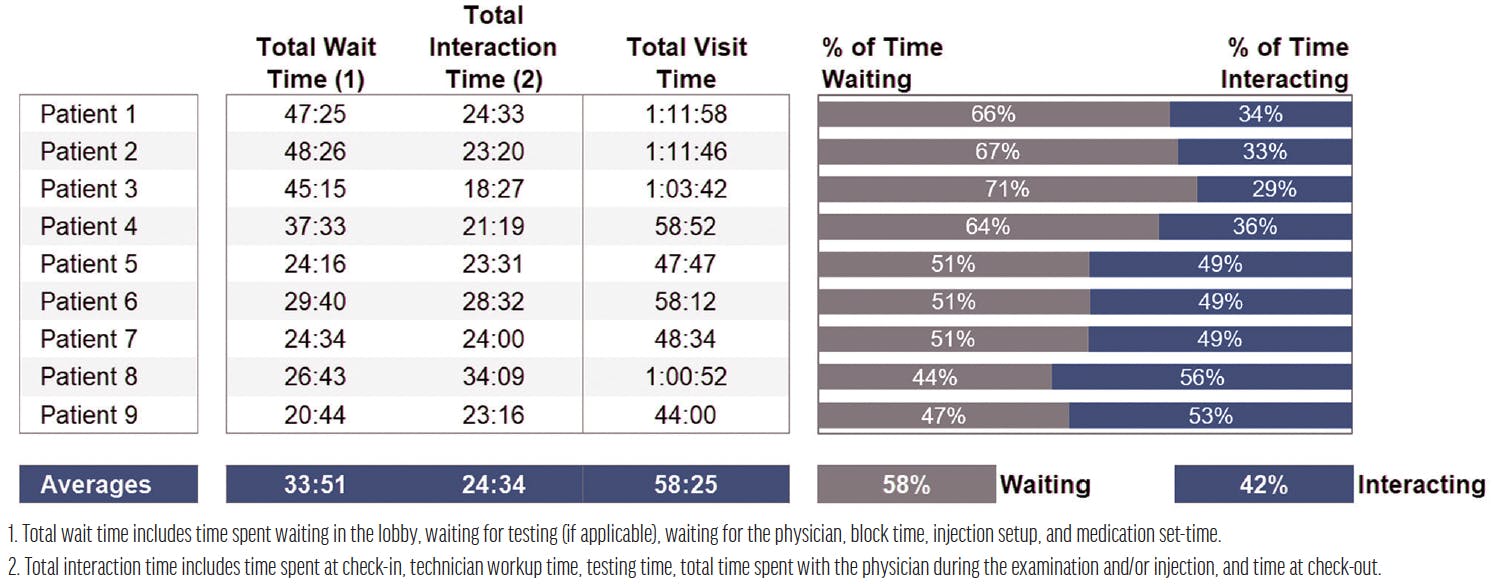
The practice documented nine unique injection patients and timed every step (Figure 1). The time-in-motion studies focused on value time (time spent with a staff member/physician) and non-value time (sitting and waiting). The analysis revealed that your injection patients spent 58% of their time waiting and 42% of their time interacting with the staff or physicians.
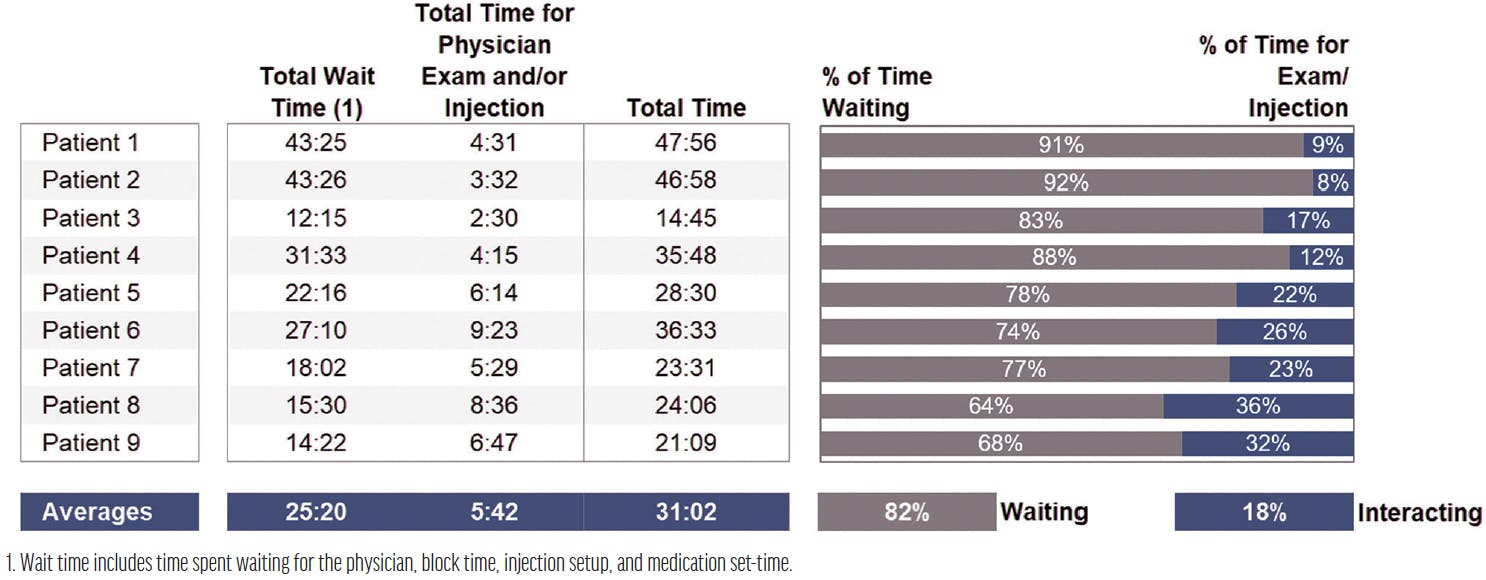
In addition to analyzing the entire visit from start to finish, data was further studied to compare the same wait time versus interaction time as it relates specifically to the injection portion of the visit—after testing is completed and before the check-out process begins. In that study, 82% of the patient visit was spent waiting, and only 18% of the patient’s time was spent interacting with the physician or staff (Figure 2).
Improve
Now that you understand the challenges, you must produce a plan to improve. In other words, work on refining the process to make things better. Improvements such as eliminating a step or purchasing new equipment may be simple and easy. Alternatively, modifications such as redesigning an entire process from start to finish may be complex.
Whatever the solution, you may encounter resistance to change from physicians or staff during improvement efforts. When working on improvements, explain why the process needs improvement, listen to other perspectives, and discuss the best and simplest solution. Remember, you do not want to add waste or unnecessary steps to a process. Lastly, document both the old and new ways of doing things, provide staff training, and outline implementation and timelines.
For this patient flow issue, your team comes up with the following improvement tactics:
- Ensure that the injection tray is set up with the correct medication before the physician walks into the room, enabling the doctor to move faster through the injection process.
- Analyze patient templates to ensure that the doctor can move easily between injections.
- Always ensure that the doctor has a scribe to assist in the room.
- Streamline the authorization process to avoid delays when verifying authorizations for medications.
- Move emergencies toward the end of the morning or afternoon to ensure that injection patients are not waiting longer due to work-in patients.
Control
Once you have the new procedure in place, you must perform the control process by developing monitoring and control systems to ensure your changes are working. This step means that you must compare actual results against expected results, make adjustments, and take remedial action when necessary. Questions that you and your team must answer for this step include:
- How can you control/measure the improvement?
- Can you chart control measures?
- Are you documenting the outcome?
- Are you continually improving?
As it relates to the patient flow scenario, the team conducted the following control process:
First, they started by ensuring that every injection tray had the ordered medication ready to go when the physician walked into the room. The team only made this one change at first to ensure they could accurately determine if this led to improved patient wait times. Once they determined the results, they implemented another improvement, systematically working to make the injection process seamless and efficient.
ONE STEP AT A TIME
With lean principles, your retina practice can improve its processes and patient wait times, but it is a multi-step undertaking. It involves identifying your challenges, building your business case, listening to the team around you, and measuring and committing to improvement efforts. By following this approach, you can make incremental changes that bring significant value to your patients—something always worth your time and effort.
1. The define measure analyze improve control (DMAIC) process. American Society fof Quality. Accessed April 5, 2023. asq.org/quality-resources/dmaic


