


vitrectomy with internal limiting membrane (ILM) peeling has become the standard procedure for full-thickness macular holes (FTMHs) and epiretinal membranes (ERMs). ILM peeling can improve success rates for FTMH closure and reduce postoperative ERM recurrence.1,2 The traditional technique involves initiating an ILM rhexis using ILM forceps (“pinch and peel”) or a secondary instrument, such as a membrane scraper. The surgeon then completes the ILM peel using ILM forceps. As the ILM is peeled, the surgeon must manually remove each fragment from the eye using the forceps.
However, some surgeons have described techniques for ILM peeling and removal without the use of forceps. Timothy Murray, MD, MBA, reported a case of ILM peeling with the vitrectomy probe, and Carl Awh, MD, reported a series of 24 patients who underwent ILM peeling with an aspirating pick (Awh MVP Micro Vacuum Pick, Katalyst Surgical).3,4
At our institution, we historically peeled ILM using a flexible loop scraper (Finesse Flex Loop, Alcon) to create the ILM rhexis before switching to an ILM forceps to peel and remove the remaining ILM tissue. Currently, after initiating the ILM rhexis with a Flex Loop (Figure 1A), we use only the aspiration function of the vitrectomy handpiece to complete the ILM peeling (Figure 1B). A key advantage of this technique is the ability to peel and remove ILM tissue without removing instruments from the eye. By reducing the number of instrument exchanges, this technique has the potential to reduce surgical time and the risk of intraoperative complications.
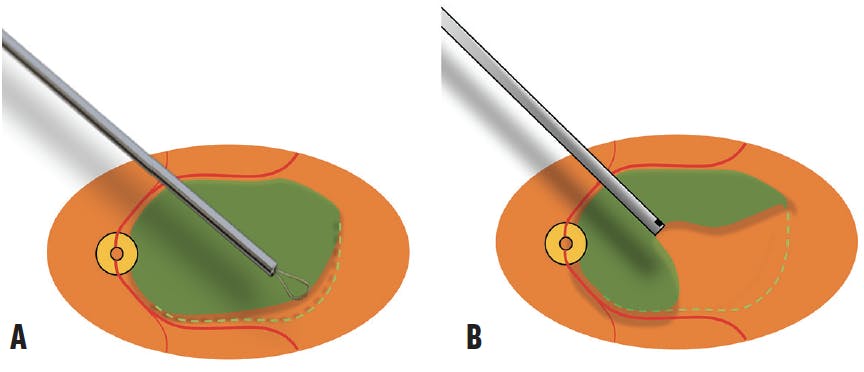
Figure 1. There is a two-step technique for ILM peeling without forceps. A 180° ILM rhexis is created along the arcades with a flexible loop scraper (A). Using the vitrectomy probe on aspiration mode, the ILM flap is then peeled to release all traction on the fovea, the ILM rhexis is completed, and the amputated ILM flap is aspirated into the port (B).
We sought to better understand the feasibility, efficiency, safety, and effectiveness of cutter-based membrane peeling compared with conventional forceps-based peeling. In this article, we review the findings, their significance, and how to apply the new technique.
WHAT WE FOUND
Between April 2020 and December 2021, we performed 92 consecutive vitrectomies with ILM peeling for ERMs (n = 62, 68%) and FTMHs (n = 30, 32%) at a single ambulatory surgery center. Most of the aspects of the surgical procedure were consistent: a 25-gauge vitrectomy, the use of “heavy” ICG for ILM staining, and the initiation of the ILM rhexis using a flex loop. The one surgical variable was whether the ILM peeling was performed using a 25-gauge ILM forceps (n = 12) or a 25-gauge vitrectomy probe, or “cutter” (n = 80). The baseline demographics, visual acuities, macular volumes, and central subfield thicknesses (CST) were similar between the two groups. The patients were followed for a minimum of 3 months postoperatively.
The primary outcome of this study was total surgical time. Cutter-based membrane peeling significantly reduced the total operative time by an average of 10 minutes (P = .001). Patients in both groups had significant improvements in visual acuity (P = .001), macular volume (P = .001), and CST (P = .001) 3 months postoperatively compared with preoperative values.
There were no intraoperative complications encountered in either group, including iatrogenic macular holes, retinal breaks, retinal detachments (RDs), or choroidal detachments. There was only one case (1.2%) of postoperative RD seen in the cutter-based group after 3 months—which is less than the expected cumulative incidence of RD (2% to 3%) observed in large claims-based studies of vitrectomy with ILM peeling.5
WHAT THIS MEANS
This study suggests the feasibility, efficiency, safety, and efficacy of cutter-based membrane peeling as an alternative to forceps-based peeling for routine indications, such as FTMHs and ERMs. When the cutter-based approach was implemented, patients had high rates of single-operation anatomic success (> 96%) and significant postoperative improvements in visual acuity, macular volume, and CST. All outcomes were comparable with traditional forceps-based ILM peeling. More importantly, the safety profile of cutter-based membrane peeling appears comparable with conventional techniques. There were no iatrogenic complications, and the rate of postoperative RD was comparable with the national average.5
Based on our findings, a cutter-based approach can reduce operative time by increasing surgical efficiency and ergonomics. The surgeon can simultaneously peel and remove membrane tissue—thereby reducing the number of intraoperative instrument exchanges. The port geometry of the 25-gauge cutter allows for efficient engagement and release of ILM tissue, thereby eliminating the need for multiple fine grasping maneuvers with the ILM forceps.
Effective peeling and manipulation of ILM tissue with the cutter require some skill and finesse, but these maneuvers should come naturally to most vitreoretinal surgeons.
TIPS FOR NEW USERS
Start by creating a large ILM rhexis. Typically, we use the flex loop to create a 180° rhexis along the inferotemporal arcade, extending all the way into the temporal macula.
Next, engage the ILM flap with the cutter and increase proportional vacuum aspiration with the foot pedal until the port is occluded by ERM/ILM tissue.
Then, maintain a low level of vacuum so the port remains occluded. The cutter now functions as if the surgeon were grasping the tissue with forceps. The tissue is then peeled by moving the cutter, rotating the port, increasing the vacuum, or a combination of these maneuvers.
At any point, the tissue can be released—either passively (by reducing vacuum to release tissue from the port) or actively (by increasing the vacuum to complete the rhexis and aspirate the tissue into the port). We find that it’s best to work on releasing all traction from the fovea before amputating the ILM/ERM flap. In some cases, a second peel may be required to remove residual ILM tissue after ERM peeling.
GETTING STARTED
Cutter-based membrane peeling has now become our standard method for ILM peeling, including cases requiring advanced ILM maneuvers. It is feasible in most cases, and we can count on one hand the number of times we have had to open a pair of ILM forceps in the last 2 years. Our study showed that patients achieved excellent anatomic and visual outcomes without sacrificing safety (Figures 2 and 3).
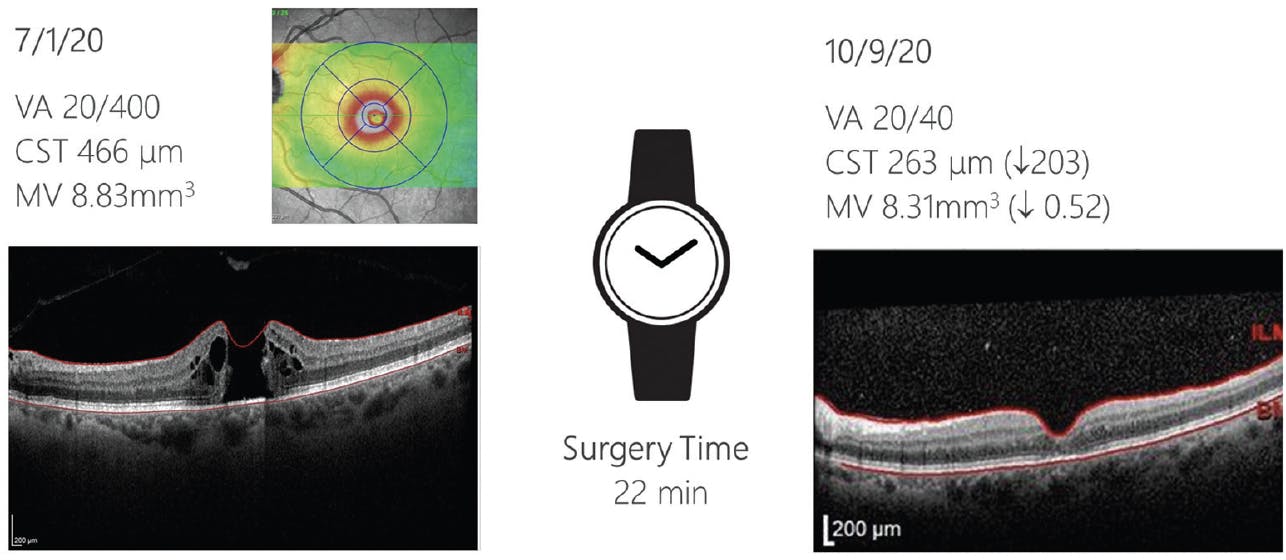
Figure 2. The first patient in this consecutive case series of cutter-based membrane peeling showed a successful closure of a large FTMH with clinically significant improvements in visual acuity, macular volume, and CST at postoperative month 1 versus baseline.
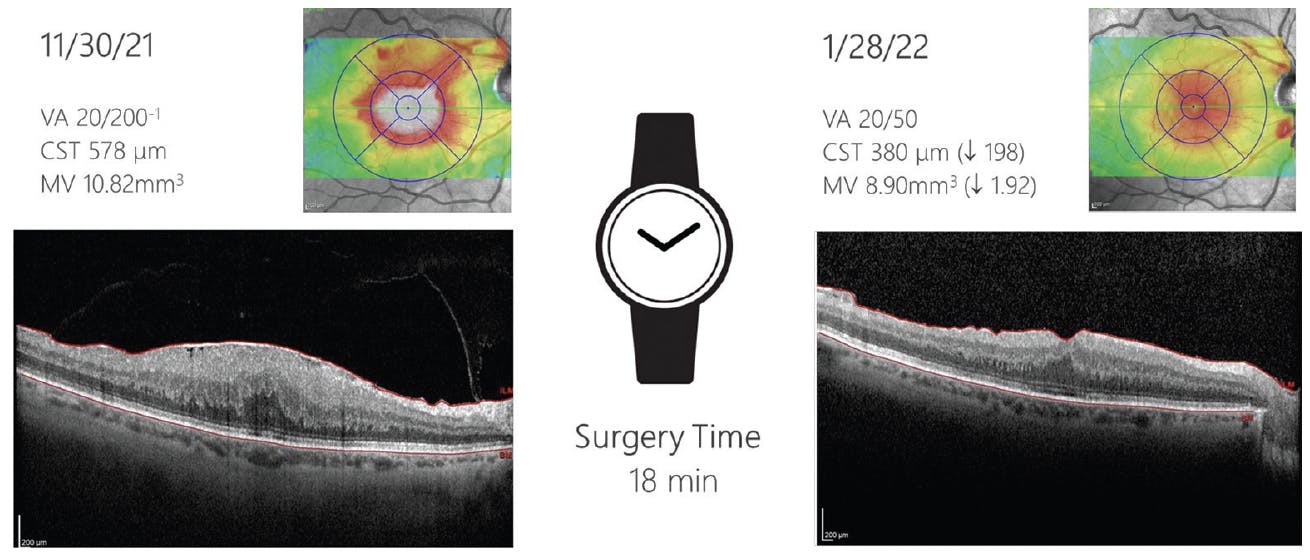
Figure 3. The last patient treated in this consecutive case series of cutter-based membrane peeling showed successful removal of an ERM with improvements in visual acuity, macular volume, and CST at postoperative month 1 versus baseline.
This technique has saved time and reduced our ambulatory surgery center instrument costs. By reducing instrument exchanges and other inefficiencies, our average incisional time for macular surgeries has decreased to approximately 18 minutes. Decreased operative time contributes to increased patient satisfaction. Patients are often amazed by how quickly their procedure was performed.
1. Spiteri Cornish K, Lois N, Scott NW, et al. Vitrectomy with internal limiting membrane peeling versus no peeling for idiopathic full-thickness macular hole. Ophthalmology. 2014;121(3):649-655.
2. Schechet SA, DeVience E, Thompson JT. The effect of internal limiting membrane peeling on idiopathic epiretinal membrane, with a review of the literature. Retina. 2017;37(5):873-880.
3. Villegas VM, Gold AS, Murray TG. Vitrectomy with cutter-only ILM peel during full-thickness macular hole surgery. Retina Today. September 2017. Accessed April 4, 2023. retinatoday.com/articles/2017-sept-supplement4/vitrectomy-with-cutter-only-ilm-peel-during-full-thickness-macular-hole-surgery
4. Awh CC, Bass EJ. A microsurgical vacuum pick for membrane peeling without forceps during vitreoretinal surgery. Ophthalmic Surg Lasers Imaging Retina. 2020;51(3):196-199.
5. Vaziri K, Schwartz SG, Kishor KS, et al. Rates of reoperation and retinal detachment after macular hole surgery. Ophthalmology. 2016;123(1):26-31.


_1784132761.jpg?auto=compress,format&w=75)


