




Back in 2006, we said that it was “an exciting time to be a retina specialist,” noting that, for Eugene de Juan, MD, the approval of ranibizumab (Lucentis, Genentech/Roche) “stands out as one of the most important medical developments in ophthalmology during my 25 years in the field.”1
Some of us remember the days when we had little to offer wet AMD patients because photodynamic therapy provided only modest benefits. Anti-VEGF therapy ushered in an era of reassurance when discussing the long-term visual outcomes with our wet AMD patients.
That sentiment voiced by Dr. de Juan didn’t resurface for the next 15 years, as we integrated anti-VEGF therapy into practice and forged ahead with clinical research. Sure, we had drug approvals, imaging advances, and improved surgical tools, but nothing topped that 2006 feeling.
Since the fall of 2021, however, “it is an exciting time to be a retina specialist,” has been rolling off our tongues almost daily with the recent approvals of longer-duration anti-VEGF agents and approaches.
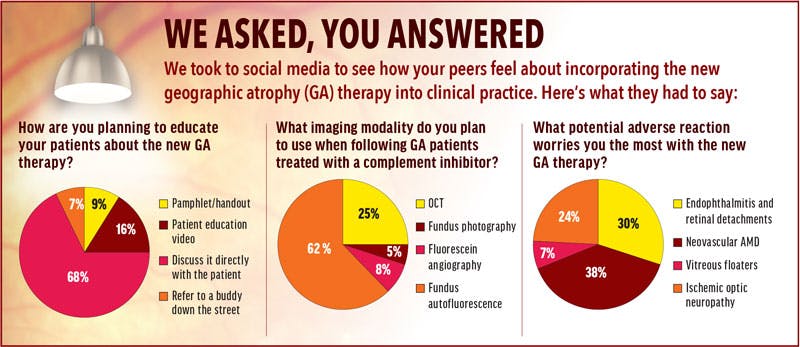
Not only that, the historic FDA approval of the first therapy to treat geographic atrophy (GA) secondary to AMD, pegcetacoplan (Syfovre, Apellis Pharmaceuticals), brought a feeling reminiscent of 2006. The approval finally provides us with a treatment option for an entire patient population that once had no options. As if that relief isn’t palpable enough, a second therapy, avacincaptad pegol (Zimura, Iveric Bio), is also awaiting approval.
As with our initial discussions with wet AMD patients about photodynamic therapy, we will have to manage expectations—a new experience for some, and an old skill some of us must dust off. Both these therapies slow, but do not stop, GA progression. While it’s a definite step in the right direction, it’s not the magic bullet that anti-VEGF agents felt like, considering we aren’t improving vision.
We also have much in the pipeline to look forward to, and we are particularly interested in the gene and cell therapies under investigation. Researchers are working toward stopping GA progression and reversing vision loss—and perhaps one day, all with a longer duration of effect.
This is one editorial we have been waiting to write for quite some time. We rarely have an opportunity to quote Winston Churchill, but Eleonora Lad, MD, was spot on when she said, “It’s the end of the beginning for GA therapy.” She, along with Jeffrey S. Heier, MD, and Dilsher Dhoot, MD, shared with us their pearls regarding the new therapeutics that will shape the early days of GA therapy.
We have many questions about how the era of GA therapy will unfold. Hopefully the articles in this issue help answer a few of them, or at least get the conversation started. Still, only time and clinical experience will garner the answers for most of these unknowns. We can’t wait to get started.
1. Breaking ground in the treatment of retinal diseases. Retina Today. September 2006. Accessed May 5, 2023. retinatoday.com/articles/2006-sept/0906_01.html


