


One of the most stressful parts of job hunting in retina is recognizing which practice model best suits your expertise, professional goals, and lifestyle. Some fellows know intrinsically which practice style fits, while others may be open to various models—as long as it’s in the right location or with the right people.
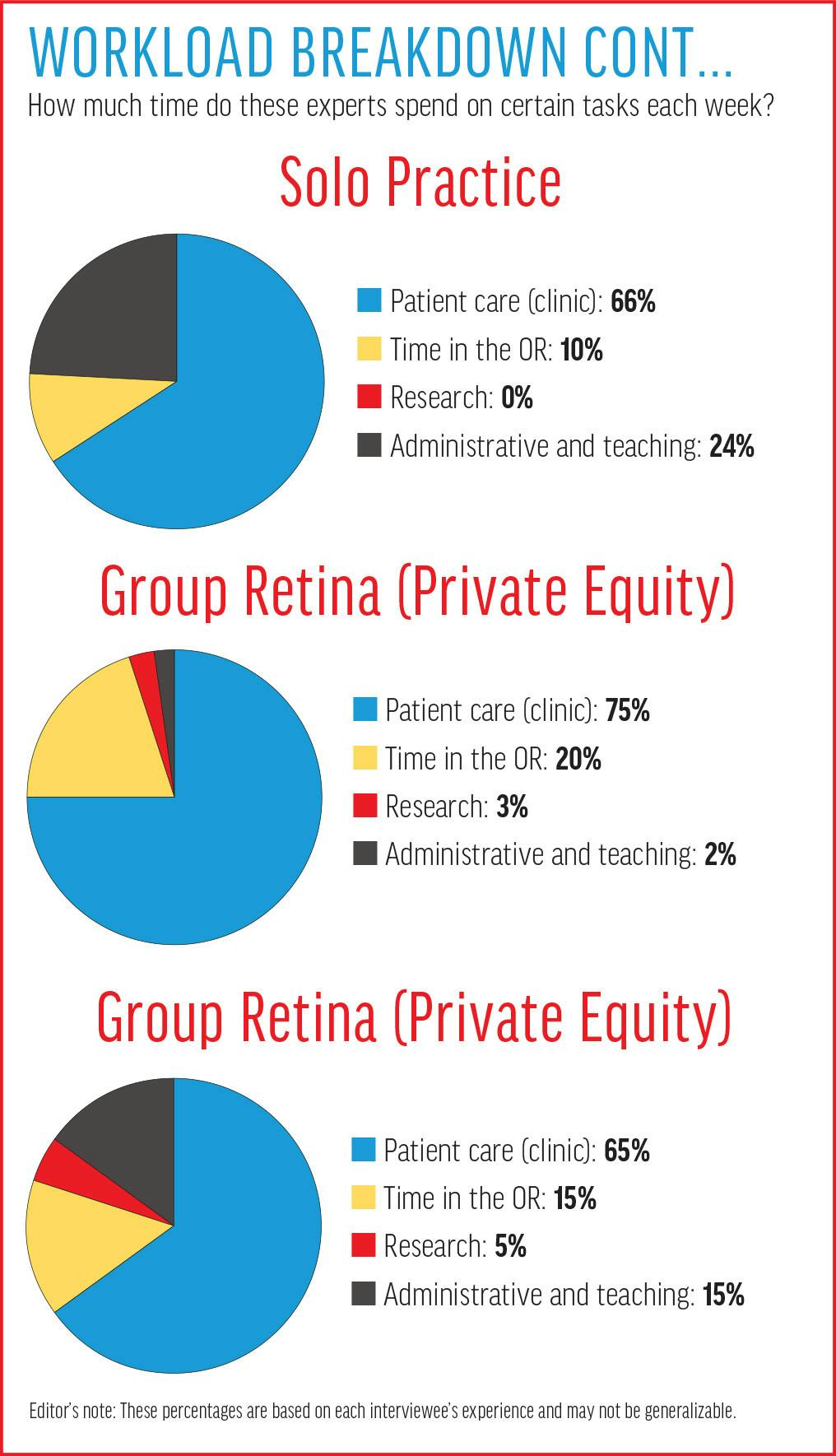
Here, Retina Today asked retina specialists to share their favorite—and least favorite—aspects of their practice model and how they spend most of their time. Their insights can help you choose the practice model that’s right for you.
ACADEMIC
By Adrienne W. Scott, MD
I chose academic practice because it was an environment that I enjoyed throughout my exposure to ophthalmology.
Pros: I was influenced early by an understanding that research is important because it can make you a stronger clinician with a better understanding of the diseases that affect our patients. You learn so much every day from your patients, and doing research is a way to formally understand, test, and challenge questions regarding disease pathophysiology and ways to diagnose and treat eye disease. I also enjoy research as a way of making a contribution to our field by moving our understanding of these diseases forward.
In academia, there is potential for flexibility in the weekly schedule, which helps somewhat with work-life balance.
AT A GLANCE
- One benefit of academic practice is the focus on research, which is a way to give back to the field.
- In a group multispecialty practice, clinicians have a constant stream of referrals.
- A group retina practice offers the advantages of learning from colleagues, reduced administrative work, and shared calls.
I also enjoy the interaction with our trainees; passing on the skills that I’ve learned and sharing these skills to affect the training of those coming behind me is one of the most exciting parts about academic medicine. Also, I treat a large population of medically underrepresented patients in East Baltimore, and I feel like I am contributing to our community health and fighting for health equity every day.
Cons: In academic medicine, the compensation can be much less than what you might earn in a private setting. In addition, the regulatory barriers can be significant at times. For example, private practices are often nimbler when recruiting for a clinical trial, and there have been times when a trial was fully enrolled before we received approval within our organization. Another concern is the ability to access newer medications, given the many regulatory hurdles of a large academic institution. Although, in some cases it does work to our advantage because we can monitor the real-world performance of new medications by observing how those medications perform in the community setting.
Advice for Job Seekers: Give thought to what excites you about the field, whether that is research (basic science or clinical), high-volume clinical and/or surgical vitreoretinal practice, teaching, or any combination of those things. Is location the key? Do you have a spouse or significant other with whom you must coordinate these life choices? No job has every aspect of what you want, but it’s important to come as close as possible to keep you engaged in your career and excited to come to work every day.
HYBRID ACADEMIC/PRIVATE PRACTICE
By Katherine E. Talcott, MD
I could have been happy in a number of practice environments, but educating trainees was particularly important to me, so I decided to select a job where I could continue to do that. My practice, the Cole Eye Institute at the Cleveland Clinic, is a hybrid model—an academic institution that is run with the efficiency of a private practice.
Pros: We see a higher clinic volume compared with many other academic institutions. The reasons for this are multifactorial, including institution philosophy, resources, and template design. One unique feature is that most of the retina surgeons work closely with an individual nurse, who is with you in clinic to coordinate and facilitate care, scrubs with you in the OR, and assists with research or care responsibilities outside of the clinic. It’s a great model that really improves the patient experience and care.
Additionally, we have an excellent trainee program and significant support from our department and chair to present our research at meetings.
Cons: Academic positions look different in terms of clinic time, locations, and responsibilities, depending on the institution and the job. This is especially true of a hybrid model. Thus, you cannot generalize the shortcomings of this model.
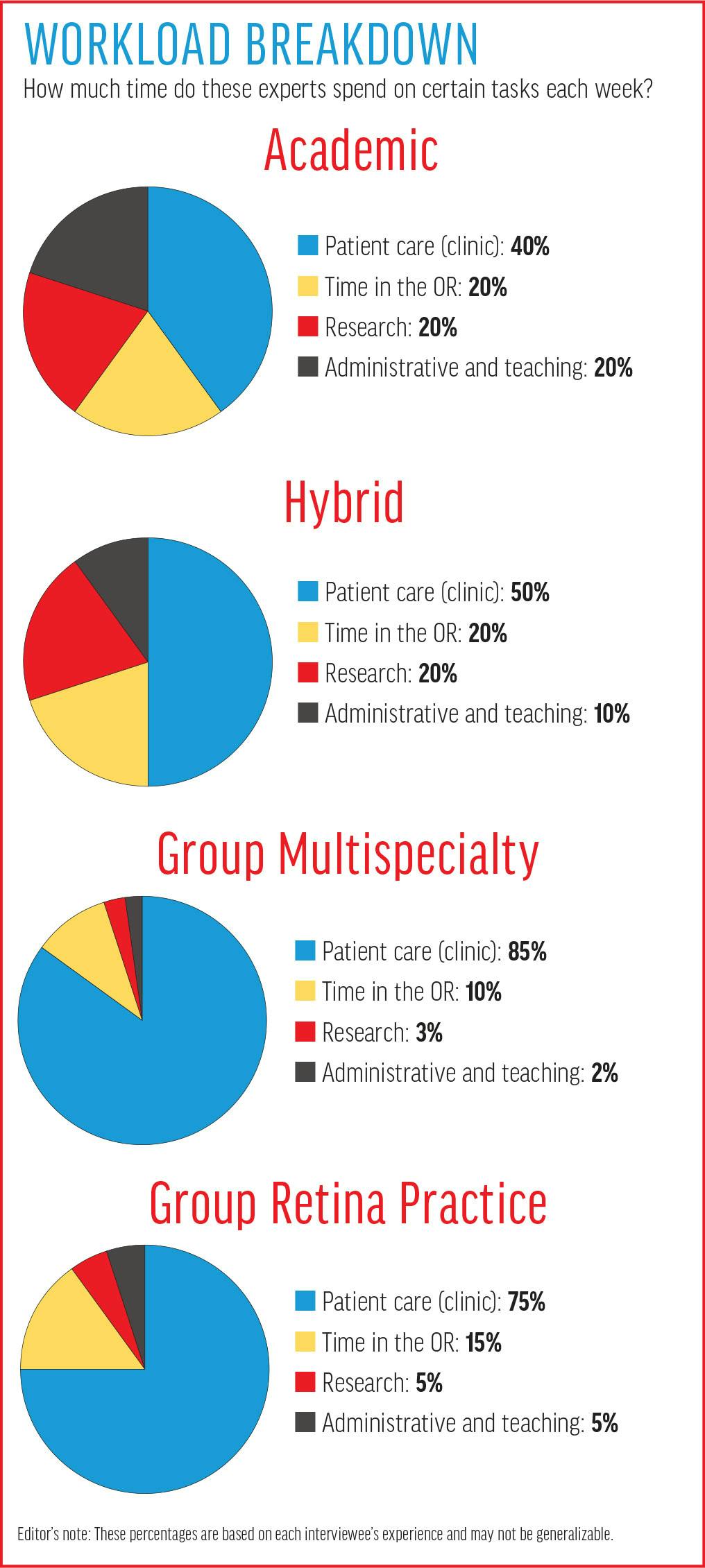
Advice for Job Seekers: Rather than focus on whether you are interested in a job in academia, private practice, or a hybrid model, think about what elements you are looking for in a job. Do you want to teach? Do you want to do research? Do you want to focus on clinical care? Determine your priorities, and then find a job that can give you those, regardless of the category. The lines between academia and private practice have blurred, where many academic jobs are highly clinical, and private practices often have fellows and participate in significant research.
GROUP MULTISPECIALTY
By Rebecca Soares, MD, MPH
I practice at the Ophthalmic Consultants of Boston, which is a group practice that cares for patients with cataracts, glaucoma, and retina and cornea disorders in 18 locations.
Pros: You always have a constant stream of referrals, which is nice when first starting out in practice. In addition, if an anterior segment question arises, or if I need to do a combination case, I can pop over to the lane next to me to get an opinion; I enjoy the collegial academic feel.
Our practice model is unique within the multispecialty realm because every physician acts as if we are our own little private practice. We pay into a corporate structure, but the rest of our revenue, minus the overhead, is our own. I love the flexibility this provides.
Another unique aspect of our practice is that we have fellows, which maintains an academic spirit, allows me to teach, and provides fellow coverage on call.
Cons: In a multispecialty group, everyone decides where we should spend our resources (eg, new equipment), and priorities do not always align, especially between anterior and posterior segment needs.
In addition, retina compensation is typically lower in a multispecialty group, partially because any patient referred from within the practice is not considered a new patient. Many multispecialty groups split the reimbursements or rebates for injectables, which makes injections a little less profitable for a retina doctor in a multispecialty group.
Advice for Job Seekers: At any practice you go to, there are going to be things you love about it and things you wish you could change. What matters most is that your family and your personal life is a solace for you.
It’s also important to understand your priorities. For example, you might have more control in a small retina group, but you will also have more administrative tasks. Specifically in a multispecialty practice, you must feel comfortable communicating with other specialties and advocating for what you need in your own specialty.
GROUP RETINA PRACTICE
By Homayoun Tabandeh, MD
I joined the Retina-Vitreous Associates Medical Group in Los Angeles because an ideal job for me entailed a busy clinical practice with collegial support and opportunities for research. A group retina practice fit the criteria well.
Pros: There are many advantages to a group practice model, including learning from colleagues, reduced administrative work, strength in numbers and economies of scale, and shared calls. We can staff multiple offices, which improves access for patients and our ability to partner with multiple insurance plans.
Another advantage for a group retina practice model is the reduced financial burden and risk associated with the expensive pharmacotherapies and drugs.
There are also opportunities for clinical research and interactions with fellows and colleagues. Dealing with complex cases in our secondary/tertiary referral practice is intellectually rewarding. I continue to be challenged and learn from my patients and colleagues daily.
Cons: The downside to a group practice model is loss of some independence. For example, there is less autonomy on decisions regarding practice style, office locations, schedules, purchasing, and associate and staff hiring, to mention a few. A democratically run group practice alleviates many of these concerns. I have found that the loss of autonomous decision making can be an advantage, as it prevents one person from making the incorrect decision—two heads are always better than one.
Advice for Job Seekers: Think about your priorities, the lifestyle you want, and the work environment you would like to be a part of. Make your family a major consideration in your decision-making process. Financials, although an important aspect, should not be the main priority. Most people can be happy in several different settings and practice models, so keep an open mind. With hard work, high standards, and patience, everything works out for the best.
SOLO RETINA PRACTICE
By Brandon B. Johnson, MD
I am the sole provider in my two-location practice in New York City. I operate out of New York University’s ambulatory surgery center, New York Eye and Ear of Mount Sinai surgical center, and a private ambulatory surgery center in Midtown.
Pros: My favorite part of solo practice is my autonomy and control over my work-life balance. For example, if I want to take a long weekend, I don’t have to get approval—I just ask my scheduler to block off next Friday.
In addition, I do not have a ceiling on my earning potential. If I want to see 50 patients a week and then spend the rest of my time doing something else, I can do that, as long as I’m profitable. If I want to see 200 patients a week, I can hire associates; I can make my practice as big or as small as I want.
Cons: The most challenging aspect is the human resources within a practice. Unless you hire a manager, you’re doing it yourself. If my front desk manager calls in sick at 7:30 AM, I must find a way to make it through the day without disrupting my patients’ appointments.
Revenue cycle management is another challenge. I must remain diligent with billing, coding, and collections, which can be difficult with decreasing reimbursements and increasing callbacks, prior authorizations, and paperwork.
Lastly, the buck stops with you in a solo practice. If something happened to you (eg, health issues), you would be in a tough position unless you have an alternate source of income.
Advice for Job Seekers: Listen to your heart with respect to your own needs and goals for your work-life balance; don’t listen to the external sources that tell you what success looks like as a retina professional. I would encourage graduating fellows to use the job search as an opportunity to tailor your career trajectory to your goals, personally and professionally.
RETINA GROUP (PRIVATE EQUITY)
By Ryan A. Shields, MD
I am a vitreoretinal surgeon with the Retina Group of Florida, a private equity (PE) retina-only group practice. I wanted to be in a large retina-only private practice in South Florida, and whether it was backed by PE or not was not a concern of mine.
Pros: The best part of my practice model is the administrative support and expertise within Retina Group of Florida and Retina Consultants of America. Because of this support, I can focus my time and energy on medical and surgical retina care.
Cons: I miss working closely with residents and fellows, which I did not anticipate after training. There are still opportunities to be involved with training and education, but less than in academia. We have a monthly grand-rounds-style meeting where challenging and unique cases are discussed, allowing for academic growth and involvement.
Advice for Job Seekers: There are no perfect practices or perfect practice models; it is critical that you decide what is most important to you. Location is one of the most important factors. If everything else is perfect but you don’t like the location of the practice, it may not be a great fit. Conversely, you may be able to tolerate different practice models/types in the perfect location.
RETINA GROUP (PRIVATE EQUITY)
By Alan Ruby, MD
I am a partner with Associated Retinal Consultants in Royal Oak, Michigan, a PE-backed group retina practice.
Pros: I like working with other clinicians who I can bounce ideas off of and discuss complicated cases with. In addition, we have a teaching program, so I can share knowledge with the next generation.
This type of retina-only practice with a strong academic overtone checked all the boxes for me without being in an academic setting, which would have provided less control. In a private practice, even a large one, you have a sense of control because the doctors are making the decisions in the practice. If you’re willing to listen to other people and come to some type of a consensus, the group practice is an excellent model.
Cons: Anytime you’re involved with a larger entity, decisions often require vetting through other people. Our PE group is incredibly smart and receptive to the practice; it understands that the physicians themselves have the best ideas.
If you have a PE firm that determines physician scheduling, hiring, firing, and individual practice policies, you will have a more difficult model because that’s when the physicians lose input. That has not been our experience; in fact, it’s not much different than what we had before PE became involved. They’re just more people involved in the decision-making process.
Advice for Job Seekers: The classic line we hear is, “I want a private practice that gives me the ability to do research and teach,” which is basically the academic model in a private practice. But most haven’t experienced private practice—and that’s what they need to do. Be open to different models because you don’t know what each of the models has to offer until you’ve spent some time in that model.


